Thank you for visiting SNEWPapers!
Sign up free
Gazette Of The United States
New York, New York County, New York
What is this article about?
U.S. House of Representatives proceedings from May 19-22, 1789: Debates on establishing three executive departments (foreign, treasury, war) with heads removable by the President; rejection of a fourth domestic department; notice on salaries; committee on New Jersey elections; resolution upholding William Smith's eligibility from South Carolina after contest by David Ramsay.
Merged-components note: These components form a single detailed 'SKETCH of PROCEEDINGS of CONGRESS' covering debates and elections from May 19-22, 1789, continued across pages 2 and 3; the last was mislabeled as story but is domestic news reporting.
Clippings
1 of 2
OCR Quality
Full Text
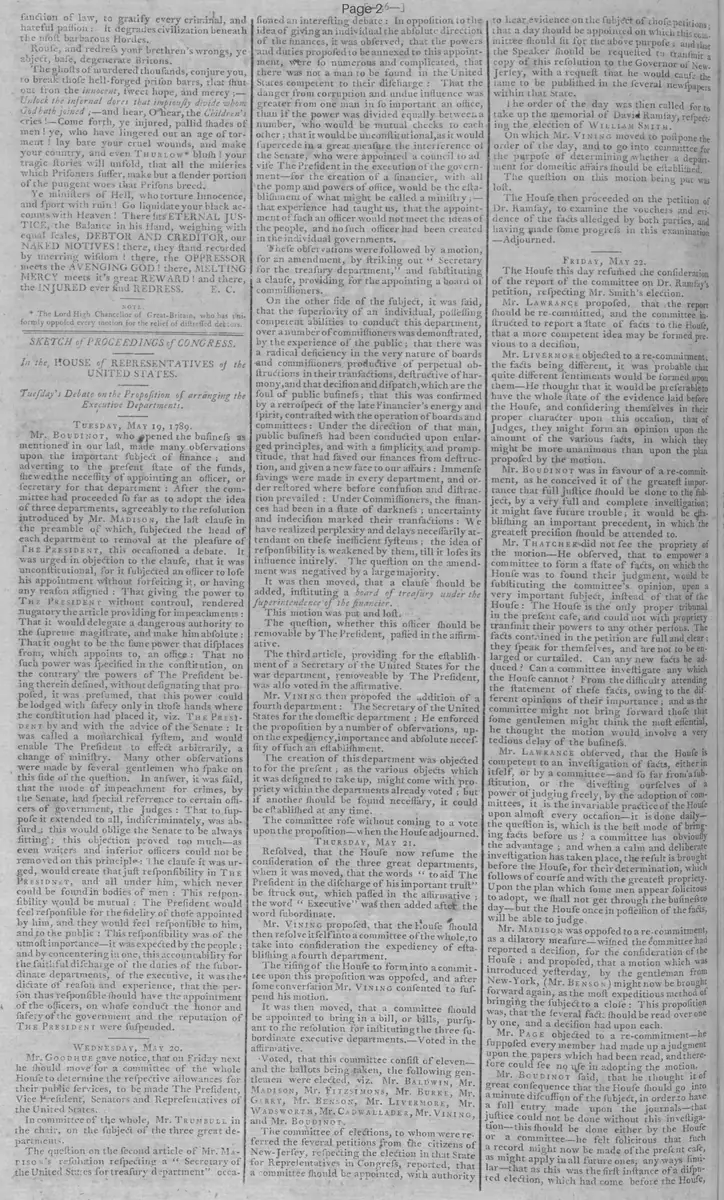
In the HOUSE of REPRESENTATIVES of the UNITED STATES.
Tuesday's Debate on the Proposition of arranging the Executive Departments.
TUESDAY, MAY 19, 1789.
Mr. Boudinot, who opened the business as mentioned in our last, made many observations upon the important subject of finance; and adverting to the present state of the funds, shewed the necessity of appointing an officer, or secretary for that department: After the committee had proceeded so far as to adopt the idea of three departments, agreeably to the resolution introduced by Mr. MADISON, the last clause in the preamble of which, subjected the head of each department to removal at the pleasure of THE PRESIDENT, this occasioned a debate. It was urged in objection to the clause, that it was unconstitutional, or it subjected an officer to lose his appointment without forfeiting it, or having any reason assigned: That giving the power to THE PRESIDENT without controul, rendered nugatory the article providing for impeachments: That it would delegate a dangerous authority to the supreme magistrate, and make him absolute: That it ought to be the same power that displaces from, which appoints to, an office: That no such power was specified in the constitution, on the contrary, the powers of The President being therein defined, without designating that proposed, it was presumed, that this power could be lodged with safety only in those hands where the constitution had placed it, viz. THE PRESIDENT by and with the advice of the Senate: It was called a monarchical system, and would enable The President to effect arbitrarily, a change of ministry. Many other observations were made by several gentlemen who spoke on this side of the question. In answer, it was said, that the mode of impeachment for crimes, by the Senate, had special reference to certain officers of government, the Judges: That to suppose it extended to all, indiscriminately, was absurd; this would oblige the Senate to be always sitting; this objection proved too much—as even waiters and inferior officers could not be removed on this principle: The clause it was urged, would create that just responsibility in THE PRESIDENT, and all under him, which never could be found in bodies of men: This responsibility would be mutual; The President would feel responsible for the fidelity of those appointed by him, and they would feel responsible to him, and to the public: This responsibility was of the utmost importance—it was expected by the people; and by concentering in one, this accountability for the faithful discharge of the duties of the subordinate departments, of the executive, it was the dictate of reason and experience, that the person thus responsible should have the appointment of the officers, on whose conduct the honor and safety of the government and the reputation of THE PRESIDENT were suspended.
WEDNESDAY, MAY 20.
Mr. GOODHUE gave notice, that on Friday next he should move for a committee of the whole House to determine the respective allowances for their public services, to be made The President, Vice President, Senators and Representatives of the United States.
In committee of the whole, Mr. TRUMBULL in the chair, on the subject of the three great departments.
The question on the second article of Mr. MADISON's resolution respecting a "Secretary of the United States for the treasury department" occasioned an interesting debate: In opposition to the idea of giving an individual the absolute direction of the finances, it was observed, that the powers and duties proposed to be annexed to this appointment, were so numerous and complicated, that there was not a man to be found in the United States competent to their discharge: That the danger from corruption and undue influence was greater from one man in so important an office, than if the power was divided equally between a number, who would be mutual checks to each other; that it would be unconstitutional, as it would supercede in a great measure the interference of the Senate, who were appointed a council to advise The President in the execution of the government—for the creation of a financier, with all the pomp and powers of office, would be the establishment of what might be called a ministry;—that experience had taught us, that the appointment of such an officer would not meet the ideas of the people, and no such officer had been created in the individual governments.
These observations were followed by a motion, for an amendment, by striking out "Secretary for the treasury department," and substituting a clause, providing for the appointing a board of commissioners.
On the other side of the subject, it was said, that the superiority of an individual, possessing competent abilities to conduct this department, over a number of commissioners was demonstrated, by the experience of the public; that there was a radical deficiency in the very nature of boards and commissioners productive of perpetual obstructions in their transactions, destructive of harmony, and that decision and dispatch, which are the soul of public business; that this was confirmed by a retrospect of the late Financier's energy and spirit, contrasted with the operation of boards and committees: Under the direction of that man, public business had been conducted upon enlarged principles, and with a simplicity and promptitude, that had saved our finances from destruction, and given a new face to our affairs: Immense savings were made in every department, and order restored where before confusion and distraction prevailed: Under Commissioners, the finances had been in a state of darkness; uncertainty and indecision marked their transactions: We have realized perplexity and delays necessarily attendant on these inefficient systems; the idea of responsibility is weakened by them, till it loses its influence intirely. The question on the amendment was negatived by a large majority.
It was then moved, that a clause should be added, instituting a board of treasury under the superintendence of the financier.
This motion was put and lost.
The question, whether this officer should be removable by The President, passed in the affirmative.
The third article, providing for the establishment of a Secretary of the United States for the war department, removeable by The President, was also voted in the affirmative.
Mr. VINING then proposed the addition of a fourth department: The Secretary of the United States for the domestic department: He enforced the proposition by a number of observations, upon the expediency, importance and absolute necessity of such an establishment.
The creation of this department was objected to for the present; as the various objects which it was designed to take up, might come with propriety within the departments already voted; but if another should be found necessary, it could be established at any time.
The committee rose without coming to a vote upon the proposition—when the House adjourned.
THURSDAY, MAY 21.
Resolved, that the House now resume the consideration of the three great departments, when it was moved, that the words "to aid The President in the discharge of his important trust" be struck out, which passed in the affirmative; the word "Executive" was then added after the word subordinate.
Mr. VINING proposed, that the House should then resolve itself into a committee of the whole, to take into consideration the expediency of establishing a fourth department.
The rising of the House to form into a committee upon this proposition was opposed, and after some conversation Mr. VINING consented to suspend his motion.
It was then moved, that a committee should be appointed to bring in a bill, or bills, pursuant to the resolution for instituting the three subordinate executive departments.—Voted in the affirmative.
Voted, that this committee consist of eleven—and the ballots being taken, the following gentlemen were elected, viz. Mr. BALDWIN, Mr. Madison, Mr. Fitzsimons, Mr. Burke, Mr. GERRY, Mr. BENSON, Mr. LIVERMORE, Mr. WADSWORTH, Mr. CADWALLADER, Mr. VINING, and Mr. Boudinot.
The committee of elections, to whom were referred the several petitions from the citizens of New-Jersey, respecting the election in that State for Representatives in Congress, reported, that a committee should be appointed, with authority to hear evidence on the subject of those petitions; that a day should be appointed on which this committee should sit for the above purpose; and that the Speaker should be requested to transmit a copy of this resolution to the Governor of New-Jersey, with a request that he would cause the same to be published in the several newspapers within that State.
The order of the day was then called for to take up the memorial of David Ramsay, respecting the election of WILLIAM SMITH.
On which Mr. VINING moved to postpone the order of the day, and to go into committee for the purpose of determining whether a department for domestic affairs should be established.
The question on this motion being put was lost.
The House then proceeded on the petition of Dr. Ramsay, to examine the vouchers and evidence of the facts alledged by both parties, and having made some progress in this examination—Adjourned.
Friday, May 22.
The House this day resumed the consideration of the report of the committee on Dr. Ramsay's petition, respecting Mr. Smith's election.
Mr. LAWRENCE proposed, that the report should be re-committed, and the committee instructed to report a state of facts to the House. that a more competent idea may be formed previous to a decision,
Mr. LIVERMORE objected to a re-commitment; the facts being different, it was probable that quite different sentiments would be formed upon them—He thought that it would be preferable to have the whole state of the evidence laid before the House, and considering themselves in their proper character upon this occasion, that of Judges, they might form an opinion upon the amount of the various facts, in which they might be more unanimous than upon the plan proposed by the motion.
Mr. BOUDINOT was in favour of a re-commitment, as he conceived it of the greatest importance that full justice should be done to the subject, by a very full and complete investigation; it might save future trouble; it would be establishing an important precedent, in which the greatest precision should be attended to.
Mr. THATCHER did not see the propriety of the motion—He observed, that to empower a committee to form a state of facts, on which the House was to found their judgment, would be substituting the committee's opinion, upon a very important subject, instead of that of the House: The House is the only proper tribunal in the present case, and could not with propriety transfer their powers to any other persons. The facts contained in the petition are full and clear; they speak for themselves, and are not to be enlarged or curtailed. Can any new facts be adduced? Can a committee investigate any which the House cannot? From the difficulty attending the statement of these facts, owing to the different opinions of their importance; and as the committee might not bring forward those that some gentlemen might think the most essential, he thought the motion would involve a very tedious delay of the business,
Mr. LAWRENCE observed, that the House is competent to an investigation of facts, either in itself, or by a committee—and so far from a substitution, or the divesting ourselves of a power of judging freely, by the adoption of committees, it is the invariable practice of the House upon almost every occasion—it is done daily—the question is, which is the best mode of bringing facts before us? a committee has obviously the advantage; and when a calm and deliberate investigation has taken place, the result is brought before the House, for their determination, which follows of course and with the greatest propriety.
Upon the plan which some men appear solicitous to adopt, we shall not get through the business to day—but the House once in possession of the facts, will be able to judge.
Mr. MADISON was opposed to a re-commitment, as a dilatory measure—wished the committee had reported a decision, for the consideration of the House; and proposed, that a motion which was introduced yesterday, by the gentleman from New-York, (Mr. BENSON) might now be brought forward again, as the most expeditious method of bringing the subject to a close: This proposition was, that the several facts should be read over one by one, and a decision had upon each.
Mr. PAGE objected to a re-commitment—he supposed every member had made up a judgment upon the papers which had been read, and therefore could see no use in adopting the motion.
Mr. BOUDINOT said, that he thought it of great consequence that the House should go into a minute discussion of the subject, in order to have a full entry made upon the journals—that justice could not be done without this investigation—this should be done either by the House or a committee—he felt solicitous that such a record might now be made of the present case, as might apply in all future ones, any ways similar—that as this was the first instance of a disputed election, which had come before the House, and the subject had been treated with attention and harmony, he wished for the satisfaction of every gentleman who thought with him—that a full and particular statement might be made of the facts adduced, as also of the reasons on which the judgment of the House shall be founded.
facts can be adduced, that should render a recommitment necessary.—The House is already in possession of those set forth in the petition, and they are conceded to on the part of Mr. Smith; the only question before the House in my opinion is this: Was Mr. Smith a citizen at the time of his election, or not? As to the facts adduced, from these facts the only question before the House... be of any importance: Every election stands on its own merits, and therefore the utility of establishing a precedent, I do not think it will fill the journals with a long account of this business is not obvious—A simple entry, that the fact advanced by the petitioner is not supported; and that Mr. Smith was eligible to a seat in this House is sufficient.—We are already in possession of a competent idea of every fact that can be adduced, and all that remains to the House to do, is to decide upon them.
Mr. Jackson observed, that although he had a great regard for the Hon. member, whose election was the subject of discussion—he thought that too much care and attention could not be paid to the subject, and he hoped the House would not be precipitate in its decision: Volumes (he said) would not be too much, to do justice to a point of this importance.—On one side, it is true, there are the feelings of an individual to be considered; and on the other, the interest of three millions of people.—He hoped the subject would be fully discussed. It materially affected the circumstances of the State, he had the honor to represent; and much, very much depended upon the decision of that House. He was in favour of the recommitment.
Mr. Carroll, Mr. Thatcher, Mr. Livermore and Mr. Gerry, severally made some short remarks.
One gentleman having observed, that a recommittance, and a full and particular statement of facts, might be productive of further communications from Doctor Ramsay, Mr. Smith rose to enquire, whether Doctor Ramsay was to be sent to, to know if he had any reply to make! if that was the case, he should think proper to withdraw his documents.—He then observed, that the business of the eligibility of his election, had been fully discussed in Carolina, and the result was, his being chosen by a large and respectable majority—That Doctor Ramsay, although a resident in the same place with himself, had never intimated a design to controvert his election, nor had he ever received the least intimation of it, till his appearance on the floor of the House.
The vote being called for, for the recommittance, it passed in the negative by a large majority.
Mr. Smith then recited a number of facts, relative to his eligibility, with observations—in proof of these, he read various passages from the laws of the State of South-Carolina.—The first fact mentioned was, that in less than one year after his arrival in his native place, he was elected a Member of the General Assembly, although the law requires three years residency; which plainly proved that he was considered a citizen, though absent: That in nineteen months after, he was elected a Privy Counsellor, though five years residence are requisite; an additional evidence of his citizenship: That the act passed in 1778, referred to by Dr. Ramsay, requiring an oath within a period, which rendered it impossible for him to take it, being then in Europe, could not possibly have any reference to him: That none of his property had been confiscated while he was abroad: That on the contrary, his absence had been sanctioned by a law of the State, allowing their young men to tarry in Europe for a limited time, to complete their education: That he had held property in Carolina during the war which had paid taxes: That no alien could hold an estate: That he had loaned money to that State, to carry on the war: That although the law required naturalization previous to election to any office, yet he had been repeatedly chosen without that previous requisite: That he was admitted to the bar immediately on his arrival, though four years probation were required.
He observed, that he could have produced many evidences of his having always considered himself an American during his residence in Europe, had he expected an event of this nature: He would just observe, that he tarried two months in France, during the war, and was introduced as an American to the Ambassadors, Mr. Franklin and Mr. Adams: That in 1782 he embarked for America, to share the fate of his country; but being shipwrecked, he was necessitated to defer prosecuting the voyage till October, 1783. Many other particulars were added.
After this, a variety of motions was introduced, and many ingenious observations were made by several members, particularly some on the subject of citizenship which we have to detail.—At about half after three o'clock, the following vote was determined by yeas and nays,
viz. That from the most mature consideration and investigation of facts, it appears to this House, that WILLIAM Smith, member from South-Carolina, had been seven years an inhabitant of the United States, previous to his election.
This passed in the affirmative—36 yeas, one nay.
Adjourned till Monday, 11 o'clock.
What sub-type of article is it?
What keywords are associated?
What entities or persons were involved?
Where did it happen?
Domestic News Details
Primary Location
United States
Event Date
May 19 22, 1789
Key Persons
Outcome
house approved three executive departments (foreign affairs, treasury, war) with heads removable by president; rejected fourth domestic department; appointed committee to draft bills; set up committee for new jersey election petitions; voted 36-1 to affirm william smith's eligibility as seven-year u.s. inhabitant for south carolina seat.
Event Details
The House debated and adopted resolutions for three subordinate executive departments based on Mr. Madison's proposal, including secretaries for foreign affairs, treasury, and war, removable by the President alone; rejected proposals for boards or a fourth domestic department; Mr. Goodhue noticed motion on salaries; committee elected to draft bills; elections committee formed for New Jersey petitions; debated and rejected recommittal of David Ramsay's petition contesting William Smith's election; after arguments on citizenship, House voted to seat Smith.