Thank you for visiting SNEWPapers!
Sign up free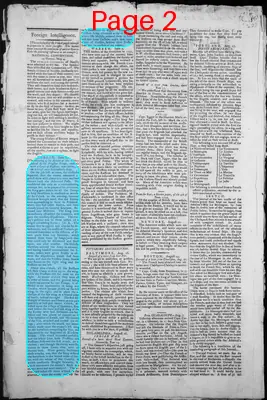
The New Hampshire Gazette
Portsmouth, Rockingham County, New Hampshire
What is this article about?
Prussian and Russian forces under the King defeated Kosciuszko's Polish army near Scelze on June 6, 1794, after a battle lasting from night into afternoon, forcing the enemy to flee.
Clipping
OCR Quality
Full Text
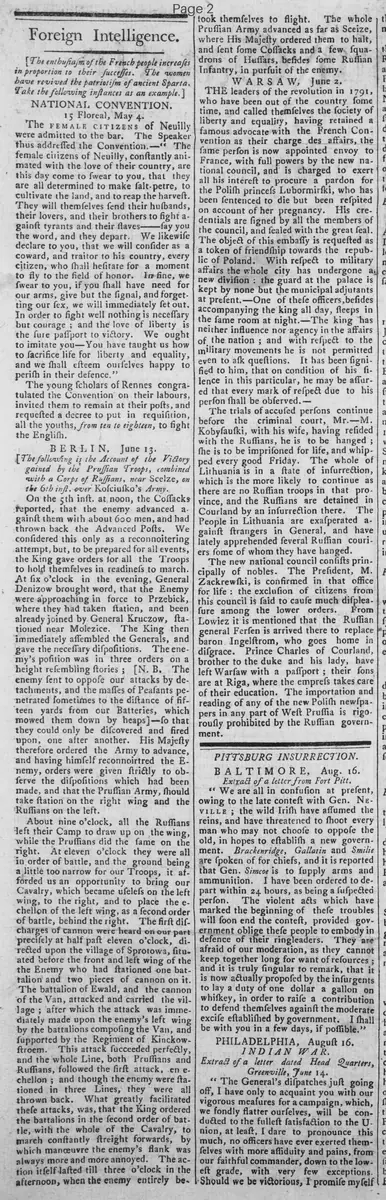
The following is the Account of the Victory gained by the Prussian Troops, combined with a Corps of Russians, near Scelze, on the 6th inst. over Kosciuszko's Army.
On the 5th inst. at noon, the Cossacks reported, that the enemy advanced against them with about 600 men, and had thrown back the Advanced Posts. We considered this only as a reconnoitering attempt, but, to be prepared for all events, the King gave orders for all the Troops to hold themselves in readiness to march. At six o'clock in the evening, General Denisow brought word, that the Enemy were approaching in force to Przebick, where they had taken station, and been already joined by General Kruczow, stationed near Molezice. The King then immediately assembled the Generals, and gave the necessary dispositions. The enemy's position was in three orders on a height resembling torrents; [N. B. The enemy sent to oppose our attacks by detachments, and the masses of Peasants penetrated sometimes to the distance of fifteen yards from our Batteries, which mowed them down by heaps]---so that they could only be discovered and fired upon, one after another. His Majesty therefore ordered the Army to advance, and having himself reconnoitred the Enemy, orders were given strictly to observe the dispositions which had been made, and that the Prussian Army, should take station on the right wing and the Russians on the left.
About nine o'clock, all the Russians left their Camp to draw up on the wing, while the Prussians did the same on the right. At eleven o'clock they were all in order of battle, and the ground being a little too narrow for our Troops, it afforded us an opportunity to bring our Cavalry, which became useless on the left wing, to the right, and to place the echellon of the left wing, as a second order of battle, behind the right. The first discharges of cannon were heard on our part precisely at half past eleven o'clock, directed upon the village of Sprotowa, situated before the front and left wing of the Enemy who had stationed one battalion and two pieces of cannon on it. The battalion of Ewald, and the cannon of the Van, attacked and carried the village; after which the attack was immediately made upon the enemy's left wing by the battalions composing the Van, and supported by the Regiment of Kinckow. This attack succeeded perfectly, and the whole Line, both Prussians and Russians, followed the first attack, en echellon; and though the enemy were stationed in three Lines, they were all thrown back. What greatly facilitated these attacks, was, that the King ordered the battalions in the second order of battle, with the whole of the Cavalry, to march constantly straight forwards, by which manoeuvre the enemy's flank was always more and more annoyed. The action itself lasted till three o'clock in the afternoon, when the enemy entirely took themselves to flight. The whole Prussian Army advanced as far as Scelze, where His Majesty ordered them to halt, and sent some Cossacks and a few squadrons of Hussars, besides some Russian Infantry, in pursuit of the enemy.
What sub-type of article is it?
What keywords are associated?
What entities or persons were involved?
Where did it happen?
Foreign News Details
Primary Location
Near Scelze
Event Date
June 6
Key Persons
Outcome
victory for prussian and russian forces; enemy army fled after being thrown back in three lines; no specific casualty numbers reported.
Event Details
On June 5, enemy advanced; King prepared troops. Battle began at 11:30 PM with cannon fire on Sprotowa village, captured by Prussian forces. Attacks on enemy left wing succeeded, supported by cavalry maneuvers; action lasted until 3 PM June 6 when enemy fled. Prussians advanced to Scelze; pursuit by Cossacks, Hussars, and Russian infantry.