Thank you for visiting SNEWPapers!
Sign up free
Literary
January 18, 1934
The Republican
Oakland, Garrett County, Maryland
What is this article about?
Homemakers column by Miss Margaret Kirby Burtis discussing corn meal production methods, regional uses in the US, and providing recipes for Scrapple, Polenta, and Tamale Pie.
Clipping
OCR Quality
95%
Excellent
Full Text
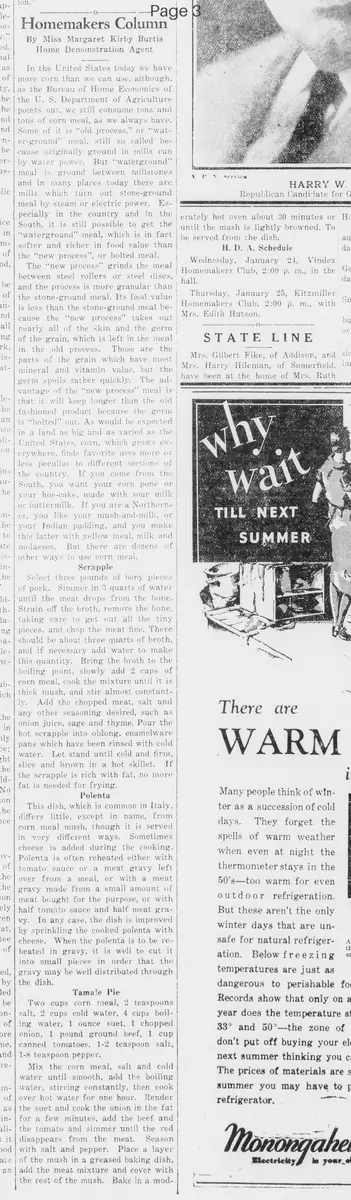
Homemakers Column
By Miss Margaret Kirby Burtis
Home Demonstration Agent
In the United States today we have more corn than we can use, although, as the Bureau of Home Economics of the U. S. Department of Agriculture points out, we still consume tons and tons of corn meal, as we always have.
Some of it is "old process," or "water-ground" meal, still so called because originally ground in mills run by water power. But "waterground" meal is ground between millstones and in many places today there are mills which turn out stone-ground meal by steam or electric power. Especially in the country and in the South, it is still possible to get the "waterground" meal, which is in fact softer and richer in food value than the "new process", or bolted meal.
The "new process" grinds the meal between steel rollers or steel discs, and the process is more granular than the stone-ground meal. Its food value is less than the stone-ground meal because the "new process" takes out nearly all of the skin and the germ of the grain, which is left in the meal in the old process. Those are the parts of the grain which have most mineral and vitamin value, but the germ spoils rather quickly. The advantage of the "new process" meal is that it will keep longer than the old fashioned product because the germ is "bolted" out. As would be expected in a land as big and as varied as the United States, corn, which grows everywhere, finds favorite uses more or less peculiar to different sections of the country. If you come from the South, you want your corn pone or your hoe-cake, made with sour milk or buttermilk. If you are a Northerner, you like your mush-and-milk, or your Indian pudding, and you make this latter with yellow meal, milk and molasses. But there are dozens of other ways to use corn meal.
Scrapple
Select three pounds of bony pieces of pork. Simmer in 3 quarts of water until the meat drops from the bone. Strain off the broth, remove the bone, taking care to get out all the tiny pieces, and chop the meat fine. There should be about three quarts of broth, and if necessary add water to make this quantity. Bring the broth to the boiling point, slowly add 2 cups of corn meal, cook the mixture until it is thick mush, and stir almost constantly. Add the chopped meat, salt and any other seasoning desired, such as onion juice, sage and thyme. Pour the hot scrapple into oblong, enamelware pans which have been rinsed with cold water. Let stand until cold and firm, slice and brown in a hot skillet. If the scrapple is rich with fat, no more fat is needed for frying.
Polenta
This dish, which is common in Italy, differs little, except in name, from corn meal mush, though it is served in very different ways. Sometimes cheese is added during the cooking. Polenta is often reheated either with tomato sauce or a meat gravy left over from a meal, or with a meat gravy made from a small amount of meat bought for the purpose, or with half tomato sauce and half meat gravy. In any case, the dish is improved by sprinkling the cooked polenta with cheese. When the polenta is to be reheated in gravy, it is well to cut it into small pieces in order that the gravy may be well distributed through the dish.
Tamale Pie
Two cups corn meal, 2 teaspoons salt, 2 cups cold water, 4 cups boiling water, 1 ounce suet, 1 chopped onion, 1 pound ground beef, 1 cup canned tomatoes, 1-2 teaspoon salt, 1-8 teaspoon pepper.
Mix the corn meal, salt and cold water until smooth, add the boiling water, stirring constantly, then cook over hot water for one hour. Render the suet and cook the onion in the fat for a few minutes, add the beef and the tomato and simmer until the red disappears from the meat. Season with salt and pepper. Place a layer of the mush in a greased baking dish, add the meat mixture and cover with the rest of the mush. Bake in a moderately hot oven about 30 minutes or until the mush is lightly browned. To be served from the dish.
By Miss Margaret Kirby Burtis
Home Demonstration Agent
In the United States today we have more corn than we can use, although, as the Bureau of Home Economics of the U. S. Department of Agriculture points out, we still consume tons and tons of corn meal, as we always have.
Some of it is "old process," or "water-ground" meal, still so called because originally ground in mills run by water power. But "waterground" meal is ground between millstones and in many places today there are mills which turn out stone-ground meal by steam or electric power. Especially in the country and in the South, it is still possible to get the "waterground" meal, which is in fact softer and richer in food value than the "new process", or bolted meal.
The "new process" grinds the meal between steel rollers or steel discs, and the process is more granular than the stone-ground meal. Its food value is less than the stone-ground meal because the "new process" takes out nearly all of the skin and the germ of the grain, which is left in the meal in the old process. Those are the parts of the grain which have most mineral and vitamin value, but the germ spoils rather quickly. The advantage of the "new process" meal is that it will keep longer than the old fashioned product because the germ is "bolted" out. As would be expected in a land as big and as varied as the United States, corn, which grows everywhere, finds favorite uses more or less peculiar to different sections of the country. If you come from the South, you want your corn pone or your hoe-cake, made with sour milk or buttermilk. If you are a Northerner, you like your mush-and-milk, or your Indian pudding, and you make this latter with yellow meal, milk and molasses. But there are dozens of other ways to use corn meal.
Scrapple
Select three pounds of bony pieces of pork. Simmer in 3 quarts of water until the meat drops from the bone. Strain off the broth, remove the bone, taking care to get out all the tiny pieces, and chop the meat fine. There should be about three quarts of broth, and if necessary add water to make this quantity. Bring the broth to the boiling point, slowly add 2 cups of corn meal, cook the mixture until it is thick mush, and stir almost constantly. Add the chopped meat, salt and any other seasoning desired, such as onion juice, sage and thyme. Pour the hot scrapple into oblong, enamelware pans which have been rinsed with cold water. Let stand until cold and firm, slice and brown in a hot skillet. If the scrapple is rich with fat, no more fat is needed for frying.
Polenta
This dish, which is common in Italy, differs little, except in name, from corn meal mush, though it is served in very different ways. Sometimes cheese is added during the cooking. Polenta is often reheated either with tomato sauce or a meat gravy left over from a meal, or with a meat gravy made from a small amount of meat bought for the purpose, or with half tomato sauce and half meat gravy. In any case, the dish is improved by sprinkling the cooked polenta with cheese. When the polenta is to be reheated in gravy, it is well to cut it into small pieces in order that the gravy may be well distributed through the dish.
Tamale Pie
Two cups corn meal, 2 teaspoons salt, 2 cups cold water, 4 cups boiling water, 1 ounce suet, 1 chopped onion, 1 pound ground beef, 1 cup canned tomatoes, 1-2 teaspoon salt, 1-8 teaspoon pepper.
Mix the corn meal, salt and cold water until smooth, add the boiling water, stirring constantly, then cook over hot water for one hour. Render the suet and cook the onion in the fat for a few minutes, add the beef and the tomato and simmer until the red disappears from the meat. Season with salt and pepper. Place a layer of the mush in a greased baking dish, add the meat mixture and cover with the rest of the mush. Bake in a moderately hot oven about 30 minutes or until the mush is lightly browned. To be served from the dish.
What sub-type of article is it?
Essay
What themes does it cover?
Agriculture Rural
What keywords are associated?
Corn Meal
Water Ground Meal
New Process Meal
Scrapple Recipe
Polenta
Tamale Pie
What entities or persons were involved?
By Miss Margaret Kirby Burtis, Home Demonstration Agent
Literary Details
Title
Homemakers Column
Author
By Miss Margaret Kirby Burtis, Home Demonstration Agent
Subject
Uses Of Corn Meal In American Cuisine