Thank you for visiting SNEWPapers!
Sign up free
Story
August 30, 1884
The Sully County Watchman
Onida, Clifton, Sully County, South Dakota
What is this article about?
Educational article explaining why kerosene lamps explode due to invisible explosive vapors, not the oil itself, with warnings for safe handling and an example of a boy's accident in a New York shop.
Clipping
OCR Quality
100%
Excellent
Full Text
Why a Kerosene Lamp Bursts.
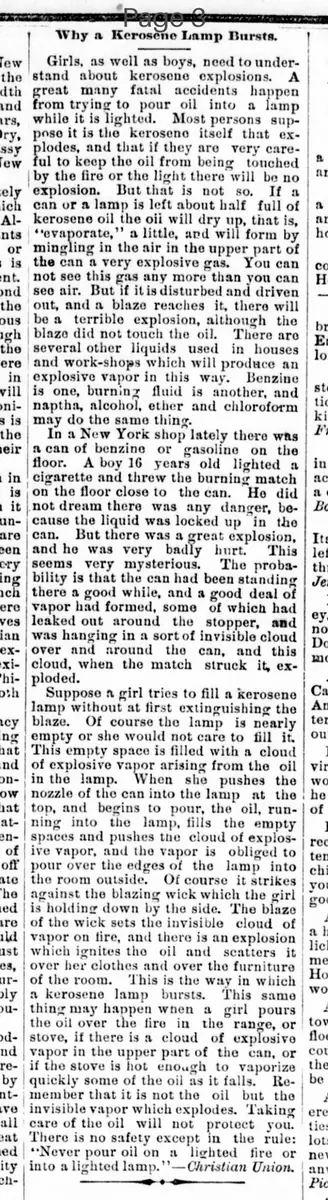
Girls, as well as boys, need to understand about kerosene explosions. A great many fatal accidents happen from trying to pour oil into a lamp while it is lighted. Most persons suppose it is the kerosene itself that explodes, and that if they are very careful to keep the oil from being touched by the fire or the light there will be no explosion. But that is not so. If a can or a lamp is left about half full of kerosene oil the oil will dry up, that is, "evaporate," a little, and will form by mingling in the air in the upper part of the can a very explosive gas. You can not see this gas any more than you can see air. But if it is disturbed and driven out, and a blaze reaches it, there will be a terrible explosion, although the blaze did not touch the oil. There are several other liquids used in houses and work-shops which will produce an explosive vapor in this way. Benzine is one, burning fluid is another, and naptha, alcohol, ether and chloroform may do the same thing.
In a New York shop lately there was a can of benzine or gasoline on the floor. A boy 16 years old lighted a cigarette and threw the burning match on the floor close to the can. He did not dream there was any danger, because the liquid was locked up in the can. But there was a great explosion, and he was very badly hurt. This seems very mysterious. The probability is that the can had been standing there a good while, and a good deal of vapor had formed, some of which had leaked out around the stopper, and was hanging in a sort of invisible cloud over and around the can, and this cloud, when the match struck it, exploded.
Suppose a girl tries to fill a kerosene lamp without at first extinguishing the blaze. Of course the lamp is nearly empty or she would not care to fill it. This empty space is filled with a cloud of explosive vapor arising from the oil in the lamp. When she pushes the nozzle of the can into the lamp at the top, and begins to pour, the oil, running into the lamp, fills the empty spaces and pushes the cloud of explosive vapor, and the vapor is obliged to pour over the edges of the lamp into the room outside. Of course it strikes against the blazing wick which the girl is holding down by the side. The blaze of the wick sets the invisible cloud of vapor on fire, and there is an explosion which ignites the oil and scatters it over her clothes and over the furniture of the room. This is the way in which a kerosene lamp bursts. This same thing may happen when a girl pours the oil over the fire in the range, or stove, if there is a cloud of explosive vapor in the upper part of the can, or if the stove is hot enough to vaporize quickly some of the oil as it falls. Remember that it is not the oil but the invisible vapor which explodes. Taking care of the oil will not protect you. There is no safety except in the rule: Never pour oil on a lighted fire or into a lighted lamp.—Christian Union.
Girls, as well as boys, need to understand about kerosene explosions. A great many fatal accidents happen from trying to pour oil into a lamp while it is lighted. Most persons suppose it is the kerosene itself that explodes, and that if they are very careful to keep the oil from being touched by the fire or the light there will be no explosion. But that is not so. If a can or a lamp is left about half full of kerosene oil the oil will dry up, that is, "evaporate," a little, and will form by mingling in the air in the upper part of the can a very explosive gas. You can not see this gas any more than you can see air. But if it is disturbed and driven out, and a blaze reaches it, there will be a terrible explosion, although the blaze did not touch the oil. There are several other liquids used in houses and work-shops which will produce an explosive vapor in this way. Benzine is one, burning fluid is another, and naptha, alcohol, ether and chloroform may do the same thing.
In a New York shop lately there was a can of benzine or gasoline on the floor. A boy 16 years old lighted a cigarette and threw the burning match on the floor close to the can. He did not dream there was any danger, because the liquid was locked up in the can. But there was a great explosion, and he was very badly hurt. This seems very mysterious. The probability is that the can had been standing there a good while, and a good deal of vapor had formed, some of which had leaked out around the stopper, and was hanging in a sort of invisible cloud over and around the can, and this cloud, when the match struck it, exploded.
Suppose a girl tries to fill a kerosene lamp without at first extinguishing the blaze. Of course the lamp is nearly empty or she would not care to fill it. This empty space is filled with a cloud of explosive vapor arising from the oil in the lamp. When she pushes the nozzle of the can into the lamp at the top, and begins to pour, the oil, running into the lamp, fills the empty spaces and pushes the cloud of explosive vapor, and the vapor is obliged to pour over the edges of the lamp into the room outside. Of course it strikes against the blazing wick which the girl is holding down by the side. The blaze of the wick sets the invisible cloud of vapor on fire, and there is an explosion which ignites the oil and scatters it over her clothes and over the furniture of the room. This is the way in which a kerosene lamp bursts. This same thing may happen when a girl pours the oil over the fire in the range, or stove, if there is a cloud of explosive vapor in the upper part of the can, or if the stove is hot enough to vaporize quickly some of the oil as it falls. Remember that it is not the oil but the invisible vapor which explodes. Taking care of the oil will not protect you. There is no safety except in the rule: Never pour oil on a lighted fire or into a lighted lamp.—Christian Union.
What sub-type of article is it?
Curiosity
Disaster
What themes does it cover?
Misfortune
Moral Virtue
What keywords are associated?
Kerosene Explosion
Explosive Vapor
Lamp Safety
Benzine Accident
Fatal Accidents
What entities or persons were involved?
Boy 16 Years Old
Where did it happen?
New York Shop
Story Details
Key Persons
Boy 16 Years Old
Location
New York Shop
Event Date
Lately
Story Details
Explanation of kerosene lamp explosions caused by invisible explosive vapors from evaporating oil, with example of a boy injured by benzine vapor ignition and warnings against pouring oil into lighted lamps or fires.