Thank you for visiting SNEWPapers!
Sign up free
Providence Daily Advertiser
Providence, Providence County, Rhode Island
What is this article about?
In 1829 Providence court, Francis West sued Canton Smith for half of $900 he paid to settle damages from the 1825 malicious shooting of elephant Little Bet in Chepachet, RI, per their agreement to share costs and conceal each other's involvement. Jury awarded West $225.
Clipping
OCR Quality
Full Text
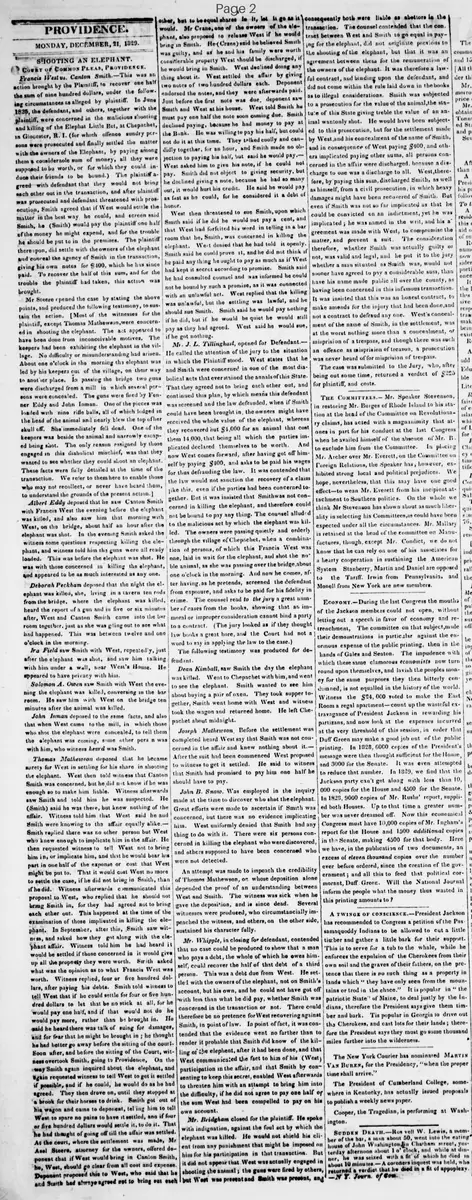
SHOOTING AN ELEPHANT.
Court of Common Pleas, Providence.
Francis West vs. Canton Smith.—This was an action brought by the Plaintiff, to recover one half the sum of nine hundred dollars, under the following circumstances as alleged by plaintiff. In June 1825, the defendant, and others, together with the plaintiff, were concerned in the malicious shooting and killing of the Elephant Little Bet, at Chepachet, in Glocester, R. I. (for which offence sundry persons were prosecuted and finally settled the matter with the owners of the Elephant, by paying among them a considerable sum of money, all they were supposed to be worth, or for which they could induce their friends to be bound.) The plaintiff agreed with defendant that they would not bring each other out in the transaction, and after plaintiff was prosecuted and defendant threatened with prosecution, Smith agreed that if West would settle the matter in the best way he could, and screen said Smith, he (Smith) would pay the plaintiff one half of the money he might expend, and for the trouble he should be put to in the premises. The plaintiff thereupon, did settle with the owners of the elephant and conceal the agency of Smith in the transaction, giving his own notes for $900, which he has since paid. To recover the half of this sum, and for the trouble the plaintiff had taken, this action was brought.
Mr. Steere opened the case by stating the above points, and produced the following testimony, to sustain the action. [Most of the witnesses for the plaintiff, except Thomas Mathewson, were concerned in shooting the elephant. The act appeared to have been done from inconceivable motives. The keepers had been exhibiting the elephant in the village. No difficulty or misunderstanding had arisen. About one o'clock in the morning the elephant was led by his keepers out of the village, on their way to another place. In passing the bridge two guns were discharged from a mill in which several persons were concealed. The guns were fired by Fenner Eddy and John Inman. One of the pieces was loaded with nine rifle balls, all of which lodged in the head of the animal and nearly blew the top of her skull off. She immediately fell dead. One of the keepers was beside the animal and narrowly escaped being shot. The only reason assigned by those engaged in this diabolical mischief, was that they wanted to see whether they could shoot an elephant. These facts were fully detailed at the time of the transaction. We refer to them here to enable those who may not recollect, or never have heard them, to understand the grounds of the present action.]
Albert Eddy deposed that he saw Canton Smith with Francis West the evening before the elephant was killed, and also saw him that morning with West, on the bridge, about half an hour after the elephant was shot. In the evening Smith asked the witness some questions respecting killing the elephant, and witness told him the guns were all ready loaded. This was before the elephant was shot. He was with those concerned in killing the elephant, and appeared to be as much interested as any one.
Deborah Peckham deposed that the night the elephant was killed, she, living in a tavern ten rods from the bridge, where the elephant was killed, heard the report of a gun and in five or six minutes after, West and Canton Smith came into the bar room together, just as she was going out to see what had happened. This was between twelve and one o'clock in the morning.
Ira Field saw Smith with West, repeatedly, just after the elephant was shot, and saw him talking with him under a wall, near West's House. He appeared to have privacy with him.
Solomon A. Owen saw Smith with West the evening the elephant was killed, conversing in the bar room. He saw him with West on the bridge ten minutes after the animal was killed.
John Inman deposed to the same facts, and also that when West came to the mill, in which those who shot the elephant were concealed, to tell them the elephant was coming, some other person was with him, who witness heard was Smith.
Thomas Mathewson deposed that he became surety for West in settling for his share in shooting the elephant. West then told witness that Canton Smith was concerned, but he did not know if he was enough so to make him liable. Witness afterwards saw Smith and told him he was suspected. He (Smith) said he was there, but knew nothing of the affair. Witness told him that West said he and Smith were knowing to the affair equally alike. Smith replied there was no other person but West who knew enough to implicate him in the affair. He then requested witness to tell West not to bring him in, or implicate him, and that he would bear his part in one half of the expense or cost that West might be put to. That it would cost West no more to settle the case, if he did not bring in Smith, than if he did. Witness afterwards communicated this proposal to West, who replied that he should not bring Smith in, for they had agreed not to bring each other out. This happened at the time of the examination of those implicated in killing the elephant. In September, after this, Smith saw witness, and asked how they got along with the elephant affair. Witness told him he had heard it would be settled if those concerned in it would give up all the property they were worth. Smith asked what was the opinion as to what Francis West was worth. Witness replied, four or five hundred dollars, after paying his debts. Smith told witness to tell West that if he could settle for four or five hundred dollars to let that be no stick at all, for he would pay one half, and if that would not do he would pay more, rather than be brought in. He said he heard there was talk of suing for damages, and for fear that he might be brought in; he thought he had better go away before the sitting of the court. Soon after, and before the sitting of the Court, witness overtook Smith, going to Providence. On the way Smith again inquired about the elephant, and again requested witness to tell West to get it settled if possible, and if he could, he would do as he had agreed. They then drove on, until they stopped at a brook for their horses to drink. Smith got out of his wagon and came to deponent, telling him to tell West to spare no pains to have it settled, and if four or five hundred dollars would settle it, to do it. That he had thought of going off till the affair was settled. At the court, where the settlement was made, Mr. Asel Steere, attorney for the owners, offered deponent that if West would bring in Canton Smith he, West, should go clear from all cost and expense. Deponent proposed this to West, who said that he and Smith had always agreed not to bring out each other, but to be equal sharers in it, let it go as it would. Mr. Crane, one of the owners of the elephant, also proposed to release West if he would bring in Smith. He (Crane) said he believed Smith was guilty, and as he and his family were worth considerable property West should be discharged, if he would bring in Smith. West declined doing any thing about it. West settled the affair by giving two notes of two hundred dollars each. Deponent endorsed the notes, and they were afterwards paid. Just before the first note was due, deponent saw Smith and West at his house. West told Smith he must pay one half the note soon coming due. Smith declined paying, because he had money to pay at the Bank. He was willing to pay his half, but could not do it at this time. They talked coolly and candidly together, for an hour, and Smith made no objection to paying his half, but said he would pay. West asked him to give his note, if he could not pay. Smith did not object to giving security, but he declined giving a note, because he had so many out, it would hurt his credit. He said he would pay as fast as he could, for he considered it a debt of honor.
West then threatened to sue Smith, upon which Smith said if he did he would not pay a cent, and that West had forfeited his word in telling in a bar room that he, Smith, was concerned in killing the elephant. West denied that he had told it openly. Smith said he could prove it, and he did not think if he paid any thing he ought to pay as much as if West had kept it secret according to promise. Smith said he had consulted counsel and was informed he could not be bound by such a promise, as it was connected with an unlawful act. West replied that the killing was unlawful, but the settling was lawful, and he should sue Smith. Smith said he would pay nothing if he did, but if he would be quiet he would still pay as they had agreed. West said he would sue, if he got nothing.
Mr. J. L. Tillinghast, opened for Defendant. He called the attention of the jury to the situation in which the Plaintiff stood. West states that he and Smith were concerned in one of the most diabolical acts that ever stained the annals of this State. That they agreed not to bring each other out, and continued this plan, by which means this defendant was screened and the law defrauded, when if Smith could have been brought in, the owners might have received the whole value of the elephant, whereas they recovered only $400 for an animal that cost them $4,000, that being all which the parties implicated declared themselves to be worth. And now West comes forward, after having got off himself by paying $400, and asks to be paid his wages for thus defrauding the law. It was contended that the law would not sanction the recovery of a claim like this, even if the parties had been concerned together. But it was insisted that Smith was not concerned in killing the elephant, and therefore could not be bound to pay any thing. The counsel alluded to the malicious act by which the elephant was killed. The owners were passing quietly and orderly through the village of Chepachet, when a combination of persons, of which this Francis West was one, laid in wait for the elephant, and shot the noble animal, as she was passing over the bridge, about one o'clock in the morning. And now he comes, after having, as he pretends, screened the defendant from exposure, and asks to be paid for his fidelity in crime. The counsel read to the jury a great number of cases from the books, showing that an immoral or improper consideration cannot bind a party to a contract. (The jury looked as if they thought law books a great bore, and the Court had not a word to say in applying the law to the case.)
The following testimony was produced for defendant.
Dean Kimball, saw Smith the day the elephant was killed. Went to Chepachet with him, and went to see the elephant. Smith wanted to see him about buying a pair of oxen. They took supper together, Smith went home with West and witness took the wagon and returned home. He left Chepachet about midnight.
Joseph Mathewson, Before the settlement was completed heard West say that Smith was not concerned in the affair and knew nothing about it. After the suit had been commenced West proposed to witness to get it settled. He said to witness that Smith had promised to pay him one half he should have to pay.
John B. Snow. Was employed in the inquiry made at the time to discover who shot the elephant. Great efforts were made to ascertain if Smith was concerned, but there was no evidence implicating him. West uniformly denied that Smith had any thing to do with it. There were six persons concerned in killing the elephant who were discovered, and others supposed to have been concerned who were not detected.
An attempt was made to impeach the credibility of Thomas Mathewson, on whose deposition alone depended the proof of an understanding between West and Smith. The witness was sick when he gave the deposition, and is since dead. Several witnesses were produced, who circumstantially impeached the witness, and others, on the other side, sustained his character fully.
Mr. Whipple, in closing for defendant, contended that no case could be produced to show that a man who pays a debt, the whole of which he owes himself, could recover the half of that debt of a third person. This was a debt due from West. He settled with the owners of the elephant, not on Smith's account, but his own, and he could not have got off with less than what he did pay, whether Smith was concerned in the transaction or not. There could therefore be no pretence for West recovering against Smith, in point of law. In point of fact, it was contended that the evidence went no farther than to render it probable that Smith did know of the killing of the elephant, after it had been done, and that West communicated the fact to him of his (West) participation in the affair, and that Smith by consenting to keep this secret, enabled West afterwards to threaten him with an attempt to bring him into the difficulty, if he did not agree to pay one half of the sum West had been compelled to pay on his own account.
Mr. Bridgham closed for the plaintiff. He spoke with indignation, against the foul act by which the elephant was killed. He would not shield his client from any punishment that might be imposed on him for his participation in that transaction. But it did not appear that West was actually engaged in shooting the animal; the guns were fired by others, but West was present and Smith was present, and consequently both were liable as abettors in the transaction. The counsel contended that the contract between West and Smith to go equal in paying for the elephant, did not originate previous to the shooting of the elephant, but that it was an agreement between them for the remuneration of the owners of the elephant. It was therefore a lawful contract, and binding upon the defendant, and did not come within the rule laid down in the books as to illegal considerations. Smith was subjected to a prosecution for the value of the animal, the statute of this State giving treble the value of an animal wantonly shot. He would have been subjected to this prosecution, but for the settlement made by West, and his concealment of the name of Smith, and in consequence of West paying $400, and others implicated paying other sums, all persons concerned in the affair were discharged, because a discharge to one was a discharge to all. West, therefore, by paying this sum, discharged Smith, as well as himself, from a civil prosecution, in which heavy damages might have been recovered of Smith. But even if Smith was not so far implicated as that he could be convicted on an indictment, yet he was implicated; he was named in the writ, and his agreement was made with West, to compromise the matter, and prevent a suit. The consideration therefore, whether Smith was actually guilty or not, was valid and legal, and he put it to the jury whether a man situated as Smith was, would not sooner have agreed to pay a considerable sum, than have his name made public all over the county, as having been concerned in this infamous transaction. It was insisted that this was an honest contract, to make amends for the injury that had been done, and not a contract to defraud any one. West's concealment of the name of Smith, in the settlement, was at the worst nothing more than a concealment, or misprision of a trespass, and though there was such an offence as misprision of treason, a prosecution was never heard of for misprision of trespass.
The case was submitted to the Jury, who, after being out some time, returned a verdict of $225 for plaintiff, and costs.
What sub-type of article is it?
What themes does it cover?
What keywords are associated?
What entities or persons were involved?
Where did it happen?
Story Details
Key Persons
Location
Chepachet, Glocester, R. I.
Event Date
June 1825
Story Details
In June 1825, Francis West and Canton Smith were involved in the malicious shooting of elephant Little Bet in Chepachet, RI. They agreed to share settlement costs and not implicate each other. West paid $900 to settle but concealed Smith's role. West sued Smith for $450 reimbursement. Testimony detailed the shooting, agreement, and defenses. Jury awarded West $225.