Thank you for visiting SNEWPapers!
Sign up free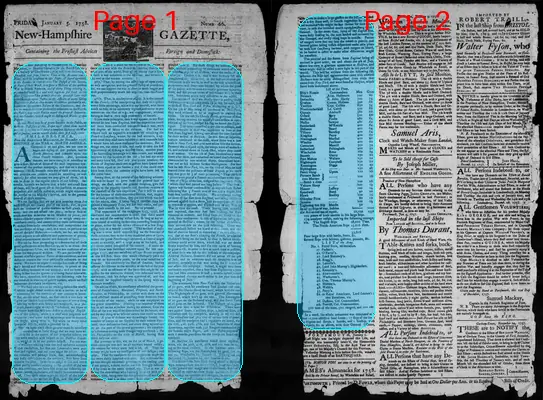
The New Hampshire Gazette
Portsmouth, Rockingham County, New Hampshire
What is this article about?
The American Magazine begins its history of the 1757 North American war campaign, focusing on the British Halifax Expedition against Louisbourg. It details preparations, fleet assembly, strategic delays due to late English reinforcements, and safe arrival at Halifax under Lord Loudoun and Admiral Holbourne, avoiding risky engagement.
Merged-components note: These components form a continuous narrative from the American Magazine on the history of the war in North America, including the fleet details in the table and subsequent descriptions of preparations at Halifax. The table is integral to the article as it lists the ships referenced in the text. Label changed to foreign_news as it pertains to the international conflict with France.
Clippings
1 of 2
OCR Quality
Full Text
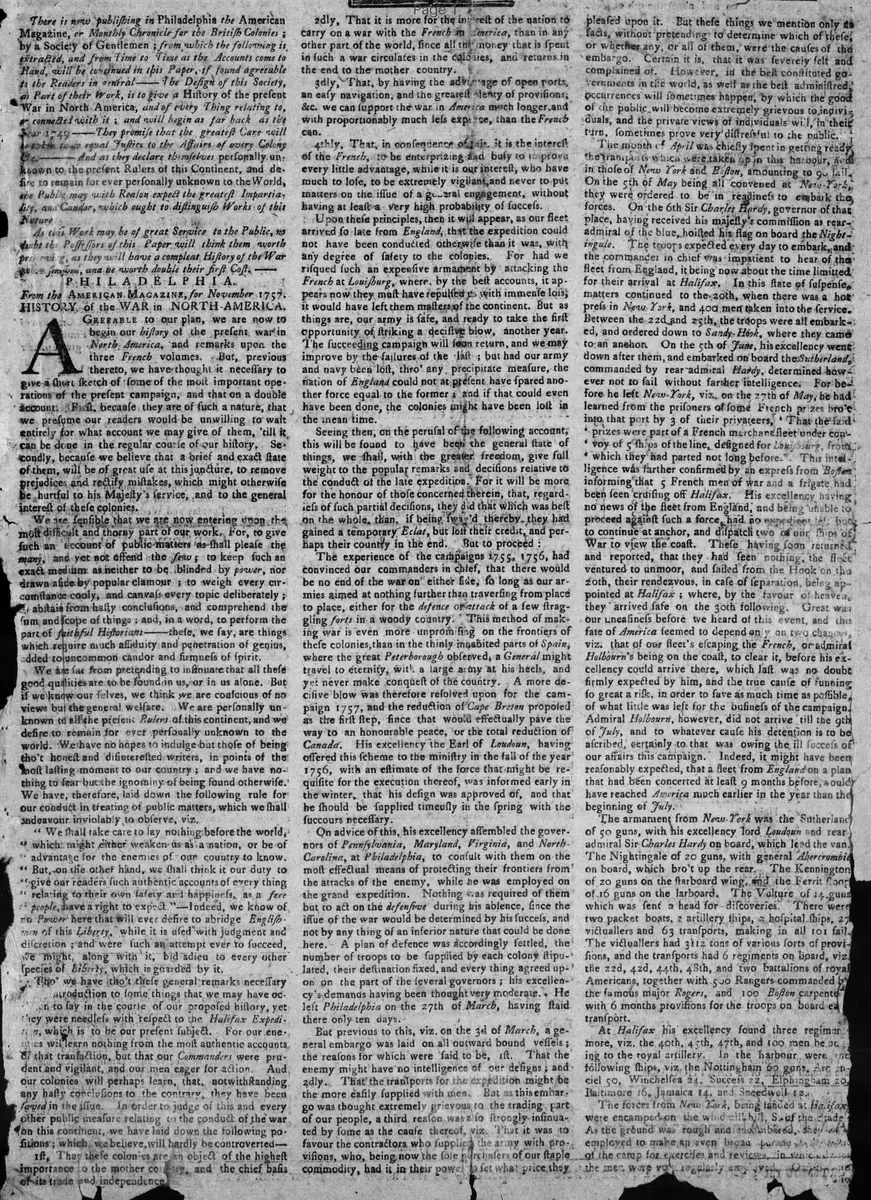
As this Work may be of great Service to the Public, no doubt the Possessors of this Paper will think them worth preserving, as they will have a complete History of the War which may be worth double their first Cost.
PHILADELPHIA.
From the American Magazine, for November 1757.
HISTORY Of the WAR in NORTH-AMERICA.
Agreeable to Our Plan, We are now to begin our history of the present war in North America, and remarks upon the three French volumes. But, previous thereto, we have thought it necessary to give a short sketch of some of the most important operations of the present campaign, and that on a double account: First, because, they are of such a nature, that we presume our readers would be unwilling to wait entirely for what account we may give of them, 'till it can be done in the regular course of our history. Secondly, because we believe that a brief and exact state of them, will be of great use at this juncture, to remove prejudices and rectify mistakes, which might otherwise be hurtful to his Majesty's service, and to the general interest of these colonies.
We are sensible that we are now entering upon the most difficult and thorny part of our work. For, to give such an account of public matters as shall please the many, and yet not offend the few; to keep such an exact medium as neither to be blinded by power, nor drawn aside by popular clamour; to weigh every circumstance coolly, and canvass every topic deliberately; abstain from hasty conclusions, and comprehend the sum and scope of things; and, in a word, to perform the part of faithful Historians—these, we say, are things which require much assiduity and penetration of genius, added to uncommon candor and firmness of spirit.
We are far from pretending to insinuate that all these good qualities are to be found in us, or in us alone. But if we know ourselves, we think we are conscious of no views but the general welfare. We are personally unknown to all the present Rulers of this continent, and we desire to remain for ever personally unknown to the world. We have no hopes to indulge but those of being thought honest and disinterested writers, in points of the highest lasting moment to our country; and we have nothing to fear but the ignominy of being found otherwise.
We have, therefore, laid down the following rule for our conduct in treating of public matters, which we shall endeavour inviolably to observe, viz.
"We shall take care to lay nothing before the world, which might either weaken us as a nation, or be of advantage for the enemies of our country to know.
"But, on the other hand, we shall think it our duty to give our readers such authentic accounts of every thing relating to their own Safety and happiness, as a free people, have a right to expect." Indeed, we know of no Power here that will ever desire to abridge Englishmen of this Liberty, while it is used with judgment and discretion; and were such an attempt ever to succeed, we might, along with it, bid adieu to every other species of Liberty, which is guarded by it.
Tho' we have thought these general remarks necessary as introduction to some things that we may have occasion to say in the course of our proposed history, yet they were needless with respect to the Halifax Expedition, which is to be our present subject. For our enemies will learn nothing from the most authentic accounts of that transaction, but that our Commanders were prudent and vigilant, and our men eager for action. And our colonies will perhaps learn, that, notwithstanding any hasty conclusions to the contrary, they have been saved in the issue. In order to judge of this and every other public measure relating to the conduct of the war on this continent, we have laid down the following positions; which, we believe, will hardly be controverted—
1st, That these colonies are an object of the highest importance to the mother country, and the chief basis of its trade and independence.
2dly, That it is more for the interest of the nation to carry on a war with the French in America, than in any other part of the world, since all that money that is spent in such a war circulates in the colonies, and returns in the end to the mother country.
3dly. That, by having the advantage of open ports, an easy navigation, and the greatest plenty of provisions; &c. we can support the war in America much longer, and with proportionably much less expense, than the French can.
4thly, That, in consequence of this, it is the interest of the French, to be enterprising and busy to improve every little advantage, while it is our interest, who have much to lose, to be extremely vigilant and never to put matters on the issue of a general engagement, without having at least a very high probability of success.
Upon these principles, then it will appear, as our fleet arrived so late from England, that the expedition could not have been conducted otherwise than it was, with any degree of safety to the colonies. For had we risked such an expensive armament by attacking the French at Louisburg, where, by the best accounts, it appears now they must have repulsed us with immense loss, it would have left them masters of the continent. But as things are, our army is safe, and ready to take the first opportunity of striking a decisive blow, another year.
The succeeding campaign will soon return, and we may improve by the failures of the last; but had our army and navy been lost, thro' any precipitate measure, the nation of England could not at present have spared another force equal to the former; and if that could even have been done, the colonies might have been lost in the mean time.
Seeing then, on the perusal of the following account; this will be found to have been the general state of things, we shall, with the greater freedom, give full weight to the popular remarks and decisions relative to the conduct of the late expedition. For it will be more for the honour of those concerned therein, that, regardless of such partial decisions, they did that which was best on the whole, than, if being swayed thereby, they had gained a temporary Eclat, but lost their credit, and perhaps their country in the end. But to proceed:
The experience of the campaigns 1755, 1756, had convinced our commanders in chief, that there would be no end of the war on either side; so long as our armies aimed at nothing further than traversing from place to place, either for the defence or attack of a few straggling forts in a woody country. This method of making war is even more unpromising on the frontiers of these colonies, than in the thinly inhabited parts of Spain, where the great Peterborough observed, a General might travel to eternity, with a large army at his heels, and yet never make conquest of the country. A more decisive blow was therefore resolved upon for the campaign 1757, and the reduction of Cape. Breton proposed as the first step, since that would effectually pave the way to an honourable peace, or the total reduction of Canada. His excellency the Earl of Loudoun, having offered this scheme to the ministry in the fall of the year 1756, with an estimate of the force that might be requisite for the execution thereof, was informed early in the winter, that his design was approved of, and that he should be supplied timely in the spring with the succours necessary.
On advice of this, his excellency assembled the governors of Pennsylvania, Maryland, Virginia, and North-Carolina, at Philadelphia, to consult with them on the most effectual means of protecting their frontiers from the attacks of the enemy, while he was employed on the grand expedition. Nothing was required of them but to act on the defensive during his absence, since the issue of the war would be determined by his success, and not by any thing of an inferior nature that could be done here. A plan of defence was accordingly settled, the number of troops to be supplied by each colony stipulated, their destination fixed, and every thing agreed upon on the part of the several governors; his excellency's demands having been thought very moderate. He left Philadelphia on the 27th of March, having staid there only ten days.
But previous to this, viz. on the 3d of March, a general embargo was laid on all outward bound vessels; the reasons for which were said to be, 1st. That the enemy might have no intelligence of our designs; and 2dly. That the transports for the expedition might be the more easily supplied with men. But as this embargo was thought extremely grievous to the trading part of our people, a third reason was also strongly insinuated by some as the cause thereof, viz. That it was to favour the contractors who supplied the army with provisions, who, being now the sole purchasers of our staple commodity, had it in their power to set what price, they pleased upon it. But these things we mention only as facts, without pretending to determine which of these, or whether any, or all of them, were the causes of the embargo. Certain it is, that it was severely felt and complained of. However, in the best constituted governments in the world, as well as the best administered, occurrences will sometimes happen, by which the good of the public will become extremely grievous to individuals, and the private views of individuals will, in their turn, sometimes prove very distressing to the public.
The month of April was chiefly spent in getting ready the Transports which were taken up in this harbour, and in those of New York and Boston, amounting to 90 sail. On the 4th of May being all convened at New-York, they were ordered to be in readiness to embark the forces. On the 6th Sir Charles Hardy, governor of that place, having received his majesty's commission as rear-admiral of the blue, hoisted his flag on board the Nightingale. The troops expected every day to embark, and the commander in chief was impatient to hear of the Fleet from England, it being now about the time limited for their arrival at Halifax. In this state of suspense matters continued to the 20th, when there was a hot press in New-York, and 400 men taken into the service. Between the 22d and 25th, the troops were all embarked, and ordered down to Sandy-Hook, where they came to an anchor. On the 5th of June, his excellency went down after them, and embarked on board the Sutherland, commanded by rear-admiral Hardy, determined however not to sail without farther intelligence. For before he left New-York, viz. on the 27th of May, he had learned from the prisoners of some French prizes brought into that port by 3 of their privateers, That the said prizes were part of a French merchant fleet under convoy of 5 ships of the line, destined for Louisbourg, from which they had parted not long before. This intelligence was farther confirmed by an express from Boston informing that 2 French men of war and a frigate had been seen cruising off Halifax. His excellency having no news of the fleet from England, and being unable to proceed against such a force, had no expedient left but to continue at anchor, and dispatch two ships of War to view the coast. These having soon returned and reported, that they had seen nothing, the fleet ventured to unmoor, and sailed from the Hook on the 20th, their rendezvous, in case of separation, being appointed at Halifax; where, by the favour of heaven, they arrived safe on the 30th following. Great was our uneasiness before we heard of this event, and the fate of America seemed to depend only on two chances, viz. that of our fleet's escaping the French, or admiral Holbourn's being on the coast, to clear it, before his excellency could arrive there, which last was no doubt firmly expected by him, and the true cause of running so great a risk, in order to save as much time as possible, of what little was left for the business of the campaign.
Admiral Holbourn, however, did not arrive till the 9th of July, and to whatever cause his detention is to be ascribed, certainly to that was owing the ill success of our affairs this campaign. Indeed, it might have been reasonably expected, that a fleet from England on a plan that had been concerted at least 9 months before, would have reached America much earlier in the year than the beginning of July.
The armament from New-York was the Sutherland of 50 guns, with his excellency lord Loudoun and rear admiral Sir Charles Hardy on board, which lead the van. The Nightingale of 20 guns, with general Abercrombie on board, which brought up the rear. The Kennington of 20 guns on the starboard wing, and the Ferret of 16 guns on the larboard. The Vulture of 14 guns which was sent a head for discoveries. There were two packet boats, 2 artillery ships, 2 hospital ships, 2 victuallers and 63 transports, making in all 101 sail. The victuallers had 2112 tons of various sorts of provisions, and the transports had 6 regiments on board, viz the 22d, 42d, 44th, 48th, and two battalions of royal Americans, together with 500 Rangers commanded by the famous major Rogers, and 100 Boston carpenters with 6 months provisions for the troops on board each transport.
At Halifax his excellency found three regiments more, viz. the 40th, 45th, 47th, and 100 men belonging to the royal artillery. In the harbour, were the following ships, viz. the Nottingham 60 guns, Arc-en-ciel 50, Winchelsea 24, Success 22, Elphinstone 20, Baltimore 16, Jamaica 14, and Speedwell 12.
The forces from New York, being landed at Halifax were encamped on the wind mill hill, S. of the citadel. As the ground was rough and encumbered, they were employed to make an even broad parade of the camp for exercises and reviews, in particular the men were regularly exercised, drilling.
| Ship's Names | Commanders | Men | Guns |
| Newark | Adm. Holbourn | 700 | 80 |
| Invincible | R. Adm. Hardy | 700 | 74 |
| Grafton | Comm. Holmes | 590 | 68 |
| Terrible | Capt. Collins | 630 | 74 |
| Northumberland | Ld. Colvil | 520 | 68 |
| Captain | Amhurit | 580 | 68 |
| Orford | Spry | 520 | 68 |
| Bedford | Fouke | 480 | 64 |
| Naffau | Sawyer | 480 | 64 |
| Sunderland | M'Kenzie | 400 | 64 |
| Defiance | Beard | 400 | 64 |
| Tilbury | Barnley | 400 | 64 |
| Kingston | Perry | 400 | 60 |
| Nottingham | Marhal | 400 | 60 |
| Windford | Faulkner | 400 | 60 |
| Centurion | Mantill | 350 | 54 |
| Sutherland | Falkingham | 400 | 50 |
| Winchelsea | Rous | 160 | 24 |
| Succes | Ourry | 150 | 22 |
| Port Mahon | Wallace | 150 | 22 |
| Nightingale | Campbell | 150 | 22 |
| Kennington | Diggs | 150 | 20 |
| Elphingham | Upton | 120 | 20 |
| Ferrit Sloop | 100 | 16 | |
| Furnace Bomb | |||
| two Mortars | |||
| --- Bomb 2 ditto | 100 | 16 | |
| Vulture Sloop | 100 | 14 | |
| Hunter | Laffery | 100 | 14 |
| Speedwell | Bond | 90 | 12 |
| Hawk | Bradley | 100 | 12 |
| Gibraltar Prize | 80 | 12 | |
| Jamaica | 100 | 14 | |
| Lightning fire-hip | Martin | 50 | |
| In all 33 ships of war, befides |
Also given to make a large garden on the hill, surrounded with a dry stone wall, to furnish vegetables for the sick and wounded who might be sent thither for their recovery, in case the intended attack upon Louisbourg should succeed. In the mean time, some of the English fleet were daily coming in, the men landed and reviewed by the General, and every thing kept in motion. Parties of rangers were sent out into the woods to patrole, and several prime sailing vessels dispatched under able pilots to look into Louisbourg harbour, with rangers on board, to be landed in order to make what discoveries might be necessary.
The admiral and the forces from England being all arrived in good order, on and about the 9th of July, there was now a glorious appearance at Halifax, and what might well be called a new sight in this part of the world. This will be evident from the following list, wherein the ships and regiments that came with admiral Holbourn may be easily distinguished from those that came from New-York, and were found at Halifax, which have been mentioned above.
The Arc en ciel out of repair... 10,200 : 1350
100 pieces of brass-cannon in ten large ships.
179 transport vessels, making the following tonnage, viz.
The English ships 18,000 Tons.
The North-American ships 15,616 ditto.
33,616
Four large ships with horses, steers, &c.
Several ships with fascines, gabions, pontoons, &c.
LIST of the Army.
No. 1. Royal Scots, 2d battalion.
17. Forbes's.
22. O'Farrel's.
27. Lord Blakeney's.
28. Bragg's.
40. Lascelles's.
42. Lord John Murray's Highlanders.
43. Kennedy's.
44. Abercrombie's.
45. Warburton's.
46. Gen. Thomas Murray's.
47. Hopson's.
48. Webb's.
55. Perry's.
62. or Royal Americans, Lord Loudoun's two Battalions. viz.
2d. Debeau. Col. Commandant.
4th. Prevost, Col. Commandant.
1000 men of the train, 500 rangers, and 100 carpenters.
In a word, the whole armament was computed at about 16,000 effective land forces; 17 ships of the line; 4 frigates and sloops, 2 bombs, and 1 fireship, with transports, &c. as above, with four General Officers, and two Admirals on the spot.
What sub-type of article is it?
What keywords are associated?
What entities or persons were involved?
Where did it happen?
Foreign News Details
Primary Location
Halifax
Event Date
1757
Key Persons
Outcome
british forces arrived safely at halifax; expedition delayed due to late arrival of english fleet and french naval presence at louisbourg; army preserved for future campaign without engaging.
Event Details
The American Magazine provides an account of the 1757 British campaign planning for the reduction of Cape Breton and Louisbourg. Lord Loudoun coordinates defenses with colonial governors, assembles troops and transports in New York amid embargo and intelligence of French forces. Fleet sails to Halifax, arriving June 30; English reinforcements under Admiral Holbourn arrive July 9. Total forces include 16,000 troops, 33 warships, and numerous transports. Preparations include encampment, exercises, reconnaissance, but no attack launched due to strategic caution.