Thank you for visiting SNEWPapers!
Sign up free
Literary
September 11, 1798
The New Hampshire Gazette
Portsmouth, Rockingham County, New Hampshire
What is this article about?
The Lay Preacher, in a sermon-like essay, praises cleanliness and neatness as minor virtues essential for personal decency, especially among literary men who often neglect their appearance. He argues it reflects order, civility, and moral character, citing examples and countering the slovenly poet stereotype, ending with a quote from Count Rumford on cleanliness's moral benefits.
Clipping
OCR Quality
98%
Excellent
Full Text
From the Farmer's Weekly Museum
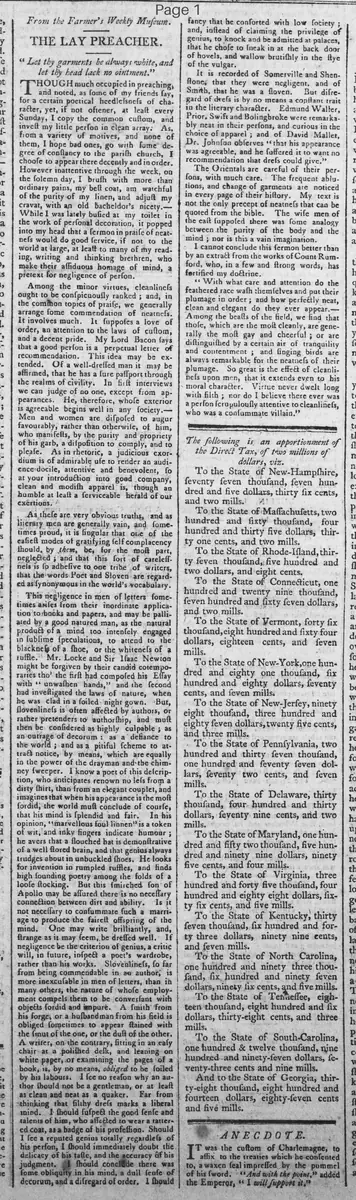
THE LAY PREACHER.
" Let thy garments be always white, and let thy head lack no ointment."
THOUGH much occupied in preaching: and noted, as some of my friends say, for a certain poetical heedlessness of character, yet, if not oftener, at least every Sunday, I copy the common custom, and invest my little person in clean array: As, from a variety of motives, and none of them, I hope bad ones, go with some degree of constancy to the parish church, I choose to appear there decently and in order. However inattentive through the week, on the solemn day, I brush with more than ordinary pains, my best coat, am watchful of the purity of my linen, and adjust my cravat, with an old bachelor's nicety.-- While I was lately busied at my toilet in the work of personal decoration, it popped into my head that a sermon in praise of neatness would do good service, if not to the world at large, at least to many of my reading, writing and thinking brethren, who make their assiduous homage of mind, a pretext for negligence of person.
Among the minor virtues, cleanliness ought to be conspicuously ranked; and, in the common topics of praise, we generally arrange some commendation of neatness. It involves much. It supposes a love of order, an attention to the laws of custom, and a decent pride. My Lord Bacon says that a good person is a perpetual letter of recommendation. This idea may be extended. Of a well-dressed man it may be affirmed, that he has a sure passport through the realms of civility. In first interviews we can judge of no one, except from appearances. He, therefore, whose exterior is agreeable begins well in any society.-- Men and women are disposed to augur favourably, rather than otherwise, of him, who manifests, by the purity and propriety of his garb, a disposition to comply, and to please. As in rhetoric, a judicious exordium is of admirable use to render an audience docile, attentive and benevolent, so at your introduction into good company, clean and modish apparel is, though an humble at least a serviceable herald of our exertions.
As these are very obvious truths, and as literary men are generally vain, and sometimes proud, it is singular that one of the easiest modes of gratifying self complacency should, by them, be, for the most part, neglected; 'and that this sort of carelessness is so adhesive to one tribe of writers, that the words Poet and Sloven are regarded as synonymous in the world's vocabulary. This negligence in men of letters sometimes arises from their inordinate application to books and papers, and may be palliated by a good natured man, as the natural product of a mind too intensely engaged in sublime speculations, to attend to the blackness of a shoe, or the whiteness of a ruffle. " Mr. Locke and Sir Isaac Newton might be forgiven by their candid contemporaries tho' the first had composed his Essay with " unwashen hands," and the second had investigated the laws of nature, when he was clad in a soiled night gown. But, slovenliness is often affected by authors, or rather pretenders to authorship. and must then be considered as highly culpable; as an outrage of decorum : as a defiance to the world ; and as a pitiful scheme to attract notice, by means, which are equally in the power of the drayman and-the chimney sweeper. I know a poet of this description, who anticipates renown no less from a dirty shirt, than from an elegant couplet, and imagines that when his appearance is the most sordid, the world must conclude of course, that his mind is splendid and fair. In his opinion, ''marvellous foul linnen" is a token of wit, and inky fingers indicate humour ; he avers that a slouched hat is demonstrative of a well stored brain, and that genius always trudges about in unbuckled shoes. He looks for invention in rumpled ruffles, and finds high sounding poetry among the folds of a loose stocking. But this minched one of Apollo may be assured there is no necessary connection between dirt and ability. Is it not necessary to consummate such a marriage to produce the fairest offspring of the mind. One may write brilliantly, and, strange as it may seem,. be dressed well. If negligence be the criterion of genius, a critic will, in future, inspect a poet's wardrobe, rather than his works. Slovenliness, so far from being commendable in an author, is more inexcusable in men of letters, than in many others, the nature of whose employment compels them to be conversant with objects sordid and impure. A smith from his forge, or a husbandman from his field is obliged sometimes to appear stained with the smut of the one, or the dust of the other. A writer, on the contrary, sitting in an easy chair at a polished desk, and leaning on white paper, or examining the pages of a book, is, by no means, obliged to be soiled by his labours. I see no reason why an author should not be a gentleman, or at least as clean and neat as a quaker. Far from thinking that filthy dress marks a liberal mind. I should suspect the good sense and talents of him, who affected to wear a tattered coat, as a badge of his profession. Should I see a reputed genius totally regardless of his person, I should immediately doubt the delicacy of his taste, and the accuracy of his judgment. I should conclude there was some obliquity in his mind, a dull sense of decorum, and a disregard of order. I should fancy that he consorted with low society ; and, instead of claiming the privilege of genius, to knock and be admitted at palaces, that he chose to sneak in at the back door of hovels, and wallow brutishly in the sty of the vulgar.
It is recorded of Somerville and Shenstone, that they were negligent, and of Smith, that he was a sloven. But disregard of dress is by no means a constant trait in the literary character. Edmund Waller, Prior. Swift and Bolingbroke were remarkably neat in their persons, and curious in the choice of apparel ; and of David Mallet, Dr. Johnson observes "that his appearance was agreeable, and he suffered it to want no recommendation that dress could give."
The Orientals are careful of their persons, with much care. The frequent ablutions, and change of garments are noticed in every page of their history. My text is not the only precept of neatness that can be quoted from the bible. The wise men of the east supposed there was some analogy between the purity of the body and the mind : nor is this a vain imagination.
I cannot conclude this sermon better than by an extract from the works of Count Rumford, who, in a few and strong words, has fortified my doctrine.
" With what care and attention do the feathered race wash themselves and put their plumage in order; and how perfectly neat, clean and elegant do they ever appear.-- Among the beasts of the field, we find that those, which are the most cleanly, are generally the most gay and cheerful; or are distinguished by a certain air of tranquility and contentment ; and singing birds are always remarkable for the neatness of their plumage. So great is the effect of cleanliness upon men, that it extends even to his moral character. Virtue never dwelt long with filth ; nor do I believe there ever was a person scrupulously attentive to cleanliness, who was a consummate villain."
THE LAY PREACHER.
" Let thy garments be always white, and let thy head lack no ointment."
THOUGH much occupied in preaching: and noted, as some of my friends say, for a certain poetical heedlessness of character, yet, if not oftener, at least every Sunday, I copy the common custom, and invest my little person in clean array: As, from a variety of motives, and none of them, I hope bad ones, go with some degree of constancy to the parish church, I choose to appear there decently and in order. However inattentive through the week, on the solemn day, I brush with more than ordinary pains, my best coat, am watchful of the purity of my linen, and adjust my cravat, with an old bachelor's nicety.-- While I was lately busied at my toilet in the work of personal decoration, it popped into my head that a sermon in praise of neatness would do good service, if not to the world at large, at least to many of my reading, writing and thinking brethren, who make their assiduous homage of mind, a pretext for negligence of person.
Among the minor virtues, cleanliness ought to be conspicuously ranked; and, in the common topics of praise, we generally arrange some commendation of neatness. It involves much. It supposes a love of order, an attention to the laws of custom, and a decent pride. My Lord Bacon says that a good person is a perpetual letter of recommendation. This idea may be extended. Of a well-dressed man it may be affirmed, that he has a sure passport through the realms of civility. In first interviews we can judge of no one, except from appearances. He, therefore, whose exterior is agreeable begins well in any society.-- Men and women are disposed to augur favourably, rather than otherwise, of him, who manifests, by the purity and propriety of his garb, a disposition to comply, and to please. As in rhetoric, a judicious exordium is of admirable use to render an audience docile, attentive and benevolent, so at your introduction into good company, clean and modish apparel is, though an humble at least a serviceable herald of our exertions.
As these are very obvious truths, and as literary men are generally vain, and sometimes proud, it is singular that one of the easiest modes of gratifying self complacency should, by them, be, for the most part, neglected; 'and that this sort of carelessness is so adhesive to one tribe of writers, that the words Poet and Sloven are regarded as synonymous in the world's vocabulary. This negligence in men of letters sometimes arises from their inordinate application to books and papers, and may be palliated by a good natured man, as the natural product of a mind too intensely engaged in sublime speculations, to attend to the blackness of a shoe, or the whiteness of a ruffle. " Mr. Locke and Sir Isaac Newton might be forgiven by their candid contemporaries tho' the first had composed his Essay with " unwashen hands," and the second had investigated the laws of nature, when he was clad in a soiled night gown. But, slovenliness is often affected by authors, or rather pretenders to authorship. and must then be considered as highly culpable; as an outrage of decorum : as a defiance to the world ; and as a pitiful scheme to attract notice, by means, which are equally in the power of the drayman and-the chimney sweeper. I know a poet of this description, who anticipates renown no less from a dirty shirt, than from an elegant couplet, and imagines that when his appearance is the most sordid, the world must conclude of course, that his mind is splendid and fair. In his opinion, ''marvellous foul linnen" is a token of wit, and inky fingers indicate humour ; he avers that a slouched hat is demonstrative of a well stored brain, and that genius always trudges about in unbuckled shoes. He looks for invention in rumpled ruffles, and finds high sounding poetry among the folds of a loose stocking. But this minched one of Apollo may be assured there is no necessary connection between dirt and ability. Is it not necessary to consummate such a marriage to produce the fairest offspring of the mind. One may write brilliantly, and, strange as it may seem,. be dressed well. If negligence be the criterion of genius, a critic will, in future, inspect a poet's wardrobe, rather than his works. Slovenliness, so far from being commendable in an author, is more inexcusable in men of letters, than in many others, the nature of whose employment compels them to be conversant with objects sordid and impure. A smith from his forge, or a husbandman from his field is obliged sometimes to appear stained with the smut of the one, or the dust of the other. A writer, on the contrary, sitting in an easy chair at a polished desk, and leaning on white paper, or examining the pages of a book, is, by no means, obliged to be soiled by his labours. I see no reason why an author should not be a gentleman, or at least as clean and neat as a quaker. Far from thinking that filthy dress marks a liberal mind. I should suspect the good sense and talents of him, who affected to wear a tattered coat, as a badge of his profession. Should I see a reputed genius totally regardless of his person, I should immediately doubt the delicacy of his taste, and the accuracy of his judgment. I should conclude there was some obliquity in his mind, a dull sense of decorum, and a disregard of order. I should fancy that he consorted with low society ; and, instead of claiming the privilege of genius, to knock and be admitted at palaces, that he chose to sneak in at the back door of hovels, and wallow brutishly in the sty of the vulgar.
It is recorded of Somerville and Shenstone, that they were negligent, and of Smith, that he was a sloven. But disregard of dress is by no means a constant trait in the literary character. Edmund Waller, Prior. Swift and Bolingbroke were remarkably neat in their persons, and curious in the choice of apparel ; and of David Mallet, Dr. Johnson observes "that his appearance was agreeable, and he suffered it to want no recommendation that dress could give."
The Orientals are careful of their persons, with much care. The frequent ablutions, and change of garments are noticed in every page of their history. My text is not the only precept of neatness that can be quoted from the bible. The wise men of the east supposed there was some analogy between the purity of the body and the mind : nor is this a vain imagination.
I cannot conclude this sermon better than by an extract from the works of Count Rumford, who, in a few and strong words, has fortified my doctrine.
" With what care and attention do the feathered race wash themselves and put their plumage in order; and how perfectly neat, clean and elegant do they ever appear.-- Among the beasts of the field, we find that those, which are the most cleanly, are generally the most gay and cheerful; or are distinguished by a certain air of tranquility and contentment ; and singing birds are always remarkable for the neatness of their plumage. So great is the effect of cleanliness upon men, that it extends even to his moral character. Virtue never dwelt long with filth ; nor do I believe there ever was a person scrupulously attentive to cleanliness, who was a consummate villain."
What sub-type of article is it?
Essay
What themes does it cover?
Moral Virtue
Social Manners
What keywords are associated?
Cleanliness
Neatness
Literary Men
Slovenliness
Moral Virtue
Personal Decorum
Authors Appearance
What entities or persons were involved?
The Lay Preacher
Literary Details
Title
The Lay Preacher.
Author
The Lay Preacher
Subject
Sermon In Praise Of Neatness
Key Lines
" Let Thy Garments Be Always White, And Let Thy Head Lack No Ointment."
My Lord Bacon Says That A Good Person Is A Perpetual Letter Of Recommendation.
"Mr. Locke And Sir Isaac Newton Might Be Forgiven By Their Candid Contemporaries Tho' The First Had Composed His Essay With " Unwashen Hands," And The Second Had Investigated The Laws Of Nature, When He Was Clad In A Soiled Night Gown.
One May Write Brilliantly, And, Strange As It May Seem,. Be Dressed Well.
" With What Care And Attention Do The Feathered Race Wash Themselves And Put Their Plumage In Order; And How Perfectly Neat, Clean And Elegant Do They Ever Appear. Among The Beasts Of The Field, We Find That Those, Which Are The Most Cleanly, Are Generally The Most Gay And Cheerful; Or Are Distinguished By A Certain Air Of Tranquility And Contentment ; And Singing Birds Are Always Remarkable For The Neatness Of Their Plumage. So Great Is The Effect Of Cleanliness Upon Men, That It Extends Even To His Moral Character. Virtue Never Dwelt Long With Filth ; Nor Do I Believe There Ever Was A Person Scrupulously Attentive To Cleanliness, Who Was A Consummate Villain."