Thank you for visiting SNEWPapers!
Sign up free
Windham County Observer
Putnam, Windham County, Connecticut
What is this article about?
Sixth in a series on inflation using data from Consumer Banking Institute and Princeton faculty consultants. Explains wartime inflation: more money chases fewer consumer goods due to war production diverting over half output in 1942, leading to price rises. Details 1941-1942 production stats and government controls: taxation, price control, rationing, credit control, war savings.
Clipping
OCR Quality
Full Text
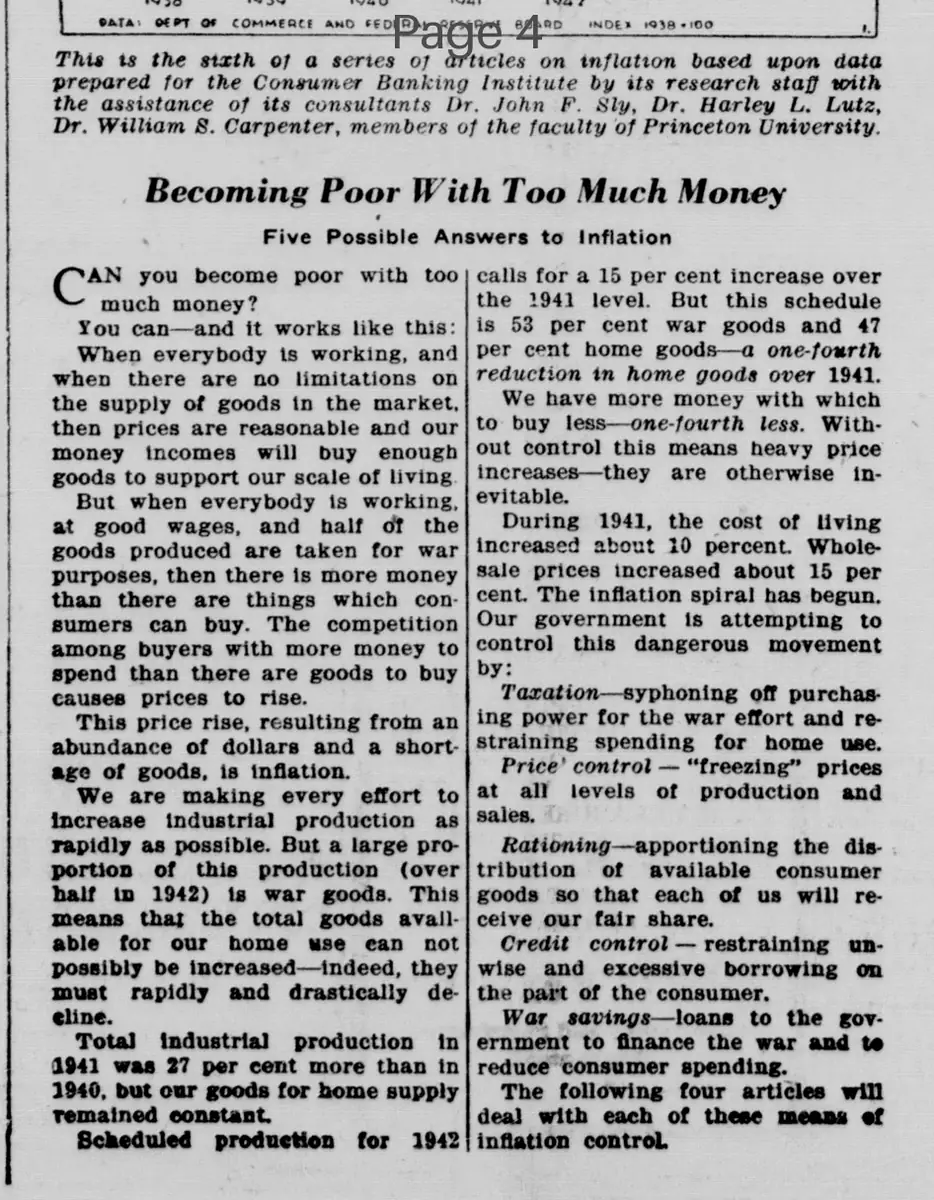
Becoming Poor With Too Much Money
Five Possible Answers to Inflation
Can you become poor with too much money?
You can-and it works like this:
When everybody is working, and when there are no limitations on the supply of goods in the market, then prices are reasonable and our money incomes will buy enough goods to support our scale of living
But when everybody is working at good wages, and half of the goods produced are taken for war purposes, then there is more money than there are things which consumers can buy. The competition among buyers with more money to spend than there are goods to buy causes prices to rise.
This price rise, resulting from an abundance of dollars and a shortage of goods, is inflation.
We are making every effort to increase industrial production as rapidly as possible. But a large proportion of this production (over half in 1942) is war goods. This means that the total goods available for our home use can not possibly be increased-indeed, they must rapidly and drastically decline.
Total industrial production in 1941 was 27 per cent more than in 1940, but our goods for home supply remained constant.
Scheduled production for 1942 calls for a 15 per cent increase over the 1941 level. But this schedule is 53 per cent war goods and 47 per cent home goods-a one-fourth reduction in home goods over 1941.
We have more money with which to buy less-one-fourth less. Without control this means heavy price increases-they are otherwise inevitable.
During 1941, the cost of living increased about 10 percent. Wholesale prices increased about 15 per cent. The inflation spiral has begun.
Our government is attempting to control this dangerous movement by:
Taxation-syphoning off purchasing power for the war effort and restraining spending for home use.
Price control- "freezing" prices at all levels of production and sales.
Rationing-apportioning the distribution of available consumer goods so that each of us will receive our fair share.
Credit control-restraining unwise and excessive borrowing on the part of the consumer.
War savings-loans to the government to finance the war and to reduce consumer spending.
The following four articles will deal with each of these means of inflation control
What sub-type of article is it?
What keywords are associated?
What entities or persons were involved?
Where did it happen?
Story Details
Key Persons
Location
Princeton University
Event Date
1941 1942
Story Details
Explains inflation as price rise from excess money and scarce consumer goods during war, with 1941-1942 production data showing decline in home goods. Government uses taxation, price control, rationing, credit control, and war savings to manage it.