Thank you for visiting SNEWPapers!
Sign up free
Lynchburg Virginian
Lynchburg, Virginia
What is this article about?
A railroad advocate presents proposals from northern contractors to build the Lynchburg-Tennessee line using company-purchased slaves for labor, with contractors subscribing one-third stock and bearing risks, to secure funding without full state aid and promote trade to Memphis. Emphasizes benefits of utilizing surplus slaves and potential economic transformation.
Clipping
OCR Quality
Full Text
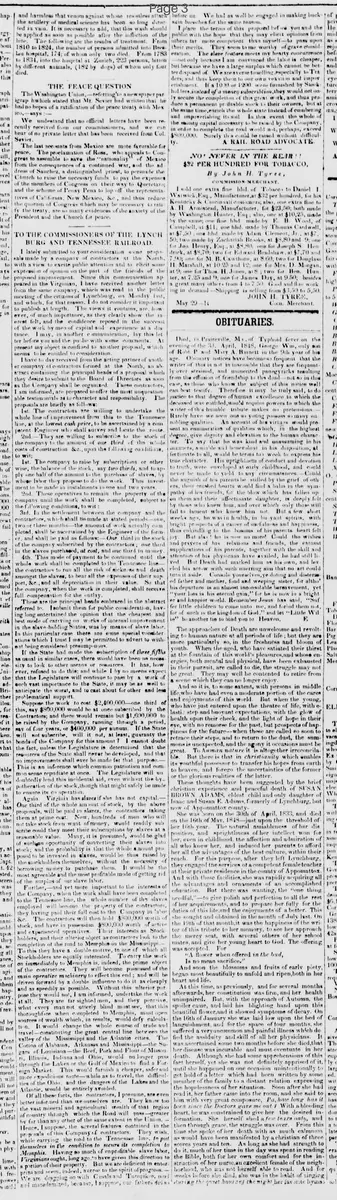
I lately submitted to your consideration some proposals made by a company of contractors at the North, with a view to excite public attention and to elicit some expression of opinion on the part of the friends of the proposed improvement. Since this communication appeared in the Virginian, I have received another letter from the same company, which was read in the public meeting of the citizens of Lynchburg, on Monday last, and which, for that reason, I do not consider it important to publish at length. The views it contains, are, however, of much importance, as they clearly show the interest felt, and the confidence reposed in the success of the work by men of capital and experience at a distance. I may, in another communication, lay this letter before you and the public with some comments. At present my object is confined to another proposal, which seems to be entitled to consideration.
I have today received from the acting partner of another company of contractors formed at the North, an abstract containing the principal heads of a proposal which they desire to submit to the Board of Directors as soon as the Company shall be organized. These contractors, I am informed, are prepared to offer the most unquestionable testimonials as to character and responsibility. The proposals are briefly as follows:
1st. The contractors are willing to undertake the whole line of improvement from this to the Tennessee line, at the lowest cash price, to be ascertained by a competent Engineer who shall survey and locate the route.
2nd.—They are willing to subscribe to the stock of the company to the amount of one third of the whole costs of construction, etc., upon the following conditions, to wit;
1st. The company to raise by subscriptions or otherwise, the balance of the stock, say two-thirds, and to apply one half of the amount to the purchase of slaves, by whose labor they propose to do the work. This investment to be made in instalments in one and two years.
2nd. These operatives to remain the property of the company until the work shall be completed, subject to the following conditions, to wit:
3rd. In the settlement between the company and the contractors, which shall be made at stated periods—one, two or three months—the amount of work actually completed, shall be ascertained by the Engineer of the former, and shall be paid as follows:—One third in the stock of the company subscribed by the contractors; one third in the slaves purchased, at cost, and one third in money.
4th. This mode of payment to be continued until the whole work shall be completed to the Tennessee line—the contractors to run all the risk of sickness and death amongst the slaves, to bear all the expenses of their support, etc., and all depreciation in their value. So that the company, when the work is completed, shall receive full compensation for the outlay.
These are the principal heads embraced in the abstract referred to. I submit them for public consideration, having long entertained the opinion that the cheapest and best mode of carrying on works of internal improvement in the slave-holding States, was by means of slave labor. In this particular case there are some special considerations which I trust I may be permitted to advert to without being considered presumptuous.
If the State had made the subscription of three fifths as usual in similar cases, there would have been no necessity to look to other means or resources. It has, however, refused to do this; and while I by no means expect that the Legislature will continue to pass by a work of such vast importance to the State, it may be as well to anticipate the worst, and to cast about for other and less problematical support.
Suppose the work to cost $2,400,000—one third of this, say $800,000 would be at once subscribed by the Contractors; and there would remain but $1,600,000 to be raised by the Company, running through a period, say of four years, or $400,000 per annum. If the State will not subscribe, will it not, at least, guarantee the bonds of the Company for this amount? I cannot doubt the fact, unless the Legislature is determined that the resources of the State shall never be developed, and that no improvements shall ever be made for that purpose. This is an inference which common patriotism and common sense repudiate at once. The Legislature will undoubtedly lend this incidental aid, even without the hypothecation of the stock, though that might safely be made to ensure its co-operation.
Again Virginia has slaves if she has not capital. One third of the whole amount of stock, by the above proposals, will be paid in slaves, the contractor taking them at prime cost. Now, hundreds of men who will not take stock from want of money, would readily subscribe could they meet their subscriptions by slaves at a reasonable value. Many, it is presumed, would be glad of such an opportunity of converting their slaves into stock; and the probability is that the whole amount proposed to be invested in slaves, would be thus raised by the stockholders themselves, without the necessity of borrowing money to purchase them. It would be the most agreeable and the most profitable mode of getting rid of the surplus of our slave labor.
Further,—and yet more important to the interests of the Company, when the work shall have been completed to the Tennessee line, the whole number of the slaves employed will become the property of the contractors, they having paid their full cost to the Company in labor, etc. The contractors will then hold $800,000 worth of stock, and have in possession $800,000 worth of active and experienced operatives. Their interests as Stock holders, and their ulterior object as contractors look to the completion of the road to Memphis on the Mississippi. To this they have a double motive, in one of which all Stockholders are equally interested. To carry the work on immediately to Memphis is, indeed, the prime object of the contractors. They will become possessed of the main operative machinery to effect this end; and will be driven forward by a double influence to do it as cheaply and as speedily as possible. Without this ulterior purpose they would not, I am informed, undertake the work at all. They are far sighted men, and they perceive, what every man not utterly blind must see, that this thoroughfare when completed to Memphis, must open sources of wealth which, in results, would defy calculation. It would change the whole course of trade and travel—constituting the great central line between the valley of the Mississippi and the Atlantic cities. The Cotton of Alabama, Arkansas and Mississippi—the Sugars of Louisiana—the Beef, Pork and Flour of Missouri, Illinois, Indiana and Ohio, would no longer pass through the Lakes or the Gulf of Mexico to find a Foreign Market. This would furnish a cheaper, safer and more expeditious route—while as to travel, the difficulties of the Ohio, and the dangers of the Lakes and the Atlantic, would be entirely avoided.
Of all these facts, the contractors, I presume, are even better informed than we ourselves are. They know too the vast mineral and agricultural wealth of that region of country through which the Road will pass—greater by far than any other of the same extent in the Union. Hence, I suppose, the several features contained in the proposals of this Company of contractors. They wish, while carrying the road to the Tennessee line, to put themselves in the condition to secure its completion to Memphis. Having so much of unprofitable slave labor, Virginians ought, long ago, to have given this direction to a portion of their property. But we are deficient in enterprise and seem, indeed, averse to the spirit of progress—and macadamized, because, I suppose, our fathers did so. We are dragging on with Canals and Turnpikes, modern improvements being too fast for us.
before us. We had as well be engaged in making buckskin breeches for the same reason.
I place the terms of this proposal before you and the public with the hope that they may elicit opinions from others far more competent than myself—to pass upon their merits. They seem to me worthy of grave consideration. The slave feature meets my hearty concurrence—not only because I am convinced the labor is cheaper but because we have a large surplus which cannot be better disposed of. We are averse to selling, especially to Traders; and thus keep them to our own vexation and impoverishment. If a 100, 200 or 1200 were furnished by Stock holders, instead of a money subscription, they would not only secure the completion of this great work, and thus produce a permanent profitable stock to their owners, but at the same time, enrich the whole state instead of cumbering and impoverishing its soil. In this event the whole of the money capital necessary to be raised by the Company in order to complete the road would not, perhaps, exceed $800,000. Surely this could be raised without difficulty.
A RAIL ROAD ADVOCATE.
What sub-type of article is it?
What themes does it cover?
What keywords are associated?
What entities or persons were involved?
Letter to Editor Details
Author
A Rail Road Advocate.
Recipient
To The Commissioners Of The Lynchburg And Tennessee Railroad.
Main Argument
advocates for a proposal from northern contractors to build the lynchburg to tennessee railroad using slave labor purchased by the company, with contractors subscribing one-third of the stock and bearing risks, to fund the project without full state subscription and utilize surplus slaves profitably while enabling extension to memphis.
Notable Details