Thank you for visiting SNEWPapers!
Sign up free
Cincinnati Daily Press
Cincinnati, Hamilton County, Ohio
What is this article about?
The Richmond Examiner outlines proposed natural boundaries for the Confederate States along the Missouri, Mississippi, and Ohio Rivers, asserting Southern independence post-Manassas and urging military reconquest of surrendered territories in Missouri, Kentucky, and elsewhere to secure the frontier against Northern invasion.
Clipping
OCR Quality
Full Text
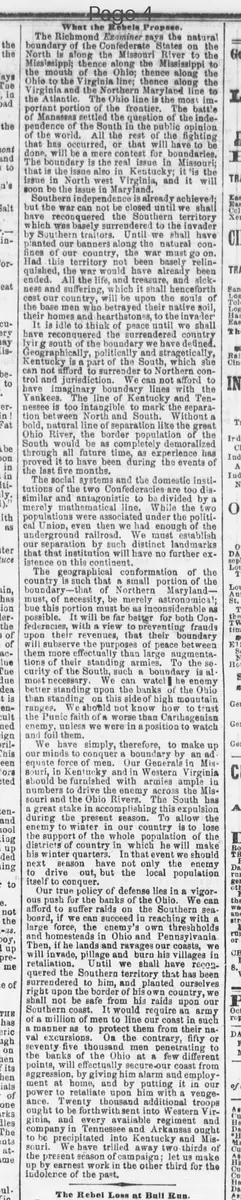
The Richmond Examiner says the natural boundary of the Confederate States on the North is along the Missouri River to the Mississippi; thence along the Mississippi to the mouth of the Ohio; thence along the Ohio to the Virginia line; thence along the Virginia and the Northern Maryland line to the Atlantic. The Ohio line is the most important portion of the frontier. The battle of Manassas settled the question of the independence of the South in the public opinion of the world. All the rest of the fighting that has occurred, or that will have to be done, will be a mere contest for boundaries. The boundary is the real issue in Missouri; that is the issue also in Kentucky; it is the issue in Northwest Virginia, and it will soon be the issue in Maryland. Southern independence is already achieved: but the war can not be closed until we shall have reconquered the Southern territory which was basely surrendered to the invader by Southern traitors. Until we shall have planted our banners along the natural confines of our country, the war must go on. Had this territory not been basely relinquished, the war would have already been ended. All the life, and treasure, and sickness and suffering, which it shall henceforth cost our country, will be upon the souls of the base men who betrayed their native soil, their homes and hearthstones, to the invader. It is idle to think of peace until we shall have reconquered the surrendered country lying south of the boundary we have defined. Geographically, politically and strategically, Kentucky is a part of the South, which she can not afford to surrender to Northern control and jurisdiction. We can not afford to have imaginary boundary lines with the Yankees. The line of Kentucky and Tennessee is too intangible to mark the separation between North and South. Without a bold, natural line of separation like the great Ohio River, the border population of the South would be as completely demoralized through all future time, as experience has proved it to have been during the events of the last five months. The social systems and the domestic institutions of the two Confederacies are too dissimilar and antagonistic to be divided by a merely mathematical line. While the two populations were associated under the political Union, even then we had enough of the underground railroad. We must establish our separation by such distinct landmarks that that institution will have no further existence on this continent. The geographical conformation of the country is such that a small portion of the boundary—that of Northern Maryland—must, of necessity, be merely astronomical but this portion must be as inconsiderable as possible. It will be far better for both Confederacies, with a view to preventing frauds upon their revenues, that their boundary will subserve the purposes of peace between them more effectually than large augmentations of their standing armies. To the security of the South, such a boundary is almost necessary. We can watch the enemy better standing upon the banks of the Ohio than standing on this side of high mountain ranges. We should not know how to trust the Punic faith of a worse than Carthagenian enemy, unless we were in a position to watch and foil them. We have simply, therefore, to make up our minds to conquer a boundary by an adequate force of men. Our Generals in Missouri, in Kentucky and in Western Virginia should be furnished with armies ample in numbers to drive the enemy across the Missouri and the Ohio Rivers. The South has a great stake in accomplishing this expulsion during the present season. To allow the enemy to winter in our country is to lose the support of the whole population of the districts of country in which he will make his winter quarters. In that event we should next season have not only the enemy to drive out, but the local population itself to conquer. Our true policy of defense lies in a vigorous push for the banks of the Ohio. We can afford to suffer raids on the Southern seacoast, if we can succeed in reaching with a large force, the enemy's own thresholds and homesteads in Ohio and Pennsylvania. Then, if he lands and ravages our coasts, we will invade, pillage and burn his villages in retaliation. Until we shall have reconquered the Southern territory that has been surrendered to him, and planted ourselves right upon the border of his own country, we shall not be safe from his raids upon our Southern coast. It would require an army of a million of men to line our coast in such a manner as to protect them from their naval excursions. On the contrary, fifty or seventy-five thousand men penetrating to the banks of the Ohio at a few different points, will effectually secure our coast from aggression, by giving him alarm and employment at home, and by putting it in our power to retaliate upon him with a vengeance. Twenty thousand additional troops ought to be forthwith sent into Western Virginia, and every available regiment and company in Tennessee and Arkansas ought to be precipitated into Kentucky and Missouri. We have trifled away two thirds of the present season of campaign; let us make up by earnest work in the other third for the indolence of the past.
What sub-type of article is it?
What keywords are associated?
Where did it happen?
Domestic News Details
Primary Location
Richmond
Event Details
The Richmond Examiner proposes natural northern boundaries for the Confederate States along the Missouri River to the Mississippi, then to the Ohio River mouth, along the Ohio to Virginia, and to the Atlantic, emphasizing the Ohio line's importance and calling for reconquest of surrendered Southern territories in Missouri, Kentucky, Northwest Virginia, and Maryland to secure independence achieved at Manassas.