Thank you for visiting SNEWPapers!
Sign up free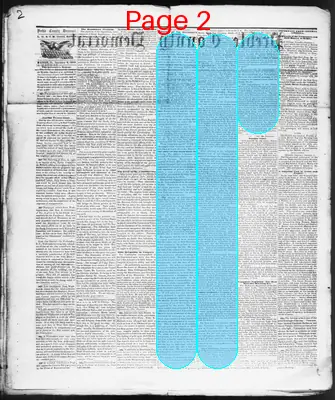
Preble County Democrat
Eaton, Preble County, Ohio
What is this article about?
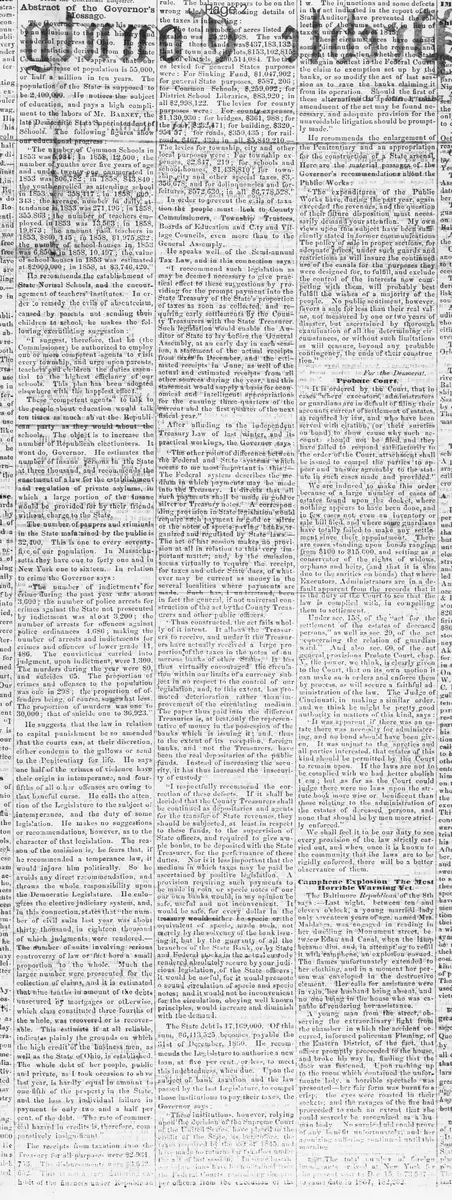
Extracts from Ohio Governor's message to legislature discuss public works disposition, population growth, education progress with statistics from 1853-1858, recommendations for normal schools and agents, care for insane, pauper and crime stats, intemperance, judiciary, state finances, taxation, treasury issues, state debt, bank taxation, and calls for penitentiary enlargement and arsenal.
Merged-components note: These components are continuations of extracts from the Governor's Message across adjacent columns on page 2.
Clipping
OCR Quality
Full Text
The expenditures of the Public Works have, during the past year, again exceeded the revenues, and the question of their future disposition, must necessarily demand your attention.
The policy of sale in proper sections, for adequate prices, under such guards and restrictions as will insure the continued use of the canals for the purposes they were designed for, to fulfill, and exclude the control of the interests now competing with them, will probably best fulfill the wishes of a majority of the people. No public sentiment, however, favors a sale for less than their real value, not measured by one or two years of disaster, but ascertained by thorough examination of all the determining circumstances, or without such limitations as will ensure, beyond any probable contingency, the ends of their construction.
The yearly increase of population is 55,000, or half a million in ten years. The population of the State is supposed to be 2,400,000. Denotes the subject of education, and pays a high compliment to the labors of Mr. Barney, the late Democratic State Superintendent of Schools. The following figures show our educational progress:
"The number of Common Schools in 1853 was 5,981; in 1858, 12,500; the number of youths over five years of age and under twenty-one, enumerated in 1853 was 806,782; in 1858, 843,840; the youth enrolled as attending school in 1853 were 358,417, in 1858, 609,313; the attendance in 1853 was 271,196; in 1858, 355,863; the number of teachers employed in 1853, 19,873; the amount paid teachers in 1853, $809,145; in 1858, $1,975,832; the number of school-houses in 1853 was 6,850 in 1858, 10,497; the value of school houses in 1853 was estimated at $2,000,000; in 1858, at $3,746,420."
He recommends the establishment of State Normal Schools, and the encouragement of teachers' institutes. In order to remedy the evils of absenteeism, caused by parents not sending their children to school, he makes the following suggestion:
"I suggest, therefore, that he (the Commissioner) be authorized to employ one or more competent agents to visit every township, and urge upon parents, teachers and children the duties essential to the highest efficiency of our schools. This plan has been adopted elsewhere with the happiest effect."
These "competent agents" to talk to the people about education would talk ten times as much about the Republican party as they would about the schools. The object is to increase the number of Republican electioneers. It won't do, Governor.
He estimates the number of insane persons in the State at three thousand, and recommends the enactment of a law for the establishment and regulation of private asylums, in which a large portion of the insane would be provided for by their friends without charge to the State.
The number of paupers and criminals in the State maintained by the public is 32,000. This is one to every seventy-five of our population. In Massachusetts they have one to forty-one and in New York one to sixteen. In relation to crime the Governor says:
"The number of indictments for crime during the past year was about 3,600; the number of police arrests for crimes against the State not prosecuted by indictment was about 3,200; the number of arrests for offences against police ordinances 4,686; making the number of arrests and indictments for crimes and offences of lower grade 11,486. The convictions carried into judgment, upon indictment, were 1,300. The murders during the year were 30, and suicides 65. The proportion of crimes and offenses to the population was one in 208; the proportion of offenders being, of course, somewhat less. The proportion of murders was one to 30,000: that of suicide one to 36,923."
He suggests that the law in relation to capital punishment be so amended that the courts can, at their discretion, either condemn to the gallows or send to the Penitentiary for life. He says one half of the crimes of violence have their origin in intemperance, and four-fifths of all other offenses are owing to that baneful curse. He calls the attention of the Legislature to the subject of intemperance, and the duty of some legislation. He makes no suggestions or recommendations, however, as to the character of that legislation. The reason of the omission is, he fears that, if he recommended a temperance law, it would injure him politically. So he avoids any direct recommendation, and throws the whole responsibility upon the Democratic Legislature. He eulogizes the elective judiciary system, and, in this connection, states that "the number of civil suits last year was about thirty thousand, in eighteen thousand of which judgments were rendered. The number of suits involving serious controversy of law or fact bear a small proportion to the whole. Much the larger number were prosecuted for the collection of claims, and it is estimated that nine tenths in amount of the debts unsecured of mortgages or otherwise, which class constituted three-fourths of the whole, was recovered or is recoverable. This estimate if at all reliable, indicates plainly the grounds on which the high credit of the business men, as well as the State of Ohio, is established. The whole debt of her people, public and private, as I took occasion to show last year, is hardly equal in amount to one-fifth of the property in the State, and the loss by individual failure in payment is only two and a half per cent. of the debt. The rate of commercial hazard in credits is, therefore, comparatively insignificant."
The receipts from taxation in the Treasurer for all purposes were $2,081,756. The disbursements were $632... His bit of the finances under Republican...
...the taxes is increasing. The total number of acres listed on was 29,368. The value of these lands was $437,183,132; town and city lots, $153,102,815; of chattels, $250,514,084. The taxes levied for general State purposes were: For Sinking Fund, $1,047,902; for general State purposes, $587,206; for Common Schools, $1,259,092; for District School Libraries, $83,920; in all $2,998,122. The levies for county purposes were: For county expenses, $1,130,930; for bridges, $361,988; for the poor, $232,471; for building, $320,954.57; for roads, $350,435; for rail roads, $167,430; in all $3,549,210. The levies for township, city and other local purposes were: For township expenses, $2,847,219; for schools and school-houses, $1,438,810; for township, city and other special taxes, $3,356,678; and for delinquencies and forfeitures, $572,630; in all $6,778,528.
In order to prevent the evils of taxation the people must look to County Commissioners, Township Trustees, Boards of Education and City and Village Councils, even more than to the General Assembly.
He speaks well of the Semi-annual Tax Law, and in this connection says:
"I recommend such legislation as may be deemed necessary to give practical effect to these suggestions by providing for the prompt payment into the State Treasury of the State's proportion of taxes as soon as collected, and requiring early settlements by the County Treasurers with the State Treasurer. Such legislation would enable the Auditor of State to avoid bringing the General Assembly, at an early day in each session, a statement of the actual receipts from taxes in December, and the estimated receipts in June, as well of the actual and estimated receipts from all other sources during the year, and this statement would supply a basis for economical and intelligent appropriations for the ensuing three-quarters of the current and the first quarter of the next fiscal year."
After alluding to the independent Treasury Law of last winter, and its practical workings, the Governor says:
"The other point of difference between the Federal and State systems which seems to me most important is this: The Federal system describes the medium in which payments may be made into the Treasury. It directs that all such payments shall be made in gold or silver or Treasury notes. A corresponding provision in State legislation would require such payment in gold or silver or the notes of specie-paying banks, organized and regulated by State laws. The act of last session makes no provision at all in relation to this very important matter; and, by the omission, seems virtually to require the receipt, for taxes and other State dues, of whatever may be current as money in the several localities where payments are made. Such has, I understand, been in fact the general, if not universal construction of the act by the County Treasurers and other public officers. Thus constructed, the act fails wholly of its intent. It allows the Treasurers to receive, and under it the Treasurers have actually received a large proportion of the taxes in the notes of numerous banks of other States. It has thus virtually encouraged the circulation within our limits of a currency subject in no respect to the control of our legislation, and, to this extent, has promoted deterioration rather than improvement of the circulating medium. The paper thus paid into the different Treasuries is, at best, only the representative of money in the possession of the banks which is issuing it; and, thus to the extent of its reception, Foreign banks, and not the Treasurers, have been the real depositaries of the public funds. Instead of increasing the security, it has thus increased the insecurity of custody.
"I respectfully recommend the correction of these defects. If it shall be decided that the County Treasurers shall be continued as depositaries and agents for the transfer of State revenues, they should be subjected, at least in respect to these funds, to the supervision of State officers, and required to give ample bonds, to be deposited with the State Treasurer, for the performance of these duties. Nor is it less important that the medium in which taxes may be paid be ascertained by positive legislation. A provision requiring such payments to be made in coin or specie notes of our own banks would, in my opinion be safe, useful and not inconvenient. It would be safe, for every dollar in the treasury would either be specie or the equivalent of specie, made such, not merely by the solvency of the bank issuing it, but by the guaranty of all the branches of the State Bank, or by State and Federal stocks in the actual custody rendered absolutely secure by your judicious legislation, of the State officers; it would be useful, for it would promote a sound circulation of specie and specie notes; and it would not be inconvenient for the circulation, obeying well known principles, would increase and diminish with the demand.
The State debt is $7,169,000. Of this sum, $6,113,525 becomes payable the 31st of December, 1860. He recommends the Legislature to authorize a new loan, at five per cent. or less, to meet this indebtedness, when due. Upon the subject of bank taxation and the law passed by the last Legislature, to compel those institutions to pay their taxes, the Governor says:
"These institutions, however, relying upon the decision of the Supreme Court of the United States, have placed in the credit of the State, as heretofore, the taxes arising by the act of 1845, and have made no returns for taxation under the act of last session. In some instances injunctions have been obtained from the Federal Courts restraining the proper officers from the collection of the taxes of the...
State Auditor have prevented the collection of the sums set off as taxes under the act of 1858. Under these circumstances have caused some diminution of the revenue and present the question whether the State will again contest in the Federal Courts the claim to exemption set up by the banks, or so modify the act of last session as to save the banks claiming it from its operation. Should the first of these alternatives be preferred an amendment of the act may be found necessary, and adequate provision for the unavoidable litigation should be promptly made."
He recommends the enlargement of the Penitentiary and an appropriation for the construction of a State arsenal.
Here are the material passages of the Governor's recommendations about the Public Works:
The expenditures of the Public Works have, during the past year, again exceeded the revenues, and the question of their future disposition, must necessarily demand your attention. My own views upon this subject have been sufficiently stated in former communications. The policy of sale in proper sections, for adequate prices, under such guards and restrictions as will insure the continued use of the canals for the purposes they were designed for, to fulfill, and exclude the control of the interests now competing with them, will probably best fulfill the wishes of a majority of the people. No public sentiment, however, favors a sale for less than their real value, not measured by one or two years of disaster, but ascertained by thorough examination of all the determining circumstances, or without such limitations as will ensure, beyond any probable contingency, the ends of their construction.
What sub-type of article is it?
What keywords are associated?
What entities or persons were involved?
Where did it happen?
Domestic News Details
Primary Location
Ohio
Event Date
Past Year (1858 Figures)
Key Persons
Outcome
state population 2,400,000; education stats show growth; 3,000 insane; 32,000 paupers/criminals; 3,600 indictments, 30 murders, 65 suicides; state debt $7,169,000
Event Details
Extracts from Ohio Governor's message address public works expenditures and sale policy, population increase, education progress and recommendations for normal schools and agents, care for insane via private asylums, pauper and crime statistics, intemperance as crime cause, judiciary system, civil suits, state finances and taxation details, treasury law issues, state debt and loan recommendation, bank taxation disputes, and calls for penitentiary enlargement and state arsenal.