Thank you for visiting SNEWPapers!
Sign up free
The Virginia Gazette
Williamsburg, Virginia
What is this article about?
On June 22, 1772, the Massachusetts House of Representatives, assembled at Cambridge, delivered a message to Governor Hutchinson criticizing the presence of British troops and cannon as an insult to the legislature, leading to the assembly's relocation. The House then formed committees to address provincial grievances and received official letters.
Clipping
OCR Quality
Full Text
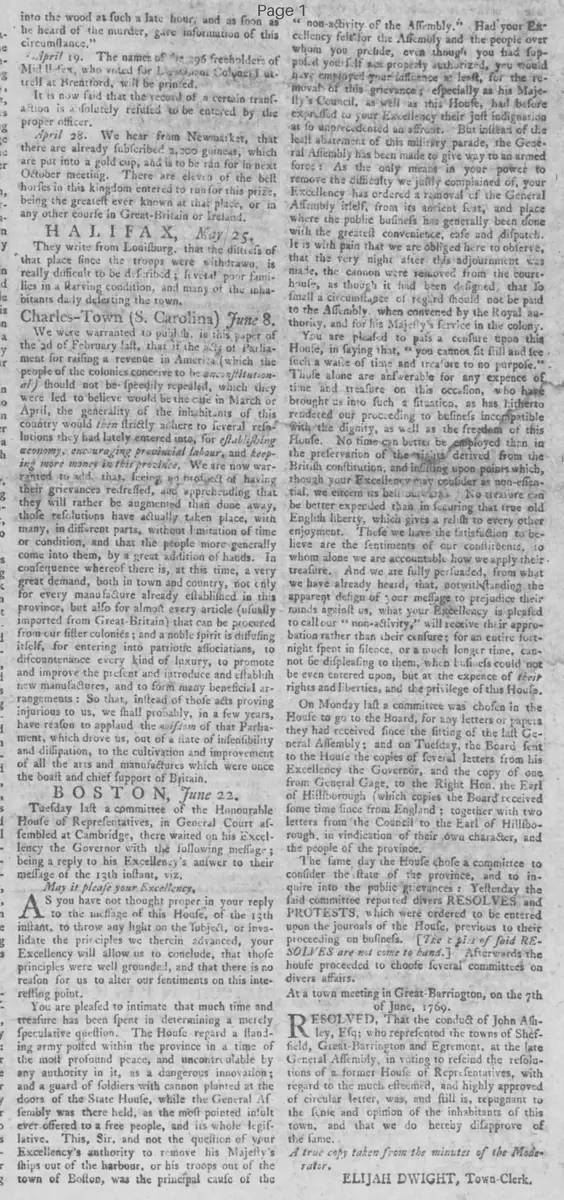
Tuesday last a committee of the Honourable House of Representatives, in General Court assembled at Cambridge, there waited on his Excellency the Governor with the following message; being a reply to his Excellency's answer to their message of the 13th instant, viz.
May it please your Excellency,
As you have not thought proper in your reply to the message of this House, of the 12th instant, to throw any light on the subject, or invalidate the principles we therein advanced, your Excellency will allow us to conclude, that those principles were well grounded, and that there is no reason for us to alter our sentiments on this interesting point.
You are pleased to intimate that much time and treasure has been spent in determining a merely speculative question. The House regard a standing army posted within the province in a time of the most profound peace, and uncontrollable by any authority in it, as a dangerous innovation; and a guard of soldiers with cannon planted at the doors of the State House, while the General Assembly was there held, as the most pointed insult ever offered to a free people, and its whole legislative. This, Sir, and not the question of your Excellency's authority to remove his Majesty's ships out of the harbour, or his troops out of the town of Boston, was the principal cause of the non-activity of the Assembly. Had your Excellency felt for the Assembly and the people over whom you preside, even though you had supposed yourself not properly authorized, you would have employed your influence at least, for the removal of this grievance: especially as his Majesty's Council, as well as this House, had before expressed to your Excellency their just indignation at so unprecedented an outrage. But instead of the least abatement of this military parade, the General Assembly has been made to give way to an armed force: As the only means in your power to remove the difficulty we justly complained of, your Excellency has ordered a removal of the General Assembly itself, from its ancient seat, and place where the public business has generally been done with the greatest convenience, ease and dispatch.
It is with pain that we are obliged here to observe, that the very night after this adjournment was made, the cannon were removed from the court-house, as though it had been designed, that so small a circumstance of regard should not be paid to the Assembly, when convened by the Royal authority, and for his Majesty's service in the colony.
You are pleased to pass a censure upon this House, in saying that, "you cannot sit still and see such a waste of time and treasure to no purpose." Those alone are answerable for any expense of time and treasure on this occasion, who have brought us into such a situation, as has hitherto rendered our proceeding to business incompatible with the dignity, as well as the freedom of this House. No time can be better employed than in the preservation of the rights derived from the British constitution, and insisting upon points which, though your Excellency may consider as non-essential, we esteem as our dearest concerns. No treasure can be better expended than in securing that true old English liberty, which gives a relish to every other enjoyment. These we have the satisfaction to believe are the sentiments of our constituents, to whom alone we are accountable how we apply their treasure. And we are fully persuaded, from what we have already heard, that, notwithstanding the apparent design of our message to prejudice their minds against us, what your Excellency is pleased to call our "non-activity," will receive their approbation rather than their censure; for an entire fortnight spent in silence, or a much longer time, cannot be displeasing to them, when business could not be even entered upon, but at the expense of their rights and liberties, and the privilege of this House.
On Monday last a committee was chosen in the House to go to the Board, for any letters or papers they had received since the sitting of the last General Assembly; and on Tuesday, the Board sent to the House the copies of several letters from his Excellency the Governor, and the copy of one from General Gage, to the Right Hon. the Earl of Hillsborough (which copies the Board received some time since from England); together with two letters from the Council to the Earl of Hillsborough, in vindication of their own character, and the people of the province.
The same day the House chose a committee to consider the state of the province, and to inquire into the public grievances: Yesterday the said committee reported divers RESOLVES and PROTESTS, which were ordered to be entered upon the journals of the House, previous to their proceeding on business. [The prints of said RESOLVES are not come to hand.] Afterwards the House proceeded to choose several committees on divers affairs.
What sub-type of article is it?
What keywords are associated?
What entities or persons were involved?
Where did it happen?
Domestic News Details
Primary Location
Cambridge
Event Date
June 22
Key Persons
Outcome
the house delivered a critical message to the governor, received official letters, reported resolves and protests on grievances, and formed committees; no physical casualties mentioned.
Event Details
A committee of the House of Representatives waited on the Governor with a message replying to his earlier response, criticizing the presence of a standing army and cannon at the State House as an insult and dangerous innovation, leading to the assembly's relocation. The House defended their non-activity as preservation of rights. Committees were chosen to retrieve letters and papers, including copies from the Governor, General Gage, and the Council to the Earl of Hillsborough. A committee on provincial state and grievances reported resolves and protests, entered on journals, followed by selection of other committees.