Thank you for visiting SNEWPapers!
Sign up free
Story
June 3, 1873
The Charlotte Democrat
Charlotte, Mecklenburg County, North Carolina
What is this article about?
An old Maine farmer shares advice on selecting seed potatoes: dig them early when tops are green for maximum vigor, based on experiments since 1815. Late-planted potatoes may also serve better as seed due to incomplete ripening.
Clipping
OCR Quality
98%
Excellent
Full Text
Potatoes for Seed.
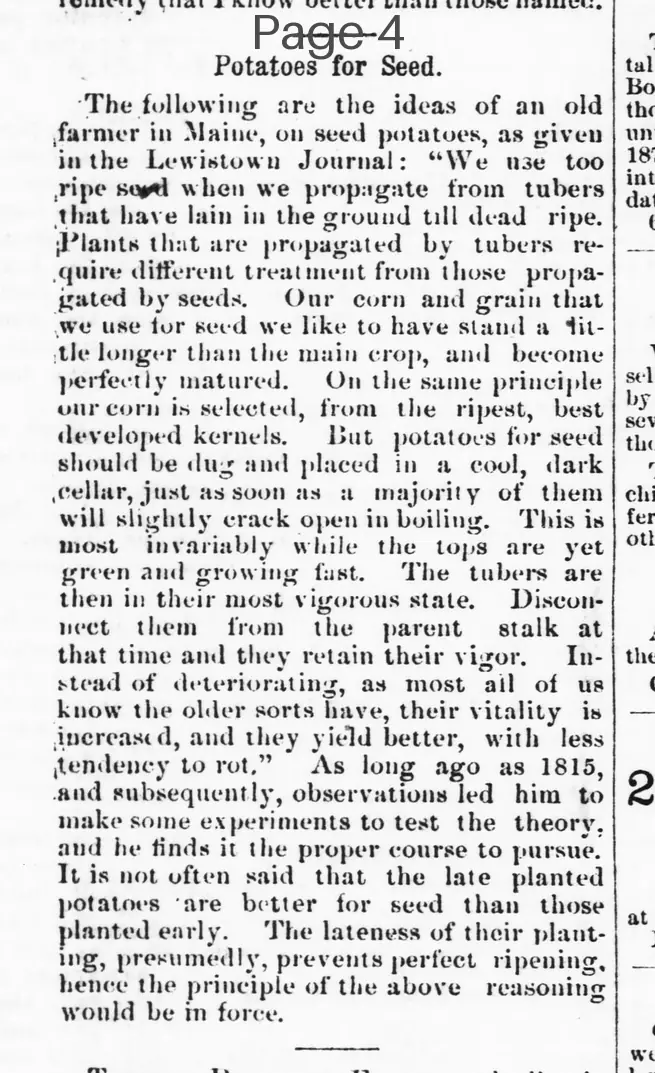
The following are the ideas of an old farmer in Maine, on seed potatoes, as given in the Lewistown Journal: "We use too ripe sod when we propagate from tubers that have lain in the ground till dead ripe. Plants that are propagated by tubers require different treatment from those propagated by seeds. Our corn and grain that we use for seed we like to have stand a little longer than the main crop, and become perfectly matured. On the same principle our corn is selected, from the ripest, best developed kernels. But potatoes for seed should be dug and placed in a cool, dark cellar, just as soon as a majority of them will slightly crack open in boiling. This is most invariably while the tops are yet green and growing fast. The tubers are then in their most vigorous state. Disconnect them from the parent stalk at that time and they retain their vigor. Instead of deteriorating, as most all of us know the older sorts have, their vitality is increased, and they yield better, with less tendency to rot." As long ago as 1815, and subsequently, observations led him to make some experiments to test the theory, and he finds it the proper course to pursue.
It is not often said that the late planted potatoes are better for seed than those planted early. The lateness of their planting, presumably, prevents perfect ripening, hence the principle of the above reasoning would be in force.
The following are the ideas of an old farmer in Maine, on seed potatoes, as given in the Lewistown Journal: "We use too ripe sod when we propagate from tubers that have lain in the ground till dead ripe. Plants that are propagated by tubers require different treatment from those propagated by seeds. Our corn and grain that we use for seed we like to have stand a little longer than the main crop, and become perfectly matured. On the same principle our corn is selected, from the ripest, best developed kernels. But potatoes for seed should be dug and placed in a cool, dark cellar, just as soon as a majority of them will slightly crack open in boiling. This is most invariably while the tops are yet green and growing fast. The tubers are then in their most vigorous state. Disconnect them from the parent stalk at that time and they retain their vigor. Instead of deteriorating, as most all of us know the older sorts have, their vitality is increased, and they yield better, with less tendency to rot." As long ago as 1815, and subsequently, observations led him to make some experiments to test the theory, and he finds it the proper course to pursue.
It is not often said that the late planted potatoes are better for seed than those planted early. The lateness of their planting, presumably, prevents perfect ripening, hence the principle of the above reasoning would be in force.
What sub-type of article is it?
Curiosity
What themes does it cover?
Triumph
What keywords are associated?
Seed Potatoes
Farming Advice
Maine Farmer
Potato Vigor
Agricultural Experiment
What entities or persons were involved?
Old Farmer In Maine
Where did it happen?
Maine
Story Details
Key Persons
Old Farmer In Maine
Location
Maine
Event Date
1815
Story Details
Old Maine farmer advises digging seed potatoes early when tops are green to preserve vigor, based on 1815 experiments; late-planted ones better due to incomplete ripening.