Thank you for visiting SNEWPapers!
Sign up free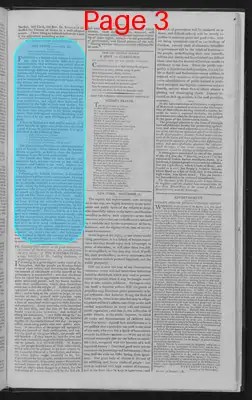
Literary
December 12, 1789
Gazette Of The United States
New York, New York County, New York
What is this article about?
An essay critiquing the capricious tyranny of fashion over society, from humble to elite, arguing it wastes time and resources better spent elsewhere. Includes anecdotes of fashion's negative impacts and a poetic description of a fickle mind.
Clipping
OCR Quality
95%
Excellent
Full Text
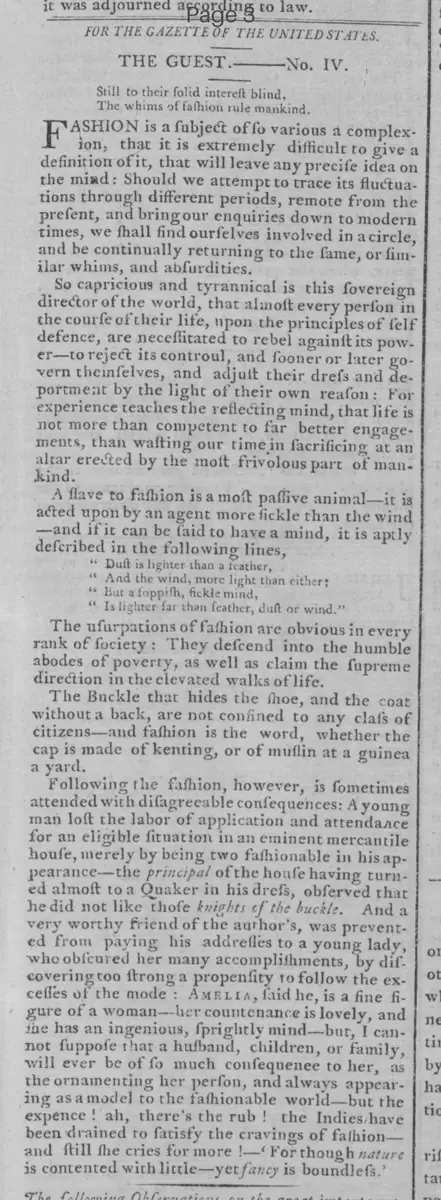
FOR THE GAZETTE OF THE UNITED STATES.
THE GUEST.
-No. IV.
Still to their solid interest blind,
The whims of fashion rule mankind.
FASHION is a subject so various a complexion, that it is extremely difficult to give a definition of it, that will leave any precise idea on the mind: Should we attempt to trace its fluctuations through different periods, remote from the present, and bring our enquiries down to modern times, we shall find ourselves involved in a circle, and be continually returning to the same, or similar whims, and absurdities.
So capricious and tyrannical is this sovereign director of the world, that almost every person in the course of their life, upon the principles of self defence, are necessitated to rebel against its power—to reject its control, and sooner or later govern themselves, and adjust their dress and deportment by the light of their own reason: For experience teaches the reflecting mind, that life is not more than competent to far better engagements, than wasting our time in sacrificing at an altar erected by the most frivolous part of mankind.
A slave to fashion is a most passive animal; it is acted upon by an agent more fickle than the wind —and if it can be said to have a mind, it is aptly described in the following lines,
'Dust is lighter than a feather,
'And the wind, more light than either;
'But a foppish, fickle mind,
'Is lighter far than feather, dust or wind.'
The usurpations of fashion are obvious in every rank of society: They descend into the humble abodes of poverty, as well as claim the supreme direction in the elevated walks of life.
The Buckle that hides the shoe, and the coat without a back, are not confined to any class of citizens—and fashion is the word, whether the cap is made of kenting, or of muslin at a guinea a yard.
Following the fashion, however, is sometimes attended with disagreeable consequences: A young man lost the labor of application and attendance for an eligible situation in an eminent mercantile house, merely by being too fashionable in his appearance—the principal of the house having turned almost to a Quaker in his dress, observed that he did not like those knights of the buckle. And a very worthy friend of the author's, was prevented from paying his addresses to a young lady, who obscured her many accomplishments, by discovering too strong a propensity to follow the excesses of the mode: AMELIA, said he, is a fine figure of a woman—her countenance is lovely, and she has an ingenious, sprightly mind—but, I cannot suppose that a husband, children, or family, will ever be of so much consequence to her, as the ornamenting her person, and always appearing as a model to the fashionable world—but the expense! ah, there's the rub! the Indies have been drained to satisfy the cravings of fashion— and still she cries for more! 'For though nature is contented with little—yet fancy is boundless.'
THE GUEST.
-No. IV.
Still to their solid interest blind,
The whims of fashion rule mankind.
FASHION is a subject so various a complexion, that it is extremely difficult to give a definition of it, that will leave any precise idea on the mind: Should we attempt to trace its fluctuations through different periods, remote from the present, and bring our enquiries down to modern times, we shall find ourselves involved in a circle, and be continually returning to the same, or similar whims, and absurdities.
So capricious and tyrannical is this sovereign director of the world, that almost every person in the course of their life, upon the principles of self defence, are necessitated to rebel against its power—to reject its control, and sooner or later govern themselves, and adjust their dress and deportment by the light of their own reason: For experience teaches the reflecting mind, that life is not more than competent to far better engagements, than wasting our time in sacrificing at an altar erected by the most frivolous part of mankind.
A slave to fashion is a most passive animal; it is acted upon by an agent more fickle than the wind —and if it can be said to have a mind, it is aptly described in the following lines,
'Dust is lighter than a feather,
'And the wind, more light than either;
'But a foppish, fickle mind,
'Is lighter far than feather, dust or wind.'
The usurpations of fashion are obvious in every rank of society: They descend into the humble abodes of poverty, as well as claim the supreme direction in the elevated walks of life.
The Buckle that hides the shoe, and the coat without a back, are not confined to any class of citizens—and fashion is the word, whether the cap is made of kenting, or of muslin at a guinea a yard.
Following the fashion, however, is sometimes attended with disagreeable consequences: A young man lost the labor of application and attendance for an eligible situation in an eminent mercantile house, merely by being too fashionable in his appearance—the principal of the house having turned almost to a Quaker in his dress, observed that he did not like those knights of the buckle. And a very worthy friend of the author's, was prevented from paying his addresses to a young lady, who obscured her many accomplishments, by discovering too strong a propensity to follow the excesses of the mode: AMELIA, said he, is a fine figure of a woman—her countenance is lovely, and she has an ingenious, sprightly mind—but, I cannot suppose that a husband, children, or family, will ever be of so much consequence to her, as the ornamenting her person, and always appearing as a model to the fashionable world—but the expense! ah, there's the rub! the Indies have been drained to satisfy the cravings of fashion— and still she cries for more! 'For though nature is contented with little—yet fancy is boundless.'
What sub-type of article is it?
Essay
Satire
What themes does it cover?
Social Manners
Moral Virtue
Commerce Trade
What keywords are associated?
Fashion
Satire
Society
Frivolity
Morality
Expense
Tyranny
Literary Details
Title
The Guest. No. Iv.
Subject
On The Tyranny And Absurdities Of Fashion
Form / Style
Satirical Prose Essay
Key Lines
Still To Their Solid Interest Blind,
The Whims Of Fashion Rule Mankind.
'Dust Is Lighter Than A Feather,
'And The Wind, More Light Than Either;
'But A Foppish, Fickle Mind,
'Is Lighter Far Than Feather, Dust Or Wind.'
'For Though Nature Is Contented With Little—Yet Fancy Is Boundless.'