Thank you for visiting SNEWPapers!
Sign up free
Literary
May 26, 1840
Rutland Herald
Rutland, Rutland County, Vermont
What is this article about?
During the Consulate, a determined young man, rejected by examiner Abbe Bossu for self-taught status, seeks Napoleon's intervention at Malmaison. Napoleon examines him, finds him qualified, and writes a note securing his admission to the Polytechnic school.
Clipping
OCR Quality
98%
Excellent
Full Text
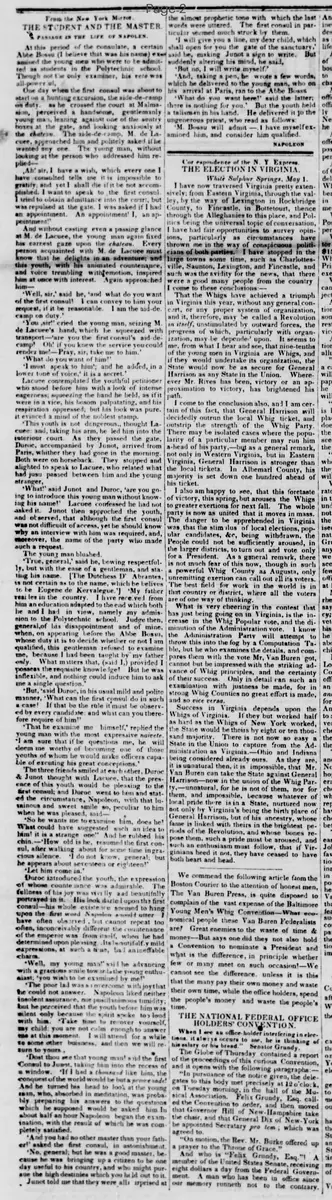
From the New York Mirror.
THE STUDENT AND THE MASTER
PASSAGE IN THE LIFE OF NAPOLEON.
At this period of the consulate, a certain Abbe Bossu (I believe that was his name) examined the young men who were to be admitted as students in the Polytechnic school. Though not the only examiner, his vote was all-powerful.
One day when the first consul was about to start on a hunting excursion, the aide-de-camp on duty, as he crossed the court at Malmaison, perceived a handsome, gentlemanly young man, leaning against one of the sentry boxes at the gate, and looking anxiously at the chateau. The aide-de-camp, M. de la Collee, approached him and politely asked if he wanted any one. The young man, without looking at the person who addressed him replied—
Ah! sir, I have a wish, which every one I have consulted tells me it is impossible to gratify, and yet I shall die if it be not accomplished. I want to speak to the first consul. I tried to obtain admittance into the court, but was repulsed at the gate. I was asked if I had an appointment. An appointment! I, an appointment!
And without casting even a passing glance at M. de Lacuce, the young man again fixed his earnest gaze upon the chateau. Every person acquainted with M. de Lacuce must know that he delights in an adventure: and this youth, with his animated countenance, and voice trembling with emotion, inspired him at once with interest. Again he approached him—
Well, sir, said he, and what do you want of the first consul! I can convey to him your request, if it be reasonable. I am the aide-de-camp on duty.
You sir! cried the young man, seizing M. de Lacuce's hand, which he squeezed with transport—are you the first consul's aide-de-camp! Oh! if you knew the service you could render me—Pray, sir, take me to him.
What do you want of him?
I must speak to him; and he added, in a lower tone of voice, it is a secret.
Lacuce contemplated the youthful petitioner who stood before him with a look of intense eagerness; squeezing the hand he held, as if it were in a vice, his bosom palpitating, and his respiration oppressed; but his look was pure. It evinced a mind of the noblest stamp.
This youth is not dangerous, thought Lacuce: and, taking his arm, he led him into the interior court. As they passed the gate, Duroc, accompanied by Junot, arrived from Paris, whither they had gone in the morning. Both were on horseback. They stopped and alighted to speak to Lacuce, who related what had just passed between him and the young stranger.
What! said Junot and Duroc, are you going to introduce this young man without knowing his name! Lacuce confessed he had not asked it. Junot then approached the youth, and observed, that although the first consul was not difficult of access, yet he should know why an interview with him was required, and, moreover, the name of the party who made such a request.
The young man blushed.
True, general, said he, bowing respectfully, but with the ease of a gentleman, and stating his name. [The Duchess D'Abrantes, is not certain as to the name, which she believes to be Eugene de Kervalegue.] My father resides in the country. I have received from him an education adapted to the end which both he and I had in view, namely my admission to the Polytechnic school. Judge then, general, of his disappointment and of mine, when, on appearing before the Abbe Bossu, whose duty it is to decide whether or not I am qualified, this gentleman refused to examine me, because I had been taught by my father only. What matters that, said I, provided I possess the requisite knowledge! But he was inflexible, and nothing could induce him to ask me a single question.
But, said Duroc, in his usual mild and polite manner, What can the first consul do in such a case! If that be the rule it must be observed by every candidate: and what can you therefore require of him!
That he examine me himself, replied the young man with the most expressive naivete. I am sure that if he questions me, he will deem me worthy of becoming one of those youths of whom he would make officers capable of executing his great conceptions.
The three friends smiled at each other, Duroc & Junot thought with Lacuce, that the presence of this youth would be pleasing to the first consul; and Duroc went to him and stated the circumstance, Napoleon, with that luminous and sweet smile so peculiar to him when he was pleased, said—
So he wants me to examine him, does he! What could have suggested such an idea to him! it is a strange one. And he rubbed his chin.—How old is he, resumed the first consul, after walking about for some time in gracious silence. I do not know, general; but he appears about seventeen or eighteen!
Let him come in.
Duroc introduced the youth, the expression of whose countenance was admirable. The calmness of his joy was vividly and beautifully portrayed in it. His look darted upon the first consul—his whole existence seemed to hang upon the first word Napoleon would utter. I have often observed, but cannot repeat too often, inconceivably different the countenance of the emperor was from itself, when he had determined upon pleasing. Its beautifully mild expressions, at such a time, had an ineffable charm.
Well, my young man! said he advancing with a gracious smile towards the young enthusiast; you wish to be examined by me?
The poor lad was so overcome with joy that he could not answer. Napoleon liked neither insolent assurance, nor pusillanimous timidity; but he perceived that the youth before him was silent only because the spirit spoke too loud within him. Take time to recover yourself, my child: you are not calm enough to answer what at this moment. I will attend for a while to some other business, and then we will return to yours.
Dost thou see that young man? said the first Consul to Junot, taking him into the recess of a window. If I had a thousand like him, the conquest of the world would be but a promenade! And he turned his head to look at the young man, who, absorbed in meditation, was probably preparing his answers to the questions which he supposed would be asked him. In about half an hour Napoleon began the examination, with the result of which he was completely satisfied.
And you had no other master than your father? asked the first consul, in astonishment.
No, general; but he was a good master, because he was bringing up a citizen to be one day useful to his country, and who might pursue the high destinies which you held out to it.
Junot told me that they were all surprised at the almost prophetic tone with which the last words were uttered. The first consul in particular seemed much struck by them.
I will give you a line, my dear child, which shall open for you the gate of the sanctuary, said he, making Junot a sign to write. But suddenly altering his mind, he said,
But no. I will write myself.
And, taking a pen, he wrote a few words which he delivered to the young man, who on his arrival at Paris, ran to the Abbe Bossu.
What do you want here? said the latter; there is nothing for you. But the youth held a talisman in his hand. He delivered it to the ungenerous priest, who read as follows:
M. Bossu will admit —. I have myself examined him, and consider him qualified.
NAPOLEON
THE STUDENT AND THE MASTER
PASSAGE IN THE LIFE OF NAPOLEON.
At this period of the consulate, a certain Abbe Bossu (I believe that was his name) examined the young men who were to be admitted as students in the Polytechnic school. Though not the only examiner, his vote was all-powerful.
One day when the first consul was about to start on a hunting excursion, the aide-de-camp on duty, as he crossed the court at Malmaison, perceived a handsome, gentlemanly young man, leaning against one of the sentry boxes at the gate, and looking anxiously at the chateau. The aide-de-camp, M. de la Collee, approached him and politely asked if he wanted any one. The young man, without looking at the person who addressed him replied—
Ah! sir, I have a wish, which every one I have consulted tells me it is impossible to gratify, and yet I shall die if it be not accomplished. I want to speak to the first consul. I tried to obtain admittance into the court, but was repulsed at the gate. I was asked if I had an appointment. An appointment! I, an appointment!
And without casting even a passing glance at M. de Lacuce, the young man again fixed his earnest gaze upon the chateau. Every person acquainted with M. de Lacuce must know that he delights in an adventure: and this youth, with his animated countenance, and voice trembling with emotion, inspired him at once with interest. Again he approached him—
Well, sir, said he, and what do you want of the first consul! I can convey to him your request, if it be reasonable. I am the aide-de-camp on duty.
You sir! cried the young man, seizing M. de Lacuce's hand, which he squeezed with transport—are you the first consul's aide-de-camp! Oh! if you knew the service you could render me—Pray, sir, take me to him.
What do you want of him?
I must speak to him; and he added, in a lower tone of voice, it is a secret.
Lacuce contemplated the youthful petitioner who stood before him with a look of intense eagerness; squeezing the hand he held, as if it were in a vice, his bosom palpitating, and his respiration oppressed; but his look was pure. It evinced a mind of the noblest stamp.
This youth is not dangerous, thought Lacuce: and, taking his arm, he led him into the interior court. As they passed the gate, Duroc, accompanied by Junot, arrived from Paris, whither they had gone in the morning. Both were on horseback. They stopped and alighted to speak to Lacuce, who related what had just passed between him and the young stranger.
What! said Junot and Duroc, are you going to introduce this young man without knowing his name! Lacuce confessed he had not asked it. Junot then approached the youth, and observed, that although the first consul was not difficult of access, yet he should know why an interview with him was required, and, moreover, the name of the party who made such a request.
The young man blushed.
True, general, said he, bowing respectfully, but with the ease of a gentleman, and stating his name. [The Duchess D'Abrantes, is not certain as to the name, which she believes to be Eugene de Kervalegue.] My father resides in the country. I have received from him an education adapted to the end which both he and I had in view, namely my admission to the Polytechnic school. Judge then, general, of his disappointment and of mine, when, on appearing before the Abbe Bossu, whose duty it is to decide whether or not I am qualified, this gentleman refused to examine me, because I had been taught by my father only. What matters that, said I, provided I possess the requisite knowledge! But he was inflexible, and nothing could induce him to ask me a single question.
But, said Duroc, in his usual mild and polite manner, What can the first consul do in such a case! If that be the rule it must be observed by every candidate: and what can you therefore require of him!
That he examine me himself, replied the young man with the most expressive naivete. I am sure that if he questions me, he will deem me worthy of becoming one of those youths of whom he would make officers capable of executing his great conceptions.
The three friends smiled at each other, Duroc & Junot thought with Lacuce, that the presence of this youth would be pleasing to the first consul; and Duroc went to him and stated the circumstance, Napoleon, with that luminous and sweet smile so peculiar to him when he was pleased, said—
So he wants me to examine him, does he! What could have suggested such an idea to him! it is a strange one. And he rubbed his chin.—How old is he, resumed the first consul, after walking about for some time in gracious silence. I do not know, general; but he appears about seventeen or eighteen!
Let him come in.
Duroc introduced the youth, the expression of whose countenance was admirable. The calmness of his joy was vividly and beautifully portrayed in it. His look darted upon the first consul—his whole existence seemed to hang upon the first word Napoleon would utter. I have often observed, but cannot repeat too often, inconceivably different the countenance of the emperor was from itself, when he had determined upon pleasing. Its beautifully mild expressions, at such a time, had an ineffable charm.
Well, my young man! said he advancing with a gracious smile towards the young enthusiast; you wish to be examined by me?
The poor lad was so overcome with joy that he could not answer. Napoleon liked neither insolent assurance, nor pusillanimous timidity; but he perceived that the youth before him was silent only because the spirit spoke too loud within him. Take time to recover yourself, my child: you are not calm enough to answer what at this moment. I will attend for a while to some other business, and then we will return to yours.
Dost thou see that young man? said the first Consul to Junot, taking him into the recess of a window. If I had a thousand like him, the conquest of the world would be but a promenade! And he turned his head to look at the young man, who, absorbed in meditation, was probably preparing his answers to the questions which he supposed would be asked him. In about half an hour Napoleon began the examination, with the result of which he was completely satisfied.
And you had no other master than your father? asked the first consul, in astonishment.
No, general; but he was a good master, because he was bringing up a citizen to be one day useful to his country, and who might pursue the high destinies which you held out to it.
Junot told me that they were all surprised at the almost prophetic tone with which the last words were uttered. The first consul in particular seemed much struck by them.
I will give you a line, my dear child, which shall open for you the gate of the sanctuary, said he, making Junot a sign to write. But suddenly altering his mind, he said,
But no. I will write myself.
And, taking a pen, he wrote a few words which he delivered to the young man, who on his arrival at Paris, ran to the Abbe Bossu.
What do you want here? said the latter; there is nothing for you. But the youth held a talisman in his hand. He delivered it to the ungenerous priest, who read as follows:
M. Bossu will admit —. I have myself examined him, and consider him qualified.
NAPOLEON
What sub-type of article is it?
Prose Fiction
Dialogue
What themes does it cover?
Political
Moral Virtue
Patriotism
What keywords are associated?
Napoleon
Polytechnic School
Abbe Bossu
Youth Examination
First Consul
Historical Anecdote
Duchess Dabrantes
What entities or persons were involved?
From The New York Mirror
Literary Details
Title
The Student And The Master
Author
From The New York Mirror
Subject
Passage In The Life Of Napoleon
Key Lines
Ah! Sir, I Have A Wish, Which Every One I Have Consulted Tells Me It Is Impossible To Gratify, And Yet I Shall Die If It Be Not Accomplished. I Want To Speak To The First Consul.
That He Examine Me Himself, Replied The Young Man With The Most Expressive Naivete. I Am Sure That If He Questions Me, He Will Deem Me Worthy Of Becoming One Of Those Youths Of Whom He Would Make Officers Capable Of Executing His Great Conceptions.
Dost Thou See That Young Man? Said The First Consul To Junot, Taking Him Into The Recess Of A Window. If I Had A Thousand Like Him, The Conquest Of The World Would Be But A Promenade!
No, General; But He Was A Good Master, Because He Was Bringing Up A Citizen To Be One Day Useful To His Country, And Who Might Pursue The High Destinies Which You Held Out To It.
M. Bossu Will Admit —. I Have Myself Examined Him, And Consider Him Qualified.
Napoleon