Thank you for visiting SNEWPapers!
Sign up free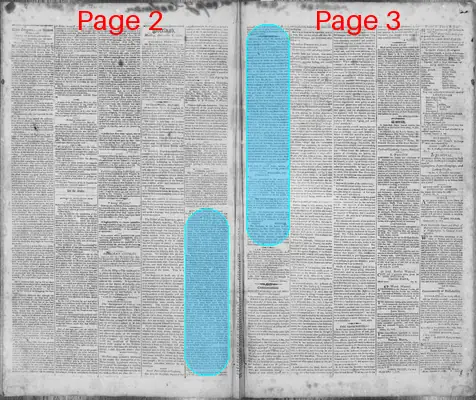
Editorial
December 5, 1808
Portland Gazette, And Maine Advertiser
Portland, Cumberland County, Maine
What is this article about?
Federalist editorial exposes Democratic Argus newspaper's false claim of British outrage in a schooner incident involving Americans, and criticizes Secretary Madison's letter to British minister Erskine for pro-French bias amid tensions with Britain.
Merged-components note: Continuation of editorial commentary on falsehoods and Madison's letter from page 2 to page 3.
Clippings
1 of 2
OCR Quality
98%
Excellent
Full Text
P. Argus Falsehoods Exposed.
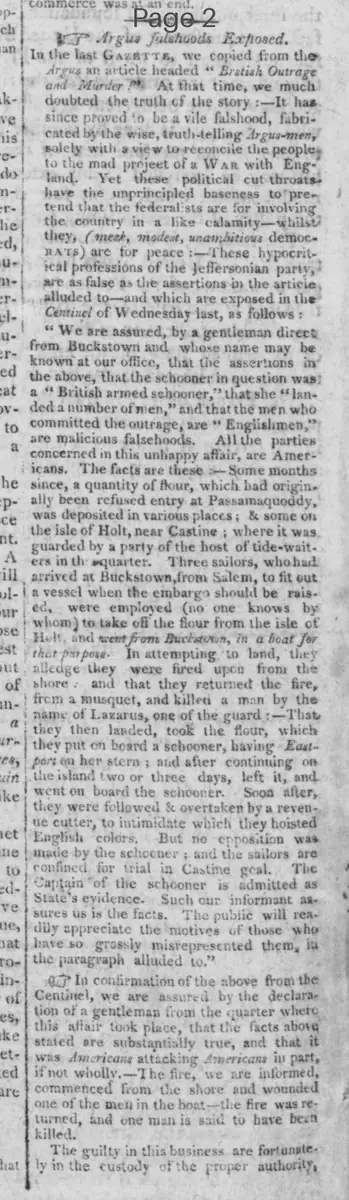
In the last GAZETTE, we copied from the Argus an article headed "British Outrage and Murder." At that time, we much doubted the truth of the story:—It has since proved to be a vile falsehood, fabricated by the wise, truth-telling Argus-men, solely with a view to reconcile the people to the mad project of a War with England. Yet these political cut throats have the unprincipled baseness to pretend that the federalists are for involving the country in a like calamity—whilst they, (meek, modest, unambitious democrats) are for peace:—These hypocritical professions of the Jeffersonian party, are as false as the assertions in the article alluded to—and which are exposed in the Centinel of Wednesday last, as follows:
"We are assured, by a gentleman direct from Buckstown and whose name may be known at our office, that the assertions in the above, that the schooner in question was a "British armed schooner," that she "landed a number of men," and that the men who committed the outrage, are "Englishmen," are malicious falsehoods. All the parties concerned in this unhappy affair, are Americans. The facts are these: Some months since, a quantity of flour, which had originally been refused entry at Passamaquoddy, was deposited in various places; & some on the isle of Holt, near Castine; where it was guarded by a party of the host of tide-waiters in that quarter. Three sailors, who had arrived at Buckstown, from Salem, to fit out a vessel when the embargo should be raised, were employed (no one knows by whom) to take off the flour from the isle of Holt, and went from Buckstown, in a boat for that purpose. In attempting to land, they allege they were fired upon from the shore: and that they returned the fire, from a musquet, and killed a man by the name of Lazarus, one of the guard:—That they then landed, took the flour, which they put on board a schooner, having Eastport on her stern; and after continuing on the island two or three days, left it, and went on board the schooner. Soon after, they were followed & overtaken by a revenue cutter, to intimidate which they hoisted English colors. But no opposition was made by the schooner; and the sailors are confined for trial in Castine jail. The Captain of the schooner is admitted as State's evidence. Such our informant assures us is the facts. The public will readily appreciate the motives of those who have so grossly misrepresented them, in the paragraph alluded to."
In confirmation of the above from the Centinel, we are assured by the declaration of a gentleman from the quarter where this affair took place, that the acts above stated are substantially true, and that it was Americans attacking Americans in part, if not wholly. The fire, we are informed, commenced from the shore and wounded one of the men in the boat—the fire was returned, and one man is said to have been killed.
The guilty in this business are fortunately in the custody of the proper authority.
and will meet due punishment. But it is highly improper to give transactions of this kind a false coloring, and endeavor to impose on the public mind.
We this day publish Mr. Madison's famous letter to Mr. Erskine, the British minister in the United States. To subscribe to the whole tenor of this production of our Secretary, would at once be to acknowledge ourselves citizens of France, and the humble vassals of the tyrant Bonaparte. We should certainly join in every proper and effectual mean to obtain an exemption from the wrongs and injuries we experience from Great Britain, but we cannot see how this object is to be secured by such communications as Mr. Madison's letter. The arch Talleyrand himself could not have apologized for Bonaparte's decrees in a better manner than Mr. M. has. The Secretary says, that France had never acted in regard to the commerce of the U. S. under the Berlin decree, till the case of the Horizon, when in fact, months before that, our vessels and property were detained at Antwerp. The truth is, our government adopted no effectual measures to ward off the approaching ruin with which the decrees of Bonaparte threatened our commerce. Their partiality or folly induced them to believe that France could do no wrong. The editor of the N. York Evening Post remarks, "I cannot permit this letter to pass through my press without entering along with it my feeble protest against the insidious, deceitful glosses it aims to throw over the atrocities of France. In all that relates to the execution of her Berlin decree, there is not only an attempt to colour, but I am sorry to be obliged to add, a guilty design to misrepresent. It is not true, that the Horizon was the first case in which the decree was executed; for American ships had before that been seized at Antwerp, and are still detained there under it. It is not true that the French government ever gave our minister any explanations at Paris, that the French decree would not be put in force against the United States. And I demand of Mr. Madison, how he dare to say this, with the following document staring him in the face."
Letter from the grand Judge, minister of justice, to the imperial attorney general for the council of prizes
"PARIS, 18 September, 1807.
(Translation.)
SIR,
"I have submitted to his majesty the emperor and king the doubts raised by his excellency the minister of marine and colonies, on the extent of certain dispositions of the imperial decree of the 21st November, 1806, which has declared the British isles in a state of blockade. The following are his majesty's intentions on the points in question:
Ist. May vessels of war, by virtue of the imperial decree of the 21st Nov. last, seize on board neutral vessels either English property, or even all merchandize proceeding from the English manufactories or territory?
Answer. His majesty has intimated that as he did not think proper to express any exception in his decree, there is no ground for making any in its execution, in relation to any whomsoever."
(Signed) REGNIER.
Mr. Madison, in his letter to Gen. Armstrong, in May 1807, says, "there are proofs that the West-India privateers have, under color of the edicts (French Berlin decree) committed DEPREDATIONS, which will constitute just claims of redress from the French Government!"
In the last GAZETTE, we copied from the Argus an article headed "British Outrage and Murder." At that time, we much doubted the truth of the story:—It has since proved to be a vile falsehood, fabricated by the wise, truth-telling Argus-men, solely with a view to reconcile the people to the mad project of a War with England. Yet these political cut throats have the unprincipled baseness to pretend that the federalists are for involving the country in a like calamity—whilst they, (meek, modest, unambitious democrats) are for peace:—These hypocritical professions of the Jeffersonian party, are as false as the assertions in the article alluded to—and which are exposed in the Centinel of Wednesday last, as follows:
"We are assured, by a gentleman direct from Buckstown and whose name may be known at our office, that the assertions in the above, that the schooner in question was a "British armed schooner," that she "landed a number of men," and that the men who committed the outrage, are "Englishmen," are malicious falsehoods. All the parties concerned in this unhappy affair, are Americans. The facts are these: Some months since, a quantity of flour, which had originally been refused entry at Passamaquoddy, was deposited in various places; & some on the isle of Holt, near Castine; where it was guarded by a party of the host of tide-waiters in that quarter. Three sailors, who had arrived at Buckstown, from Salem, to fit out a vessel when the embargo should be raised, were employed (no one knows by whom) to take off the flour from the isle of Holt, and went from Buckstown, in a boat for that purpose. In attempting to land, they allege they were fired upon from the shore: and that they returned the fire, from a musquet, and killed a man by the name of Lazarus, one of the guard:—That they then landed, took the flour, which they put on board a schooner, having Eastport on her stern; and after continuing on the island two or three days, left it, and went on board the schooner. Soon after, they were followed & overtaken by a revenue cutter, to intimidate which they hoisted English colors. But no opposition was made by the schooner; and the sailors are confined for trial in Castine jail. The Captain of the schooner is admitted as State's evidence. Such our informant assures us is the facts. The public will readily appreciate the motives of those who have so grossly misrepresented them, in the paragraph alluded to."
In confirmation of the above from the Centinel, we are assured by the declaration of a gentleman from the quarter where this affair took place, that the acts above stated are substantially true, and that it was Americans attacking Americans in part, if not wholly. The fire, we are informed, commenced from the shore and wounded one of the men in the boat—the fire was returned, and one man is said to have been killed.
The guilty in this business are fortunately in the custody of the proper authority.
and will meet due punishment. But it is highly improper to give transactions of this kind a false coloring, and endeavor to impose on the public mind.
We this day publish Mr. Madison's famous letter to Mr. Erskine, the British minister in the United States. To subscribe to the whole tenor of this production of our Secretary, would at once be to acknowledge ourselves citizens of France, and the humble vassals of the tyrant Bonaparte. We should certainly join in every proper and effectual mean to obtain an exemption from the wrongs and injuries we experience from Great Britain, but we cannot see how this object is to be secured by such communications as Mr. Madison's letter. The arch Talleyrand himself could not have apologized for Bonaparte's decrees in a better manner than Mr. M. has. The Secretary says, that France had never acted in regard to the commerce of the U. S. under the Berlin decree, till the case of the Horizon, when in fact, months before that, our vessels and property were detained at Antwerp. The truth is, our government adopted no effectual measures to ward off the approaching ruin with which the decrees of Bonaparte threatened our commerce. Their partiality or folly induced them to believe that France could do no wrong. The editor of the N. York Evening Post remarks, "I cannot permit this letter to pass through my press without entering along with it my feeble protest against the insidious, deceitful glosses it aims to throw over the atrocities of France. In all that relates to the execution of her Berlin decree, there is not only an attempt to colour, but I am sorry to be obliged to add, a guilty design to misrepresent. It is not true, that the Horizon was the first case in which the decree was executed; for American ships had before that been seized at Antwerp, and are still detained there under it. It is not true that the French government ever gave our minister any explanations at Paris, that the French decree would not be put in force against the United States. And I demand of Mr. Madison, how he dare to say this, with the following document staring him in the face."
Letter from the grand Judge, minister of justice, to the imperial attorney general for the council of prizes
"PARIS, 18 September, 1807.
(Translation.)
SIR,
"I have submitted to his majesty the emperor and king the doubts raised by his excellency the minister of marine and colonies, on the extent of certain dispositions of the imperial decree of the 21st November, 1806, which has declared the British isles in a state of blockade. The following are his majesty's intentions on the points in question:
Ist. May vessels of war, by virtue of the imperial decree of the 21st Nov. last, seize on board neutral vessels either English property, or even all merchandize proceeding from the English manufactories or territory?
Answer. His majesty has intimated that as he did not think proper to express any exception in his decree, there is no ground for making any in its execution, in relation to any whomsoever."
(Signed) REGNIER.
Mr. Madison, in his letter to Gen. Armstrong, in May 1807, says, "there are proofs that the West-India privateers have, under color of the edicts (French Berlin decree) committed DEPREDATIONS, which will constitute just claims of redress from the French Government!"
What sub-type of article is it?
Partisan Politics
Foreign Affairs
War Or Peace
What keywords are associated?
Argus Falsehoods
British Outrage Hoax
Madison Letter
French Decrees
Berlin Decree
War With England
Jeffersonian Hypocrisy
What entities or persons were involved?
Argus
Jeffersonian Party
Mr. Madison
Mr. Erskine
Bonaparte
Talleyrand
Centinel
N. York Evening Post
Editorial Details
Primary Topic
Exposing Argus Falsehoods On British Outrage And Criticizing Madison's Pro French Letter
Stance / Tone
Strongly Anti Jeffersonian And Anti War With England
Key Figures
Argus
Jeffersonian Party
Mr. Madison
Mr. Erskine
Bonaparte
Talleyrand
Centinel
N. York Evening Post
Key Arguments
Argus Fabricated British Outrage Story To Promote War With England
Incident Involved Americans Only, Not British
Jeffersonians Hypocritically Claim To Favor Peace While Pushing War
Madison's Letter Apologizes For French Decrees And Misrepresents Facts
France Seized Us Vessels Before Horizon Case Under Berlin Decree
Us Government Failed To Counter French Threats To Commerce