Thank you for visiting SNEWPapers!
Sign up free
The National Intelligencer And Washington Advertiser
Washington, District Of Columbia
What is this article about?
In House of Lords on July 3, Lord Holland moved for papers on U.S.-West Indies intercourse, supported by Lord Stanhope; Earl Camden opposed, leading to motion's defeat 14-8.
Clipping
OCR Quality
Full Text
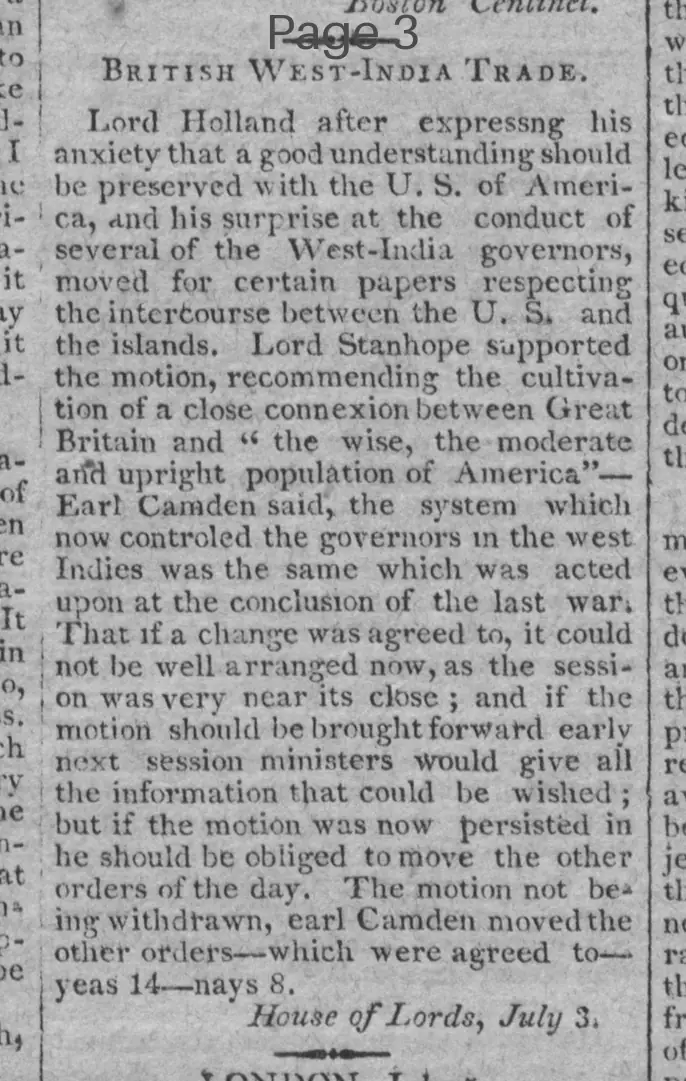
Lord Holland after expressing his anxiety that a good understanding should be preserved with the U. S. of America, and his surprise at the conduct of several of the West-India governors, moved for certain papers respecting the intercourse between the U. S. and the islands. Lord Stanhope supported the motion, recommending the cultivation of a close connexion between Great Britain and "the wise, the moderate and upright population of America"
Earl Camden said, the system which now controled the governors in the west Indies was the same which was acted upon at the conclusion of the last war: That if a change was agreed to, it could not be well arranged now, as the session was very near its close; and if the motion should be brought forward early next session ministers would give all the information that could be wished ; but if the motion was now persisted in he should be obliged to move the other orders of the day. The motion not being withdrawn, earl Camden moved the other orders--which were agreed to-- yeas 14--nays 8.
House of Lords, July 3.
What sub-type of article is it?
What keywords are associated?
What entities or persons were involved?
Where did it happen?
Foreign News Details
Primary Location
West Indies
Event Date
July 3
Key Persons
Outcome
motion not withdrawn; other orders of the day moved and agreed to, yeas 14, nays 8.
Event Details
Lord Holland moved for papers respecting intercourse between the U. S. and the West-India islands, expressing anxiety for good understanding with the U. S. and surprise at West-India governors' conduct. Lord Stanhope supported, recommending close connexion with America's population. Earl Camden opposed, stating the system controlling governors was the same as post-last war, and change could not be arranged now; promised information next session but moved other orders when motion persisted.