Thank you for visiting SNEWPapers!
Sign up free
Editorial
March 26, 1852
Kenosha Telegraph
Kenosha, Kenosha County, Wisconsin
What is this article about?
Editorial critiques Rev. Orville Dewey's lecture defending the fugitive slave law and gradual emancipation, arguing instead for absolute rights of prepared fugitives to freedom, humane aid against recapture, and a more just law with jury trials, as supported by Webster.
Clipping
OCR Quality
95%
Excellent
Full Text
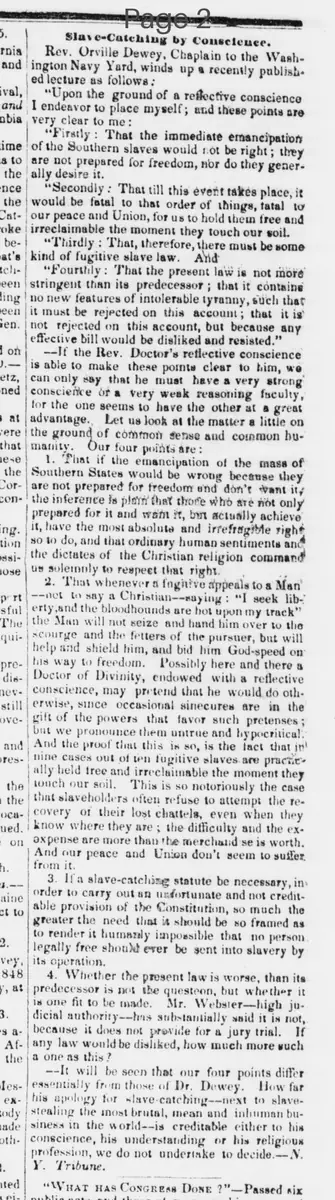
Slave-Catching by Conscience.
Rev. Orville Dewey, Chaplain to the Washington Navy Yard, winds up a recently published lecture as follows:
"Upon the ground of a reflective conscience I endeavor to place myself; and these points are very clear to me:
"Firstly: That the immediate emancipation of the Southern slaves would not be right; they are not prepared for freedom, nor do they generally desire it.
"Secondly: That till this event takes place, it would be fatal to that order of things, fatal to our peace and Union, for us to hold them free and irreclaimable the moment they touch our soil.
"Thirdly: That, therefore, there must be some kind of fugitive slave law. And
"Fourthly: That the present law is not more stringent than its predecessor; that it contains no new features of intolerable tyranny, such that it must be rejected on this account; that it is not rejected on this account, but because any effective bill would be disliked and resisted."—
If the Rev. Doctor's reflective conscience is able to make these points clear to him, we can only say that he must have a very strong conscience or a very weak reasoning faculty, for the one seems to have the other at a great advantage. Let us look at the matter a little on the ground of common sense and common humanity. Our four points are:
1. That if the emancipation of the mass of Southern States would be wrong because they are not prepared for freedom and don't want it; the inference is plain that those who are not only prepared for it and want it, but actually achieve it, have the most absolute and irrefragible right so to do, and that ordinary human sentiments and the dictates of the Christian religion command us solemnly to respect that right.
2. That whenever a fugitive appeals to a Man—not to say a Christian—saying: "I seek liberty, and the bloodhounds are hot upon my track" the Man will not seize and hand him over to the scourge and the fetters of the pursuer, but will help and shield him, and bid him God-speed on his way to freedom. Possibly here and there a Doctor of Divinity, endowed with a reflective conscience, may pretend that he would do otherwise, since occasional sinecures are in the gift of the powers that favor such pretenses; but we pronounce them untrue and hypocritical. And the proof that this is so, is the fact that in nine cases out of ten fugitive slaves are practically held free and irreclaimable the moment they touch our soil. This is so notoriously the case that slaveholders often refuse to attempt the recovery of their lost chattels, even when they know where they are; the difficulty and the expense are more than the merchandise is worth. And our peace and Union don't seem to suffer from it.
3. If a slave-catching statute be necessary, in order to carry out an unfortunate and not creditable provision of the Constitution, so much the greater the need that it should be so framed as to render it humanly impossible that no person legally free should ever be sent into slavery by its operation.
4. Whether the present law is worse, than its predecessor is not the question, but whether it is one fit to be made. Mr. Webster—high judicial authority—has substantially said it is not, because it does not provide for a jury trial. If any law would be disliked, how much more such a one as this?
—It will be seen that our four points differ essentially from those of Dr. Dewey. How far his apology for slave-catching—next to slave-stealing the most brutal, mean and inhuman business in the world—is creditable either to his conscience, his understanding or his religious profession, we do not undertake to decide.—N. Y. Tribune.
Rev. Orville Dewey, Chaplain to the Washington Navy Yard, winds up a recently published lecture as follows:
"Upon the ground of a reflective conscience I endeavor to place myself; and these points are very clear to me:
"Firstly: That the immediate emancipation of the Southern slaves would not be right; they are not prepared for freedom, nor do they generally desire it.
"Secondly: That till this event takes place, it would be fatal to that order of things, fatal to our peace and Union, for us to hold them free and irreclaimable the moment they touch our soil.
"Thirdly: That, therefore, there must be some kind of fugitive slave law. And
"Fourthly: That the present law is not more stringent than its predecessor; that it contains no new features of intolerable tyranny, such that it must be rejected on this account; that it is not rejected on this account, but because any effective bill would be disliked and resisted."—
If the Rev. Doctor's reflective conscience is able to make these points clear to him, we can only say that he must have a very strong conscience or a very weak reasoning faculty, for the one seems to have the other at a great advantage. Let us look at the matter a little on the ground of common sense and common humanity. Our four points are:
1. That if the emancipation of the mass of Southern States would be wrong because they are not prepared for freedom and don't want it; the inference is plain that those who are not only prepared for it and want it, but actually achieve it, have the most absolute and irrefragible right so to do, and that ordinary human sentiments and the dictates of the Christian religion command us solemnly to respect that right.
2. That whenever a fugitive appeals to a Man—not to say a Christian—saying: "I seek liberty, and the bloodhounds are hot upon my track" the Man will not seize and hand him over to the scourge and the fetters of the pursuer, but will help and shield him, and bid him God-speed on his way to freedom. Possibly here and there a Doctor of Divinity, endowed with a reflective conscience, may pretend that he would do otherwise, since occasional sinecures are in the gift of the powers that favor such pretenses; but we pronounce them untrue and hypocritical. And the proof that this is so, is the fact that in nine cases out of ten fugitive slaves are practically held free and irreclaimable the moment they touch our soil. This is so notoriously the case that slaveholders often refuse to attempt the recovery of their lost chattels, even when they know where they are; the difficulty and the expense are more than the merchandise is worth. And our peace and Union don't seem to suffer from it.
3. If a slave-catching statute be necessary, in order to carry out an unfortunate and not creditable provision of the Constitution, so much the greater the need that it should be so framed as to render it humanly impossible that no person legally free should ever be sent into slavery by its operation.
4. Whether the present law is worse, than its predecessor is not the question, but whether it is one fit to be made. Mr. Webster—high judicial authority—has substantially said it is not, because it does not provide for a jury trial. If any law would be disliked, how much more such a one as this?
—It will be seen that our four points differ essentially from those of Dr. Dewey. How far his apology for slave-catching—next to slave-stealing the most brutal, mean and inhuman business in the world—is creditable either to his conscience, his understanding or his religious profession, we do not undertake to decide.—N. Y. Tribune.
What sub-type of article is it?
Slavery Abolition
Moral Or Religious
Legal Reform
What keywords are associated?
Fugitive Slave Law
Emancipation
Slavery
Conscience
Humanity
Christian Duty
Jury Trial
What entities or persons were involved?
Rev. Orville Dewey
Mr. Webster
Southern Slaves
N. Y. Tribune
Editorial Details
Primary Topic
Critique Of Fugitive Slave Law And Defense Of Emancipation Rights
Stance / Tone
Strongly Anti Slave Catching, Pro Fugitive Freedom And Humane Treatment
Key Figures
Rev. Orville Dewey
Mr. Webster
Southern Slaves
N. Y. Tribune
Key Arguments
Prepared And Desiring Fugitives Have Absolute Right To Freedom, Respected By Humanity And Christianity.
True Christians Aid Fugitives Escaping Slavery, Not Return Them; Most Fugitives Are Practically Free Upon Reaching Free Soil Without Harming Union.
Any Necessary Fugitive Slave Law Must Prevent Free Persons From Being Enslaved, Ensuring Humane Safeguards.
Current Law Unfit Due To Lack Of Jury Trial, As Noted By Webster; Its Stringency Irrelevant If Unjust.