Thank you for visiting SNEWPapers!
Sign up free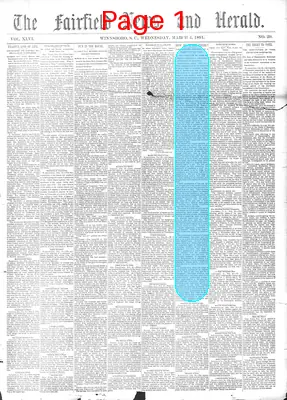
Story
March 4, 1891
The Fairfield News And Herald
Winnsboro, Fairfield County, South Carolina
What is this article about?
In Crittenden, Arizona, on Feb. 25, workers digging for a hotel foundation discovered a king's tomb with a clay effigy, gold crown featuring battle scenes, girdle, obsidian axe, and god image, hinting at a pre-Aztec civilization superior in craftsmanship.
Clipping

OCR Quality
95%
Excellent
Full Text
HOW DID IT GET THERE?
THE REPORTED DISCOVERY OF A KING'S TOMB OUT WEST.
What People Did He Belong to and When Did They Live—A Very Important Discovery if it Proves True.
CRITTENDEN, ARIZ., Feb. 25.—While removing earth for the foundation of the new hotel to be erected by Harmon & Brooks there was discovered what seems to be the tomb of a king, though of what people it would doubtless puzzle an antiquarian to say. The workmen had penetrated at some eight feet below the surface of the ground what they took to be stone of a soft, friable nature, which was evidently masonry of a very superior workmanship when they reached the tomb itself.
This was composed of large square blocks of stone, which was identified as red or rose granite, and cemented together with such skill as to at first cause the whole, measure 12 by 15 feet, to appear as a solid mass. The opening of this, while very difficult, as the use of powder was prohibited by Mr. Henrikson, who, as a learned archaeologist, was placed in charge of the exhumation by the authorities, was accomplished by night, when the interest and curiosity of the party was so great that the work was continued by lamplight till dawn.
The tomb, when opened, was found to contain a gigantic image of a man lying at full length and made of clay mixed with a sort of preparation which gives a bright blue color and a slight elasticity, the whole appearing to have been subjected to great heat. The image represents the naked figure, except for a very tight girdle about the waist, a pair of close-fitting sandals and a crown on the head shaped very much like a bishop's mitre, but topped with the head of a hawk or eagle.
The features are roughly moulded, of an imperious cast, and of a man in middle age, with a prominent nose and a very wide mouth, but with cheek bones so low as to preclude all idea that the original could have been an Indian. The hands, which are as small as a woman's, and bear on the backs the head of the bird, as on the crown, are crossed on the breast and hold an image about three inches long of a squatting figure, probably that of a god. The feet are also crossed, the right presenting the peculiarity of possessing a sixth toe, which the sandal is cut to bring into prominence, as if the owner had prided himself on it. The hair of the image is dressed in thick curls on both sides of the head, reaching to the shoulders, and brought down to the brows over the forehead.
Careful examination of this clay figure revealed that it was merely the elaborate coffin of the real body and could be opened from the back. This was done with care so as not to disturb the remains within, but a few handfuls of dust, dark brown and almost impalpable powder, is all that was left of the body. The crown, however, together with the girdle, the image of the god, and a large battle axe with a blade of sharp glass or obsidian, and a handle of petrified wood were found in the coffin.
The crown is of thick red gold, carved with minute but well executed drawings, representing battle scenes, triumphal marches and other pictures, the meaning of which is somewhat misty, but in all the principal figure is that of a man with six toes on his right foot. The workmanship of the whole crown is very fine, and the bird's head on top is a masterpiece worthy of Cellini. It holds in its mouth magnificent Chalchihuites or green diamonds, valued by the Aztecs, which shows some attempt at lapidification.
The girdle found is composed of plates of gold arranged like scales and very thin, so as to give with every movement of the wearer's body. On each of these plates, which is in shape a half eclipse, is engraved a figure or hieroglyphics, conveying, however, no hint of their meaning in their form. The image of what is presumably a god is made of clay combined with the preparation spoken of before, and also burnt till thoroughly hardened. It represents a male being seated on a pedestal in a squatting posture, its eyes squinting and grinning in hideous mirth, while both hands are over the ears as if to shut out sound.
A peculiar thing about this image is that its hair is represented as hanging down its back in one long plat like a Chinaman's. The figure is hollow, but contained only a half dozen small black pebbles slightly polished and a somewhat larger stone of a dull gray hue.
The coffin and these relics are now on exhibition at the court house and are to be donated to the State museum of history and archaeology at Tucson. No clue of any value as to what race the remains are to be ascribed can be found, but it is probable that it was one antedating the Aztec and even the mound builders, and superior to both in the knowledge of masonry, sculpture and the working of metal.
THE REPORTED DISCOVERY OF A KING'S TOMB OUT WEST.
What People Did He Belong to and When Did They Live—A Very Important Discovery if it Proves True.
CRITTENDEN, ARIZ., Feb. 25.—While removing earth for the foundation of the new hotel to be erected by Harmon & Brooks there was discovered what seems to be the tomb of a king, though of what people it would doubtless puzzle an antiquarian to say. The workmen had penetrated at some eight feet below the surface of the ground what they took to be stone of a soft, friable nature, which was evidently masonry of a very superior workmanship when they reached the tomb itself.
This was composed of large square blocks of stone, which was identified as red or rose granite, and cemented together with such skill as to at first cause the whole, measure 12 by 15 feet, to appear as a solid mass. The opening of this, while very difficult, as the use of powder was prohibited by Mr. Henrikson, who, as a learned archaeologist, was placed in charge of the exhumation by the authorities, was accomplished by night, when the interest and curiosity of the party was so great that the work was continued by lamplight till dawn.
The tomb, when opened, was found to contain a gigantic image of a man lying at full length and made of clay mixed with a sort of preparation which gives a bright blue color and a slight elasticity, the whole appearing to have been subjected to great heat. The image represents the naked figure, except for a very tight girdle about the waist, a pair of close-fitting sandals and a crown on the head shaped very much like a bishop's mitre, but topped with the head of a hawk or eagle.
The features are roughly moulded, of an imperious cast, and of a man in middle age, with a prominent nose and a very wide mouth, but with cheek bones so low as to preclude all idea that the original could have been an Indian. The hands, which are as small as a woman's, and bear on the backs the head of the bird, as on the crown, are crossed on the breast and hold an image about three inches long of a squatting figure, probably that of a god. The feet are also crossed, the right presenting the peculiarity of possessing a sixth toe, which the sandal is cut to bring into prominence, as if the owner had prided himself on it. The hair of the image is dressed in thick curls on both sides of the head, reaching to the shoulders, and brought down to the brows over the forehead.
Careful examination of this clay figure revealed that it was merely the elaborate coffin of the real body and could be opened from the back. This was done with care so as not to disturb the remains within, but a few handfuls of dust, dark brown and almost impalpable powder, is all that was left of the body. The crown, however, together with the girdle, the image of the god, and a large battle axe with a blade of sharp glass or obsidian, and a handle of petrified wood were found in the coffin.
The crown is of thick red gold, carved with minute but well executed drawings, representing battle scenes, triumphal marches and other pictures, the meaning of which is somewhat misty, but in all the principal figure is that of a man with six toes on his right foot. The workmanship of the whole crown is very fine, and the bird's head on top is a masterpiece worthy of Cellini. It holds in its mouth magnificent Chalchihuites or green diamonds, valued by the Aztecs, which shows some attempt at lapidification.
The girdle found is composed of plates of gold arranged like scales and very thin, so as to give with every movement of the wearer's body. On each of these plates, which is in shape a half eclipse, is engraved a figure or hieroglyphics, conveying, however, no hint of their meaning in their form. The image of what is presumably a god is made of clay combined with the preparation spoken of before, and also burnt till thoroughly hardened. It represents a male being seated on a pedestal in a squatting posture, its eyes squinting and grinning in hideous mirth, while both hands are over the ears as if to shut out sound.
A peculiar thing about this image is that its hair is represented as hanging down its back in one long plat like a Chinaman's. The figure is hollow, but contained only a half dozen small black pebbles slightly polished and a somewhat larger stone of a dull gray hue.
The coffin and these relics are now on exhibition at the court house and are to be donated to the State museum of history and archaeology at Tucson. No clue of any value as to what race the remains are to be ascribed can be found, but it is probable that it was one antedating the Aztec and even the mound builders, and superior to both in the knowledge of masonry, sculpture and the working of metal.
What sub-type of article is it?
Extraordinary Event
Curiosity
Historical Event
What themes does it cover?
Exploration
Misfortune
Moral Virtue
What keywords are associated?
Tomb Discovery
Ancient King
Clay Effigy
Gold Artifacts
Six Toes
Archaeological Find
What entities or persons were involved?
The King
Mr. Henrikson
Where did it happen?
Crittenden, Ariz.
Story Details
Key Persons
The King
Mr. Henrikson
Location
Crittenden, Ariz.
Event Date
Feb. 25
Story Details
Workers unearthed a tomb containing a clay image of a six-toed king with artifacts including a gold crown, girdle, battle axe, and god image, suggesting an ancient civilization predating the Aztecs.