Thank you for visiting SNEWPapers!
Sign up free
The Columbia Banner
Magnolia, Columbia County, Arkansas
What is this article about?
Agricultural article from Prairie Farmer answering Dr. F.'s questions on thoroughbred and standard-bred horses, detailing their origins, key sires like Darley and Godolphin Arabians, and listing various established horse breeds worldwide.
Clipping
OCR Quality
Full Text
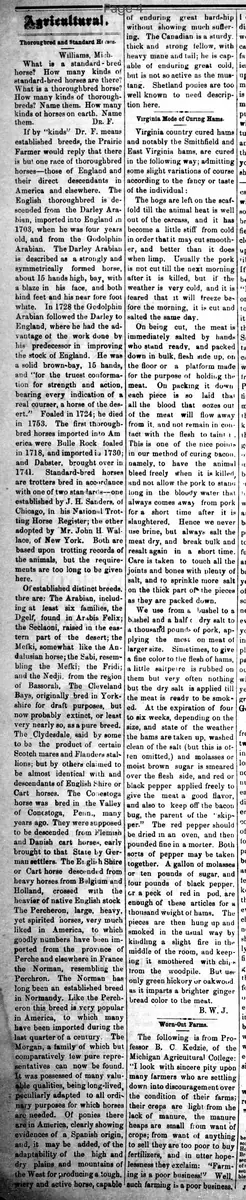
Thoroughbred and Standard Horse Co.
Williams, Mich.
What is a standard-bred horse? How many kinds of standard-bred horses are there? What is a thoroughbred horse? How many kinds of thoroughbreds? Name them. How many kinds of horses on earth. Name them.
Dr. F.
If by "kinds" Dr. F. means established breeds, the Prairie Farmer would reply that there is but one race of thoroughbred horses—those of England and their direct descendants in America and elsewhere. The English thoroughbred is descended from the Darley Arabian, imported into England in 1703, when he was four years old, and from the Godolphin Arabian. The Darley Arabian is described as a strongly and symmetrically formed horse, about 15 hands high, bay, with a blaze in his face, and both hind feet and his near fore foot white. In 1728 the Godolphin Arabian followed the Darley to England, where he had the advantage of the work done by his predecessor in improving the stock of England. He was a solid brown-bay, 15 hands, and "for the truest conformation for strength and action, bearing every indication of a real courser, a horse of the desert." Foaled in 1724; he died in 1753. The first thoroughbred horses imported into America were Bulle Rock foaled in 1718, and imported in 1730 and Dabster, brought over in 1741. Standard-bred horses are trotters bred in accordance with one of two standards—one established by J. H. Sanders, of Chicago, in his National Trotting Horse Register; the other adopted by Mr. John H. Wallace, of New York. Both are based upon trotting records of the animals, but the requirements are too long to be given here.
Of established distinct breeds, there are: The Arabian, including at least six families, the Dgelf, found in Arabia Felix; the Seclaoni, raised in the eastern part of the desert; the Mefki, somewhat like the Andalusian horse; the Sabi, resembling the Mefki; the Fridi; and the Nedji, from the region of Bassorah. The Cleveland Bays, originally bred in Yorkshire for draft purposes, but now probably extinct, or least very nearly so, as a pure breed. The Clydesdale, said by some to be the product of certain Scotch mares and Flanders stallions; but by others claimed to be almost identical with and descendants of English Shire or Cart horses. The Conestoga horse was bred in the Valley of Conestoga, Penn., many years ago. They were supposed to be descended from Flemish and Danish cart horses, early brought to that State by German settlers. The English Shire or Cart horse descended from heavy horses from Belgium and Holland, crossed with the heavier of native English stock. The Percheron, large, heavy, yet spirited horses, very much liked in America, to which goodly numbers have been imported from the province of Perche and elsewhere in France the Norman, resembling the Percheron. The Norman has long been an established breed in Normandy. Like the Percheron this breed is very popular in America, to which many have been imported during the last quarter of a century. The Morgan, a family of which but comparatively few pure representatives can now be found. It was possessed of many valuable qualities, being long-lived peculiarly adapted to all ordinary purposes for which horses are needed. Of ponies there are in America, clearly showing evidences of a Spanish origin, and, it may be added, of the adaptability of the high and dry plains and mountains of the West for producing a tough, very and active horse, capable
What sub-type of article is it?
What themes does it cover?
What keywords are associated?
What entities or persons were involved?
Where did it happen?
Story Details
Key Persons
Location
Williams, Mich.; England; America; Arabia; Yorkshire; Scotland; Pennsylvania; France; Normandy
Event Date
1703; 1728; 1724 1753; 1718; 1730; 1741
Story Details
Response to Dr. F.'s query defines thoroughbred as one race from English sires Darley and Godolphin Arabians, with first imports to America in 1730 and 1741; standard-bred as trotters per Sanders or Wallace standards; lists breeds including Arabian families, Cleveland Bays, Clydesdale, Conestoga, Shire, Percheron, Norman, Morgan, and American ponies of Spanish origin.