Thank you for visiting SNEWPapers!
Sign up free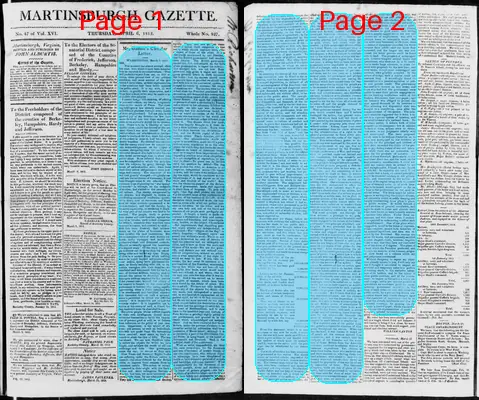
Martinsburgh Gazette
Martinsburg, Berkeley County, West Virginia
What is this article about?
William Gaston's March 1, 1815, circular letter to constituents reviews the War of 1812's end, critiques the administration for unnecessary prolongation, failure to secure free trade and seamen's rights, massive debts and taxes, opposition to conscription, while praising American military achievements and character.
Merged-components note: Merged as this is the continuation of Mr. Gaston's Circular Letter across pages 1 and 2, forming a single coherent editorial piece.
Clippings
1 of 2
OCR Quality
Full Text
WASHINGTON, March 1, 1815.
SIR,
The moment has almost arrived, when the trust, with which I have been honored, is to be restored to my constituents. They will probably expect from me, on this occasion, some general view of our political condition, and some account of the part which I have taken, as their representative, in the questions that have lately agitated the public mind. It is my wish, as well as duty, to gratify their expectation, and I hope that a short letter may be made to accomplish this purpose.
I cannot forego this occasion, of offering to you and to them, my hearty congratulations on the return of Peace. The cheering intelligence has already reached you, and diffused gladness through every family of your neighborhood. Let me join in the general joy of my friends—for few have more detested this war than myself, and none more anxiously sighed for its termination. Peace is to us, a blessing of inestimable value—and it has arrived at the moment when it was most needed. The object for which our administration had professed to continue the war, since the repeal of the orders in council, had become evidently hopeless. No rational man believed that the enemy could now be coerced into any acknowledgment on the subject of seamen, derogating from his uniform and universal demand of a right to take his own men found on the high seas, in other than public ships. None believed that he could now be compelled to admit the principle, that his subjects, by going through the forms of naturalization here, were freed from their native obligations to their sovereign and country. The character of the war had greatly changed.—Originally carried into the territories of the enemy, it had been brought home to our own soil. The visionary hope of planting the "star spangled banner" in triumph, on the ramparts of Quebec, had yielded to the necessity of self defence. The enemy, exasperated by our attacks, and disposed to return an overflowing measure of retaliation—powerful in arms, rich in resources, and freed from all other contests—prosecuted a ferocious warfare, and had the faculty, by his naval superiority, of rendering it doubtful what part of our country was next to be assailed. The people, ready to protect their homes and their families, against the fury of an invader, were indeed competent for defence, whenever their exertions were required in season, and directed by skill.—Had this been doubted, their achievements, on the plains of Louisiana, must have satisfied the most incredulous. But the undisciplined valor of men hastily collected, badly equipped, and under the guidance of weak and distracted councils, afforded no security against the incursions of a regular army. Of this truth no stronger evidence can be given than the smouldering ruins now before my eyes. Engaged thus in a contest, from which nothing was to be hoped beyond self-preservation—our militia dying with pestilential diseases, or barely escaping with life, to introduce contagion into their families—an unsatisfied and dishonored debt for the last year, of thirteen millions, hanging over us without the means to discharge it—millions upon millions required for the service of the present year, beyond the ability of the country to furnish, or the credit of the government to borrow—the spring rapidly approaching, when a fourth campaign was to be commenced, and hostilities renewed with increased fury—at such a moment, peace is permitted to revisit our afflicted country! It is impossible not to hail the welcome visitor! It is impossible not to rejoice at the return of such a friend, too long banished from its cherished home!
But a free people, whose welfare depends on their own intelligence, should never surrender themselves so far to the impression of present good or evil, as to forbear from reflection on the policy of past measures. Experience, is the school of wisdom; and nations, as well as individuals, who will not profit from the instructions there received, must make up their accounts to abide the fate of folly. The war has closed. We can now, therefore, calmly review the objects for which we have fought, and estimate the result of all our sufferings and toils. Our government made the war, to secure as they said, … Free Trade and Seamen's Rights”—the one suffering under the British orders in council—the other violated by the British claim to impress their seamen from our merchant vessels. The orders in Council, connected in their origin with the Berlin, Milan and other outrageous Decrees of France, had been yet more intimately connected with them, by our administration.—They had declared the orders and decrees, equally illegal, and had pledged themselves to wreak their vengeance on that nation which should continue hers, after a repeal of those of the other. It was afterwards proclaimed by our President, that the French government had revoked their decrees. The British government denied this fact, and refused, on the faith of the proclamation, to repeal the orders.—The alleged fact, was not true. Bonaparte had only given a vague and ambiguous promise, which in truth amounted but to this: that his decrees should cease to operate upon us provided we should take part with him in his continental system, or compel his enemy to renounce the usages of maritime war. The decrees were not revoked when the President proclaimed their revocation, and demanded as a consequence, a corresponding repeal of the orders, from Great Britain. Yet upon the supposition or pretence of such a revocation by France, and a refusal by her adversary to follow the example, the late war was declared—Scarcely had this declaration issued, before an actual revocation of the French decrees was announced to the world, and a repeal of the British orders followed close upon it. The dispute about free trade, was thus happily brought to a close, before a blow had been struck. There were but five days between our declaration of war, and the British repeal of the obnoxious orders. Peace, however, did not ensue. Our administration would not agree to an armistice, much less to a peace, without some stipulation as to the other object for which they had drawn the sword. "Seamen on board of American vessels, must be exempted from impressment. The degrading practice must cease altogether—It is not susceptible of regulations to prevent its abuse—No peace can be durable until the question be settled—The flag must protect the crew, or America is no longer an independent nation—To appeal to arms, and lay them down without securing this right, would be considered as a relinquishment of it, and expose us to the scorn and derision of the world." Such was the unvarying purport of the declarations of government, made and repeated in every form of language. To gain this right, "the flag shall protect the crew," was the avowed cause of the continuance of the war, of the invasion of Canada, of the desolation which have laid waste the frontiers on either side, of all our gallant contests on the ocean, on the lakes, and on our own holy soil, and of the blood and treasure of our people most prodigally expended. At length, a treaty is made—It contains a declaration of firm and universal peace and friendship, and some regulations, besides, on the subject of boundaries—But impressment, that degrading practice which attacks our independence, is overlooked—The "religion of the flag" is utterly forgotten—"Seamen's rights" are passed over without a word—There is not even a declaration by way of reserve, to repel the inference that we relinquish our claim, and to save us from the scorn and derision of the world—We are the plaintiffs, and dismiss our suit without cost, without compensation, without an admission or even reservation of the right for which we went to law. If this view be correct, the war owed its existence to a proclamation of the President, announcing that as fact which was not fact.—It was waged for free trade, which would have been ours without it, and which, (but for the war) was ours five days after it was declared. And it was carried on to secure the rights of seamen, which have been since waived by the treaty of peace. But this is not all. We have not only failed to obtain any of the objects for which war was made, and relinquished a material, and, as was heretofore represented, all important right, for which we had contended, but we are not even restored to the state which existed before the declaration of war. We have lost the privilege to catch fish on the coast of Newfoundland, and to cure them in the unsettled bays and harbors of Nova Scotia—a privilege highly prized by our predecessors, and granted us in the treaty which acknowledged our independence. And we have consented that Great Britain, under the pretence of a claim to be hereafter settled by arbitration, shall keep possession of Moose-Island; although it is as decidedly a part of the Old thirteen United States, as Long-Island, or the Island of Portsmouth and Ocracoke. Such is the political result of the controversy.
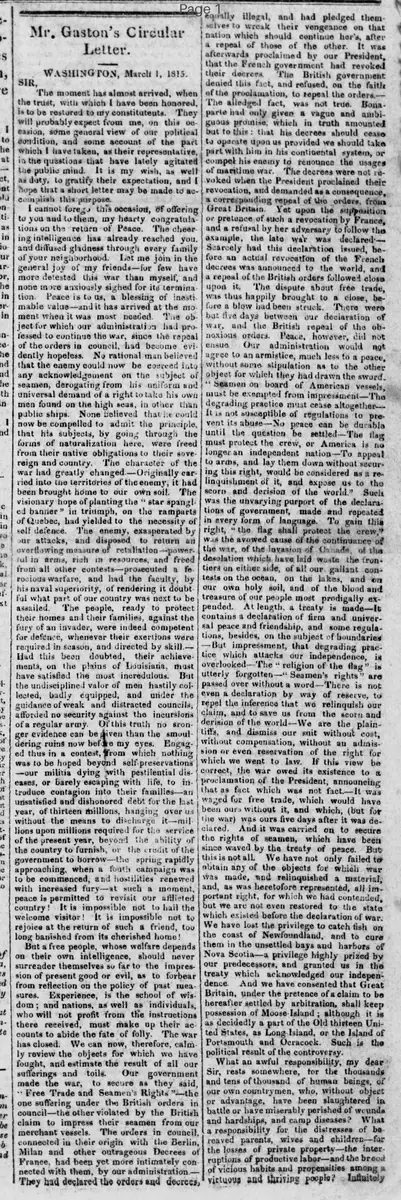
What an awful responsibility, my dear Sir, rests somewhere, for the thousands and tens of thousands of human beings, of our own countrymen, who, without object or advantage, have been slaughtered in battle or have miserably perished of wounds and hardships, and camp diseases? What a responsibility for the distresses of bereaved parents, wives and children—for the losses of private property—the interruptions of productive labor—and the brood of vicious habits and propensities among a virtuous and thriving people? Infinitely Defective is that estimate which counts the cost of war by the expenditure of public money—for one cent of national wealth thus expended, dollars and hundreds of dollars are lost in the stagnation of commerce, and the mechanic arts; in the waste and decay of individual property: in the want of a sale for the products of agriculture; in the heavy personal services demanded by the government; or in the enhanced price of the necessaries and conveniences of life—
But even these, weighty as they are, bear no comparison with the sacrifice of individual happiness, the wreck of domestic joys, and the destruction of pure morals. "To value these, no scale of political economy has yet been graduated. Too often therefore, do they escape the notice of the short sighted politicians, to whom an unsuspicious people sometimes entrust their concerns."
In reviewing the history of this contest, some consolation may be found in the reflection, that the American character finally escaped degradation. In defiance of all the mismanagement of the American cabinet; and that a gross and dangerous error is now dissipated, which party prejudice had endeavored, not without effect, to impress on the public mind. The vain glorious boastings and wretched failures of our Counsellors and Generals, at the beginning of the war, and in the two first campaigns—the shameful flight of the principal officers of our government, from the capital of the nation, and the abandonment of its splendid monuments and edifices to the torch of the invader—these required some indications of conduct and valor, to prove that Americans had not degenerated from their fathers. Happily the testimony has been exhibited. The ocean has been "our field of fame." and the lakes have more than once resounded to the shouts of our triumph. In no instance have we had reason to blush for our seamen
Where victory was possible, they have achieved it—where impossible, they have deserved it. The navy, formerly the object of party jealousy, is now the subject of universal favor. Even those politicians who formerly declared themselves reluctant to "hand one bucket of water to save it from the flames," are now ready to admit that it is the cheap defence of our rights and our honor. And on the land too, occasions were not wanting, nor permitted to pass without improvement, to shew that Detroit and Bladensburg are not the standards by which to test our military character. The sanguinary battles of Chippewa, Erie and Bridgewater—the repulse of a vastly superior force at Plattsburgh—and, to name no more—the late unparalleled victory at Orleans, a victory which ushered in the peace, which was obtained indeed after the treaty was ratified in England, but before it had arrived here—these have preserved to us the rank which our revolutionary struggle had obtained for us, and of which the presumption, cowardice or imbecility of a few, had almost deprived us.
Some time must yet elapse, before we ascertain with certainty the addition which the war has made to our public debt—
Claims are even now brought before Congress, which had their origin in the war of the revolution, and this which has just past, short as was its continuance, has given rise to many more than our revolutionary struggle. Several of these debts will be paid off as they are liquidated, and thus pass unobserved, in the general mass of expenditures—most of them, however, must be funded, and made an annual charge on the public resources.
The funded debt of the nation on the 1st January preceding the war, was
$45,154,189
Of this, there has been paid in 1812, '13 '14,
5,244,006
Leaving on the 1st January, 1815. of the old debt,
$39,905,183
During the war, loans have been made, and funded stock created, or is about to be created,
47,803,229
The United States also owe on account of certain temporary loans and issues of treasury notes,
19,002,800
Many urgent claims on account of military services and supplies, the paying of the disbanded troops, and various other military expenses, will probably be met by the new treasury notes, or the loan authorised by a late law, say
17,000,000
$123,711,212
From this statement, which is as near exactness as can now be made, it results that the war will have made an addition of about eighty millions to our funded debt, the interest of which must be annually paid by taxes on the nation until the principal can be reimbursed by our descendants.
The work of taxation has been extensively prosecuted at this session. The double duties on imported articles, imposed at the commencement of the war, remain unaltered. The internal taxes laid at the last session, have been continued and increased, and many new ones created. Besides these double duties, and the duty of 20 cents per bushel on imported salt, a direct tax on lands and slaves, of six millions a year; a tax of 20 cents per gallon on all spirits distilled within the United States, besides the tax imposed on the still itself; a tax on porter, ale and strong beer; on leather, iron, nails and brads; paper; candles; hats, caps and bonnets, of leather, wool or fur, and chip hats of certain descriptions; boots and bootees, saddles and bridles; household furniture, watches, manufactured tobacco and snuff, umbrellas and parasols, playing and visiting cards, and on gold, silver, and plated ware and jewelry; a duty on all sugar refined within the United States; an additional duty of fifty per cent on the postage of letters and newspapers; a duty on licences to retailers; and on the sale at auction of ships and merchandise, fifty per cent. higher than that of last year; a stamp duty on bank notes and promissory notes negotiable at bank and bills of exchange, and a heavy tax on all carriages for the conveyance of persons—
and these, not for one year, or a limited term of years, but permanent and pledged to the public creditors—are among the scourges which have ensued from the war, and the mementos by which the people are to be reminded of its authors and conductors. A prosperous commerce, a peaceful state, and a rigid economy, may enable us, ere long, to remove or to alleviate some of these burthens—but neither you nor I, can expect to see the day when all of them can be taken off, and the people restored to the "state before the war."
Many questions occurred during the session, which created here, and I believe throughout the nation, the greatest solicitude; but which have now lost much of their interest by the blessed return of peace. I cannot with propriety pass them over without notice. Among those none stood more prominent than the claim advanced by the administration, of a right in the general government to force every man, they pleased, into the ranks of the regular army. This extraordinary power, as despotic as any ever exercised by the most arbitrary government in any age, was not only broadly asserted by the President, through his Secretary of War, and attempted to be justified under our limited and free constitution, but was earnestly and perseveringly sought to be enforced by various projects brought before Congress.—
Some of the projects proposed a distribution of the freemen able to bear arms, into classes; and the compelling of each class, either by draft or fines, to furnish soldiers for the regular army, who should be "delivered over" to the nearest recruiting officer. One scheme more cunning than the rest, endeavored to effect the same object, in an indirect way—It provided for a classification of the militia, and a draft from each class of a certain number nominally as militia men, but in fact, to perform services of the most burthensome kind and which militia cannot under the constitution be called on to render—from these services they were to be excused, on condition of finding soldiers for the army.
The same principle ran through all these schemes; a principle in my judgment equally unfounded and detestable, and utterly repugnant to the nature of the federal government—the principle of military conscription. It was pretended that as the constitution gave to Congress an authority "to raise and support armies," this grant carried with it as a necessary and proper incident, the power to force any man they pleased to become himself a soldier—to serve for any length of time—for any purpose—in any region of the globe—by sea, or by land! After demonstrating the absurdity of this forced construction of a plain grant of power, it was asked how is it to be reconciled with the security which the constitution has provided against unreasonable calls for the services of the militia? They cannot be ordered out but on certain specified emergencies, and to do limited duties, and to be commanded by their own officers. How is this restriction consistent with an unlimited authority over every one of them. The answer was gravely given, that the conscripts were to be called out as individuals, and not in their capacity as militia men! It was impossible for such sophistry to effect its purpose—from it nothing was to be dreaded "But I thank God that neither executive influence, nor the violence of party spirit, nor the desperation of the times, was able to fasten a conscription upon us! With a power of conscription in the general government, there is no sovereignty for the States; with such a power carried into full execution, there is no freedom for the citizen—He becomes the slave of military despotism—he has no country to merit defence or attachment.
The wretched state of the public finances, greatly occupied the attention of Congress, throughout the session. When war was declared, it was known it would cut off nearly all the revenue derived from commerce; and it was certain that the conquest of the Canadas, and the expulsion of Great Britain from the American continent, could not be effected without an immense expenditure. Yet, obvious as were these truths, those who made the war, and were resolved on effecting these brilliant schemes, were afraid to raise the necessary ways and means—they dared not hazard the popularity of the war by a timely imposition of taxes. The thirteenth Congress, while yet full of plans of conquest, had indeed proceeded to lay taxes—but these were far short of what was requisite for the accomplishment of their object, and were no security on which to borrow, for they were limited in their duration—the direct tax to one year only, and the other tax to one year after the war.—
The calculation nevertheless, was, that all the war expenditures might be defrayed by loans; and to doubt it, was to want patriotism. At first, the government, coming into market in good credit, and finding there a surplus capital which the war had thrown out of employment, was able to procure loans on reasonable terms. But the more they borrowed, while there were no means of repayment provided, the worse became their credit—and the more they borrowed, and the longer the war continued, the fewer persons could be found able to lend. The prospect of extravagant gain, however tempted several banks and speculators, who were not in a fit condition to make large advances, to come forward with proposals for the new loan; and their terms, though most extravagant and usurious, were greedily accepted. In the nature of things, such a course could not continue long. It accordingly found its termination in a general explosion of public and private credit. The government was unable to borrow on any terms, and those who had lent the government were unable to meet their private engagements.
All the banking institutions south of the Hudson, dishonored their own paper; and the treasury was obliged to protest the most sacred demands of its creditors.—
This alarming and disgraceful state was brought to a completion, soon after the commencement of the session. The principal remedies suggested for it were, a resort to a vigorous system of taxation, and the establishment of a national bank. To a certain extent, I believe both of these propositions advantageous; but in relation to each of them, notions seem to obtain, that were in my judgement utterly wild and extravagant. The taxes proposed, which were to be without limitation as to time, and mortgaged to the creditors as security for the principal and interest of their debt, exceeded the ability of the people to pay during a state of war and blockade while there was no commerce, nor price for the products of industry. To most of them therefore, particularly to the exorbitant direct tax, and the taxes on the most necessary manufactures, I could not yield my assent—such as seemed to me least exceptionable, I found myself bound to vote for. In regard to the bank, I had no doubt that a bank, on correct principles, might be rendered salutary to the government, and convenient to the nation. A portion of its capital being made to consist either of treasury notes, or of stock hereafter to be issued, would operate so far as a loan to the government on the most beneficial terms. The bank might be advantageous in anticipating the receipts of taxes, and eminently useful in safely keeping and cheaply transmitting, from place to place, the public monies. It would furnish a sound medium of general circulation, and might be made to foster and cherish such of the state banks, as were honestly anxious to retrieve their affairs. Under these impressions, and with these views, I zealously co-operated in endeavoring to effect such an establishment. One of the plans which I supported, failed in the house of representatives—another, passed both branches of the national legislature, and then was rejected by the President. His reasons are before the world, and are assuredly entitled to great respect—truth, however, requires of me to say, that they have not convinced me of the error of Congress. The plans of a bank which the President preferred, and through his minister of the treasury proposed, were based on a scheme which my best judgement condemned.
Without designing to repeat my objections already known to you, I will only say that I thought it calculated to impart an artificial and temporary value to a portion of existing stock, to the exclusive advantage of its holders, and to the injury of other public creditors, and of the government—to impose on the nation a heavy annual charge, and to put into the pockets of speculators an exorbitant profit for manufacturing government securities, in the form of bank notes—to sink still lower the public credit, by a partnership with a corporation whose very charter stamped upon it the character of insolvency—and to increase the already intolerable evil of a depreciated currency, by pouring on the country a flood of paper, which was neither money nor the representative of money.—
Congress refused to sanction any of the plans founded on this scheme.
My letter has been unavoidably protracted to a length which I did not foresee—I will hasten to bring it to a close, by assuring you that I am, with much regard, your friend and obedient servant,
WILLIAM GASTON.
What sub-type of article is it?
What keywords are associated?
What entities or persons were involved?
Editorial Details
Primary Topic
Critique Of The War Of 1812 And Its Consequences
Stance / Tone
Critical Of Administration's War Policies, Celebratory Of Peace And American Valor
Key Figures
Key Arguments