Thank you for visiting SNEWPapers!
Sign up free
Daily National Intelligencer
Washington, District Of Columbia
What is this article about?
In a House of Commons speech on Feb. 20, 1815, Mr. Whitbread criticizes Lord Castlereagh's handling of the Congress of Vienna, questioning secret treaties, territorial partitions (Poland, Saxony, Genoa, Italy), Austrian actions in Italy, the fate of Murat in Naples, the slave trade, and the recent escape of Napoleon from Elba, urging transparency on diplomatic proceedings.
Clipping
OCR Quality
Full Text
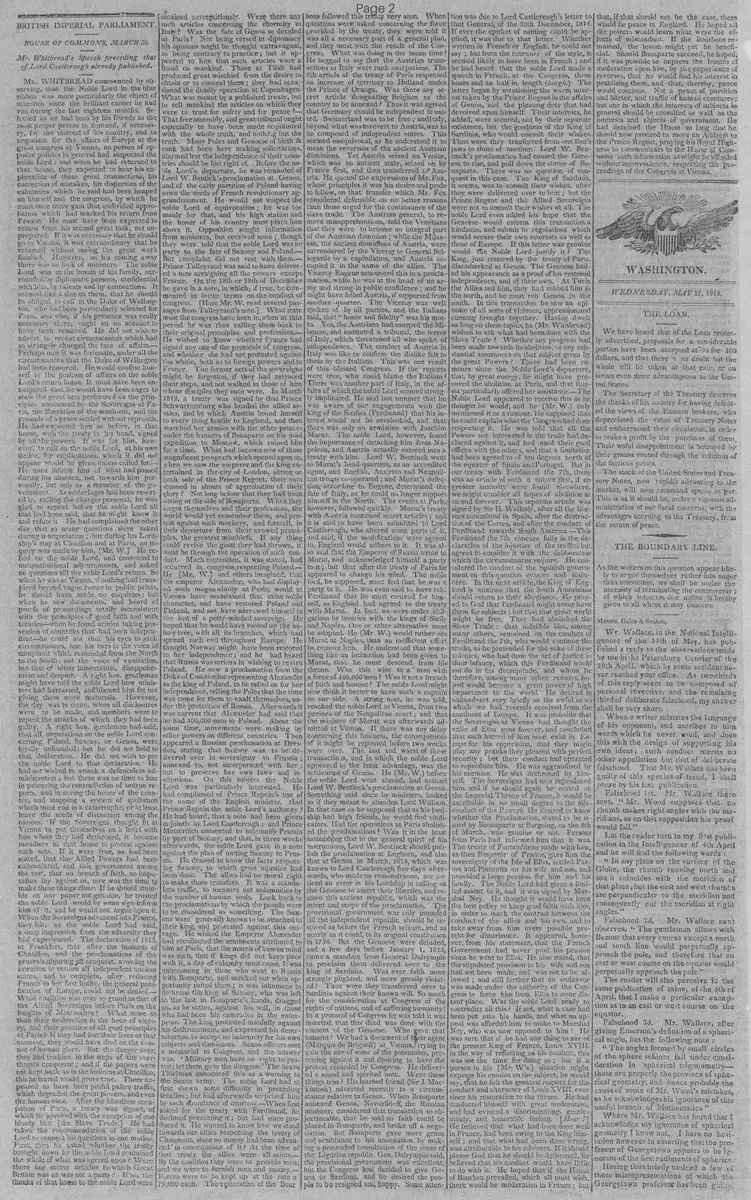
HOUSE OF COMMONS, Feb. 20.
Mr. Whitbread's Speech preceding that of Lord Castlereagh already published.
Mr. WHITBREAD commenced by observing, that the Noble Lord in the blue ribbon was more particularly the object of attention since the brilliant career he had run during the last eighteen months. Selected as he had been by his friends as the most proper person to contend, if necessary, for the interest of his country, and to negotiate for the affairs of Europe at the great congress at Vienna, no person of opposite politics in general had suspected the noble Lord: and when he had returned to that house, they expected to hear his explanation of those great transactions, his correction of mistakes, his dispersion of the calumnies which he said had been heaped on himself and the congress, by which he must once more gain that undivided approbation which had marked his return from France. He must have been expected to return from his second great task, not unprepared. If it was necessary that he should go to Vienna, it was extraordinary that he returned without seeing the great work finished. However, on his coming away there was no lack of ministers. The noble Lord was in the bosom of his family, surrounded by diplomatic persons, confidential with him, by talents and by connections. It seemed like a slur on them, that he should be obliged to call in the Duke of Wellington, who had been particularly selected for Paris, and who, if his presence was really necessary there, ought on no account to have been removed. He did not wish to advert to recent circumstances which had so strangely changed the face of affairs. Perhaps now it was fortunate, under all the circumstances that the Duke of Wellington had been removed. He would confine himself to the position of affairs on the noble Lord's return home. It must have been anticipated that he would have been eager to state the great acts performed on the principles announced by the Sovereigns at Paris, the liberation of the continent, and the grounds of a peace settled without reproach. He had expected him as before, in that house, with the treaty in his hand, signed by all the powers. It was for him, however, to call on the noble Lord, at his own desire, for explanations, which it did not appear would be given unless called for. He must inform him of what had passed during his absence, not towards him personally, but only as a member of the government. As subterfuges had been resorted to, calling the charges personal, he was glad to repeat before the noble Lord all that had been said, that he might know it and refute it. He had complained the other day that so many questions were asked during a negociation; but during his Lordship's stay at Chatillon and at Paris, no inquiry was made by him. [Mr. W.] He relied on the noble Lord, and consented to unconstitutional adjournments, and asked no questions till the noble Lord's return. So when he was at Vienna, if nothing had transpired beyond vague rumor in public prints, he should have made no enquiries: but when he saw documents, and heard of proofs of proceedings totally inconsistent with the principles of good faith and with treaties—when he found armies taking possession of countries that had been independent—he could not shut his eyes to such circumstances, nor his ears to the voice of complaint which resounded from the North to the South: not the voice of exultation, but that of bitter lamentation, disappointment and despair. A right hon. gentleman might have told the noble Lord how ministers had harrassed, and blamed him for not giving them more materials. However, the day was to come, when all disclosures were to be made, and members were to repent the attacks of which they had been guilty. A right hon. gentleman had said, that all imputations on the noble Lord concerning Poland, Saxony, or Genoa, were totally unfounded: but he did not hold to that declaration. He did not wish to pin the noble Lord to that declaration. He had not wished to attack a defenceless administration: but there was no time to lose in procuring the contradiction of untrue reports, and in saving the honor of the country, and stopping a system of spoliation which must end in a catastrophe, or at least leave the seeds of discontent among the nations. If the Sovereigns thought fit at Vienna to put themselves on a level with him whom they had dethroned, it became members in that house to protest against such acts. If it were true, as had been stated, that the Allied Powers had been calumniated, and this government among the rest, that no breach of faith, no imputation lay against us, now was the time to make these things clear. If he should stumble on any paper not genuine, he trusted the noble Lord would by some sign inform him of it, and he would not argue upon it. When the Sovereigns advanced into France, they felt, as the noble Lord had said, a deep impression from the adversity they had experienced. The declaration of 1813, at Frankfort, that after the business of Chatillon, and the proclamations of the generals, abjuring all conquest, avowing the intention to restore all independent ancient states, and to complete, after reducing France to her first limits, the general pacification of Europe, could not be denied. What coalition was ever so grand as that of the Allied Sovereigns before Paris on the heights of Montmartre? What more so than their moderation in the hour of victory, and their practice of all good principles at Paris? If they had lost their lives at that moment, they would have died on the summit of human glory. But the danger over, they had trodden in the steps of the overthrown conqueror; and if the papers were not kept back as in the business at Chatillon, this he feared would prove true. There appeared to have been pitiful paltry traffic, which degraded the great powers, and even the human race. After the bloodless occupation of Paris, a treaty was signed, of which he approved with the exception of one bloody blot [the Slave Trade.] He had taken the recommendation of the noble Lord to connect his questions in one motion. First, then he asked whether the treaty brought down by the noble Lord contained the whole of what was agreed upon? Were there any secret articles to which Great Britain was or was not a party? If so, the thanks of that house to the noble Lord were obtained surreptitiously. Were there any such articles concerning the enormity in Italy? Was the fate of Genoa so decided at Paris? Not being versed in diplomacy his opinions might be thought extravagant, as being contrary to practice; but it appeared to him that such articles were a fraud on mankind. Those at Tilsit had produced great mischief from the desire to obtain or to conceal them; they had occasioned the deadly operation at Copenhagen. What was meant by a published treaty, but to tell mankind the articles on which they were to trust for safety and for peace? That free assembly, and great tribunal ought especially to have been made acquainted with the whole truth, and nothing but the truth. Many Poles and Genoese of birth & rank had been here making solicitations, alarmed lest the independence of their countries should be lost right of. Before the noble Lord's departure, he was reminded of Lord W. Bentinck's proclamation at Genoa, and of the early partition of Poland having sown the seeds of French revolutionary aggrandizement. He would not suspect the noble Lord of equivocation; he was too manly for that, and his high station and the honor of his country must place him above it. Opposition sought information from ministers, but received none; though they were told that the noble Lord was no party to the fate of Saxony and Poland. But complaint did not rest with them. Prince Talleyrand was said to have delivered a note arraigning all the powers except France. On the 18th or 19th of December he gave in a note, in which, if true, he commented in bitter terms on the conduct of congress. [Here Mr. W. read several passages from Talleyrand's note.] What state must the congress have been in, when at that period he was thus calling them back to their original principles and professions. He wished to know whether France had signed any one of the protocols of congress, and whether she had not protested against the whole, both as to foreign powers and to France. The former acts of the sovereigns might be forgotten, if they had retraced their steps, and not walked in those of him whose disciples they once were. In March 1812, a treaty was signed by that Prince Schwarzenburg who headed the allied armies, and by which Austria bound herself to every thing hostile to England, and then marched her armies with the other princes under the banners of Bonaparte on his mad expedition to Moscow, which ruined him for a time. What had become now of those magnificent prospects which opened upon us, when we saw the emperor and the king entertained in the city of London, sitting on each side of the Prince Regent, their ears stunned in shouts of approbation of their glory? Not long before that they had been sitting at the side of Bonaparte. When they forgot themselves and their professions, the world would yet remember them, and protest against such mockery, and foretell, in their departure from their avowed principles, the greatest mischiefs. If any thing could revive the giant they had thrown, it must be through the operation of such conduct. Much contention, it was stated, had occurred in congress respecting Poland. He [Mr. W.] and others imagined, that the emperor Alexander, who had displayed such magnanimity at Paris, would at Vienna have maintained that same noble character, and have restored Poland and Finland, and not have narrowed himself to the lust of a petty-minded sovereign. He hoped that he would have rooted up the unholy tree, with all its branches, which had spread such evil throughout Europe. He thought Norway might have been restored to her independence; and he had heard that Russia was serious in wishing to revive Poland. He saw a proclamation from the Duke of Constantine representing Alexander as the king of Poland, to be relied on for her independence, telling the Poles that the time was come for them to exalt themselves, under the protection of Russia. Afterwards it was current that Alexander had said that he had 500,000 men in Poland. About the same time, movements were making by other powers on different countries. Then appeared a Russian proclamation at Dresden, stating that Saxony was to be delivered over in sovereignty to Prussia; annexed to, not incorporated with her; but to preserve her own laws and institutions. On this subject the Noble Lord was particularly interested. He had complained of Prince Repnin's use of the name of the English minister. Had Prince Repnin the noble Lord's authority? He had heard, that a note had been given in jointly by Lord Castlereagh; and Prince Metternich consented to indemnify Prussia by part of Saxony, and that, in three weeks afterwards, the noble Lord gave in a note against the plan of uniting Saxony to Prussia. He desired to know the facts respecting Saxony, to which gross injustice had been done. The allies had no moral right to make those transfers. It was a scandalous traffic, to measure out indemnities by the number of human souls. Look back to the proclamations by which the people were to be considered as something. The Saxons were generally known to be attached to their king, and protested against this outrage. He wished the Emperor Alexander had recollected the sentiments attributed to him at Paris, that the march of human mind was such, that if kings did not keep pace with it, a day of calamity must come. It was unbecoming in those who went to Russia with Bonaparte, and sneaked out when opportunity suited them; it was inhumane to dethrone the king of Saxony, who was left to the last in Bonaparte's hands, dragged on, as he states, against his will, in those who had been his comrades in the enterprise. The king protested manfully against his dethronement, and expressed his determination to accept no indemnity for his own subjects and dominions. Saxon officers sent a memorial to Congress, and the answer was, 'Military men have no right to protest; let them go to the dungeon.' The brave Thielman announced this as a warning to the Saxon army. The noble Lord had at first shewn some difficulty in preceding treaties; but had afterwards surprised him by such abundance of courtesy. When first asked for the treaty with Ferdinand, he declined presenting it; but had since produced it. He wanted to know how we stood towards our allies respecting the treaty of Chaumont, since no money had been advanced in consequence of it? At the time of that treaty the allies were all saints. By the coalition they were to provide men, and we were to furnish men and money. Forces were to be kept up at the rate of 75,000 each. The restoration of the Bourbons questions were asked concerning the force provided by the treaty, they were told it was all a necessary part of a general plan, and they must wait the result of the Congress. What was doing in the mean time? He begged to say that the Austrian transactions in Italy were rank usurpations. The 6th article of the treaty of Paris respected an increase of territory to Holland under the Prince of Orange. Was there any secret article designating Belgium as the country to be annexed? Thus it was agreed that Germany should be independent & united. Switzerland was to be free; and Italy, beyond what was to revert to Austria, was to be racing of independent states. This seemed unequivocal, as he understood it to mean the reversion of the ancient Austrian dominions. Yet Austria seized on Venice, which was an ancient state, seized on by France first, and then transferred to Austria. He quoted the expressions of Mr. Fox, whose principles it was his desire and pride to follow, on that transfer which Mr. Fox considered defensible on no better reasons than those urged for the continuance of the slave trade. The Austrian general, to remove misapprehensions, told the Venetians that they were to become an integral part of the Austrian dominion; while the Milanese, the ancient dominions of Austria, were surrendered by the Viceroy to General Bellegarde by a capitulation, and Austria occupied it in the name of the allies. The Viceroy Eugene announced this in a proclamation, while he was at the head of an army and strong in public confidence; and he might have foiled Austria, if supported from another quarter. The Viceroy was well spoken of by all parties, and the Italians said, that "honor and fidelity" was his motto. Yes, the Austrians had usurped the Milanese, and instituted a tribunal, the terror of Italy, which threatened all who spoke of independence. The conduct of Austria in Italy was like to confirm the dislike felt to them by the Italians. This was one result of this blessed Congress. If the reports were true, who could blame the Italians? There was another part of Italy, in the affairs of which the noble Lord seemed strongly implicated. He said last summer that he was aware of our engagements with the king of the Sicilies (Ferdinand) that his interest would not be overlooked, and that there was only an armistice with Joachim Murat. The noble Lord, however, found the importance of detaching him from Napoleon, and Austria actually entered into a treaty with him. Lord W. Bentinck went to Murat's head-quarters, as an accredited agent, and English, Austrian and Neapolitan troops co-operated; and Murat's defection, according to Eugene, determined the fate of Italy, as he could no longer support himself in the North. The events at Paris, however, followed quickly. Murat's treaty with Austria contained secret articles; and it is said to have been submitted to Lord Castlereagh, who altered some parts of it and said, if the modifications were agreed to, England would adhere to it. It was also said that the Emperor of Russia wrote to Murat, and acknowledged himself a party to it; but that after the treaty of Paris he appeared to change his mind. The noble lord, he supposed, must feel that he was a party to it. He was even said to have told Ferdinand that he must contend for himself, as England had agreed to the treaty with Murat. In fact, we were under obligations by treaties with the kings of Sicily and Naples. One or other alternative must be adopted. He (Mr. W.) would rather see Murat at Naples, than an inefficient effort to remove him. He understood that something like an intimation had been given to Murat, that he must descend from his throne. Was this wise to a man with a force of 100,000 men? Was it not a breach of faith and honour? The noble Lord might now think it better to have such a captain on our side. A strong note, he was told, reached the noble Lord at Vienna, from two persons of the Neapolitan court; and that the minister of Murat was afterwards admitted at Vienna. If there was any delay concerning this business, the consequences of it might be repented before two weeks were over. The last and worst of these transactions, and in which the noble Lord appeared to the least advantage, was the settlement of Genoa. He (Mr. W.) before the noble Lord went abroad, had noticed Lord W. Bentinck's proclamation at Genoa. Something said since by ministers, looked as if they meant to abandon Lord William. In that case as he supposed that as his lordship had high friends, he would find vindicators. Had the operations at Paris abolished the proclamations? Was it in the least astonishing that in the general spirit of his instructions, Lord W. Bentinck should publish the proclamation at Leghorn, and also that at Genoa in March, 1814, which was known to Lord Castlereagh five days afterwards, who made no remonstrance, nor noticed an error in his Lordship in calling on the Genoese to assert their liberties, and restore this ancient republic, which was the intent and scope of the proclamation. The provisional government was only intended till the independent republic should be restored as before the French seizure, and as nearly as it could, to its original constitution in 1756. But the Genoese were deluded, and a few days before January 1, 1815, came a mandate from General Dalrymple to proclaim them delivered over to the king of Sardinia. Was ever faith more strongly plighted, and more grossly violated? Thus were they transferred over to Sardinia against their known will. So much for the consideration at Congress of the rights of nations, and of suffering humanity! In a protocol of Congress he was told it was inserted, that this deed was done with the consent of the Genoese. Who gave that consent? We had a document of their agent (Marquis de Brignoli) at Vienna, trying to gain the ear of some of the potentates, protesting against it and desiring to have the protest recorded by Congress. He delivered a sound and spirited note. Were these things true? His learned friend (Sir J. Mackintosh) adverted recently to a circumstance relative to Genoa. When Bonaparte annexed Genoa, Novosiltsov, the Russian minister, considered that transaction so objectionable, that he said no faith could be placed in Bonaparte, and broke off a negotiation. But Bonaparte gave more grace and semblance to his annexation, by making a pretended consultation of the sense of the Ligurian republic. Gen. Dalrymple said, the provisional government was excellent, but the Congress had decided to give Genoa to Sardinia, and he desired the people to be resigned and happy. Some attention that General, of the 20th December, 1814. If ever the epithet of canting could be applied, it was due to that letter. Whether written in French or English, he could not say; but from the tournure of the style, it seemed likely to have been in French; and he had heard that the noble Lord made a speech in French, at the Congress, three hours and an half in length (laugh.) The letter began by mentioning the warm interest taken by the Prince Regent in the affairs of Genoa, and the pleasing duty that had devolved upon himself. Their interests, he added, were secured, not by their separate existence, but the goodness of the King of Sardinia, who would consult their wishes. Thus were they transferred from one lion's jaws to those of another. Lord W. Bentinck's proclamation had caused the Genoese to rise, and pull down the statue of Bonaparte. There was no question of conquest in this case. 'The King of Sardinia, it seems, was to consult their wishes, after they were delivered over to him; but the Prince Regent and the Allied Sovereigns were not to consult their wishes at all. The noble Lord even added his hope that the Genoese would esteem this transaction a kindness, and submit to regulations which would secure their own interests as well as those of Europe. If this letter was genuine would the Noble Lord justify it? The King, just restored by the treaty of Paris, disembarked at Genoa. The Genoese hailed his appearance as a proof of his restored independence, and of their own. At Turin the Allies tell him, they had robbed him in the north, and he must rob Genoa in the south. In this transaction he saw an epitome of all sorts of violence, oppression, and cunning brought together. Having dwelt so long on these topics, he (Mr. Whitbread) wished to ask what had been done with the Slave Trade? Whether any progress had been made towards its abolition, or any substantial assurances on that subject given by the great Powers? There had been rumours since the Noble Lord's departure, that, by great energy, he might have procured the abolition at Paris, and that Russia particularly offered her assistance. The Noble Lord appeared to receive this as he thought he would, and he (Mr. W.) only mentioned it as a rumour. He supposed that he could explain what the Congress had done respecting it. He was told that all the Powers not interested in the trade had declared against it, and had used their good offices with the others, and that a limitation had been agreed to of ten degrees north of the equator of Spain and Portugal. But in our treaty with Ferdinand the 7th, there was an article of such a nature that, if no greater sincerity were found elsewhere, we might consider all hopes of abolition at an end forever. This separate article was signed by Sir H. Wellesley, after all the horrors committed in Spain, after the destruction of the Cortes, and after the conduct of Ferdinand towards South America. This Ferdinand the 7th concurs fully in the declaration of the injustice of the traffic, but agrees to consider it with the deliberation which the circumstances require. He considered the conduct of the Spanish government on this question evasive and insincere. In the next article, the King of England is anxious that the South Americans should return to their allegiance. He prayed to God that Ferdinand might never have them for subjects; but that that great world might be free. They had abolished the Slave Trade: that indelible blot, among many others, remained on the conduct of Ferdinand the 7th, who would continue the trade, as he pretended for the sake of these colonies, who had done the act of justice in their infancy, which this Ferdinand would not do in his decrepitude, and whom he therefore, among many other reasons, hoped would become a great power of high importance to the world. He desired to animadvert very briefly on the awful news which we had recently received from the continent of Europe. It was probable that the Sovereigns at Vienna had thought the exile of Elba gone forever, and concluded that such hatred of him must exist in Europe for his oppression, that they might play any pranks they pleased with perfect security; but their conduct had operated to reproduce him. He was aggrandised by his enemies. He was dethroned by himself. The Sovereigns had now reproduced him, and if he should again be seated on the Imperial Throne of France, it would be ascribable in no small degree to the misconduct of the Powers. He desired to know whether the Proclamation, stated to be issued by Buonaparte at Bourgong, on the 8th of March, was genuine or not. Persons from Paris had informed him that it was. The treaty of Fontainbleau made with him, as then Emperor of France, gave him the sovereignty of the Isle of Elba, settled Parma and Placentia on his wife and son, and provided a large pension for him and his family. The Noble Lord had given a limited assent to it, and it was signed by Marshal Ney. He thought it would have been the best policy to keep good faith with him, in order to mark the contrast between the conduct of the allies and his own, and to take away from him every possible pretext for disturbance. It appeared, however, from his statement, that the French Government had never paid his pension since he went to Elba. He also stated, that the stipulated provision to his wife and son had not been made, and was not to be allowed; and still further that an endeavor was made under the authority of the Congress to force him from Elba to some distant place. Was the noble Lord ready to contradict all this? If not, what a case had been put into his hands, and what an appeal was afforded him to make to Marshal Ney, who was now opposed to him! He was sure that if he had any thing to say of the present King of France, Louis XVIII. in the way of reflecting on his conduct, this was not the time for doing so; but if a person in his [Mr. W's.] situation might express his opinion on the subject, he would say, that he felt the greatest respect for the conduct and character of Louis XVIII. ever since his restoration to the throne. He had conducted himself with great moderation, and had evinced a discriminating, gentlemanly, and honorable feeling. [Hear, hear.] He believed that what had been done well in France, had been owing to the King himself; and that what had been done wrong, was attributable to his advisers. If it should please God that he should be dethroned, he believed that his conduct would have little to do with it. He hoped that if the House of Bourbon prevailed, which all must wish, there would be moderation in France: but that, if that should not be the case, there would be peace in England. He hoped all the powers would learn what were the effects of misconduct. If the Bourbons remained, the lesson might yet be beneficial. Should Bonaparte succeed, he hoped, if it was possible to impress the lessons of moderation upon him, by the experience of reverses, that he would find his interest in practising them, and that, thereby, peace would continue. Not a peace of partition and barter, and traffic of human creatures; but one in which the interests of subjects in general should be consulted as well as the interests and objects of government. He had detained the House so long that he should now proceed to move an Address to the Prince Regent, praying his Royal Highness to communicate to the House of Commons such information as might be afforded without inconvenience, respecting the proceedings of the Congress at Vienna.
What sub-type of article is it?
What keywords are associated?
What entities or persons were involved?
Where did it happen?
Foreign News Details
Primary Location
Vienna
Event Date
Feb. 20
Key Persons
Outcome
territorial partitions including saxony to prussia, genoa to sardinia, austrian seizures in italy; no abolition progress on slave trade; napoleon's escape from elba reproducing instability; calls for transparency on secret articles and protests against breaches of faith.
Event Details
Mr. Whitbread's speech in the House of Commons critiques the Congress of Vienna's proceedings, secret treaties, and territorial decisions affecting Poland, Saxony, Genoa, Italy, and Naples; questions British involvement and faith in proclamations; addresses slave trade assurances; discusses Napoleon's return from Elba as a consequence of allied misconduct; moves for an Address to the Prince Regent for information on the Congress.