Thank you for visiting SNEWPapers!
Sign up free
Editorial
April 30, 1819
Kentucky Gazette
Lexington, Fayette County, Kentucky
What is this article about?
Letter IV criticizes Kentucky legislators Samuel M'Kee and Solomon P. Sharpe for proposing to tax U.S. Bank branches, arguing it undermines federal authority, risks destroying the Union, and revives Hartford Convention principles. The author defends constitutional federal supremacy and peaceful reform.
Clipping
OCR Quality
98%
Excellent
Full Text
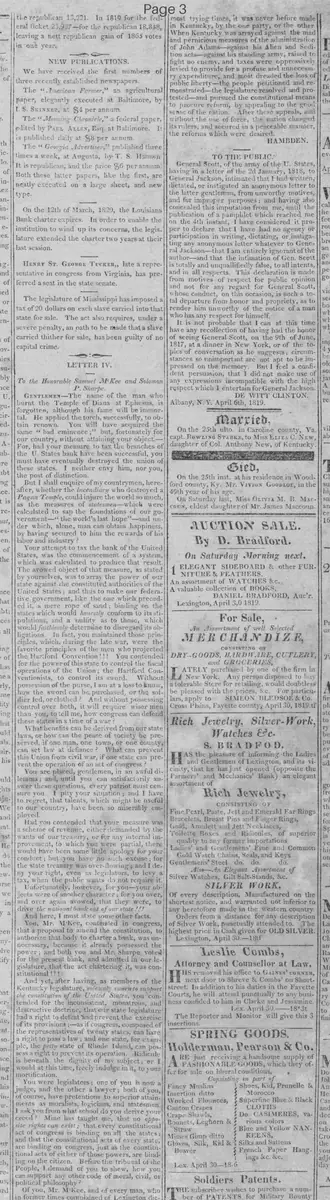
LETTER IV.
To the Honorable Samuel M'Kee and Solomon P. Sharpe.
GENTLEMEN-The name of the man who burnt the Temple of Diana at Ephesus, is forgotten, although his fame will be immortal. He applied the torch, successfully, to obtain renown. You will have acquired the same "bad eminence;" but, fortunately for our country, without attaining your object.- For, had your measure to tax the branches of the U. States bank have been successful, you must have eventually destroyed the union of these states. I neither envy him, nor you, the post of distinction.
But I shall enquire of my countrymen, hereafter, whether the incendiary who destroyed a Pagan Temple, could injure the world so much, as the measures of statesmen-which were calculated to sap the foundations of our government-"the world's last hope"-and under which, alone, man can obtain happiness, by having secured to him the rewards of his labor and industry?
Your attempt to tax the bank of the United States, was the commencement of a system, which was calculated to produce that result. The avowed object of that measure, as stated by yourselves, was to array the power of our state against the constituted authorities of the United States; and thus to make our federal government, like the one which preceded it, a mere rope of sand; binding on the states which would honestly conform to its stipulations, and a nullity as to those, which faithlessly determine to disregard its obligations. In fact, you maintained those principles, which, during the late war, were the favorite principles of the men who projected the Hartford Convention!!! You contended for the power of this state to control the fiscal operations of the Union; the Hartford Conventionists, to control its sword. Without possession of the purse, I am at a loss to know, how the sword can be purchased, or the soldier fed, or clothed? And without possessing control over both, it will require wiser men than you, to tell me, how congress can defend these states in a time of war?
What benefits can be derived from our state laws, or how can the peace of society be preserved, if one man, one town, or one county, can set law at defiance? What can prevent this Union from civil war, if one state can prevent the operation of an act of congress?
You are placed, gentlemen, in an awful dilemma; and, until you can satisfactorily answer these questions, every patriot must censure you. I pity your situation; and I have to regret, that talents, which might be useful to our country, have been so miserably employed.
Had you contended that your measure was a scheme of revenue, either demanded by the wants of our treasury, or for any internal improvement, to which you were partial, there would have been some little apology for your conduct; but you have no such excuse; for the state treasury was over-flowing; and I deny your right, even as legislators, to levy a tax, when the public wants do not require it.
Unfortunately, however, for you-your objects were of another character; for you over, and over again avowed, that they were, to drive the national bank out of our state!!!
And here, I must state some other facts.
You, Mr. M'Kee, contended in congress, that a proposal to amend the constitution, to authorize that body to charter a bank, was unnecessary, because it already possessed the power; and both you and Mr. Sharpe voted for the present bank, and admitted in our legislature, that the act chartering it, was constitutional!!!
And yet, after having, as members of the Kentucky legislature, solemnly sworn to support the constitution of the United States, you contended for the inconsistent, monstrous, and destructive doctrine, that our state legislature had a right to defeat and prevent the exercise of its provisions;-as if congress, composed of the representatives of twenty states, can have a right to pass a law ; and one state, for example, the petty state of Rhode Island, can possess a right to prevent its operation. Ridicule is beneath the dignity of my subject; or I would at this time, freely indulge in it, to your mortification.
You were legislators; one of you is now a judge, and the other a lawyer; both of you, of course, have pretensions to superior attainments as moralists, logicians, and statesmen.
I ask you from what school do you derive your creed? Mine has taught me, that no opposite rights can exist ; that every constitutional act of congress is binding on all the states; and that the constitutional acts of every state, are binding on congress, just as the constitutional acts of either of those powers, are binding on the citizen. Before the tribunal of the People, I demand of you to shew, how you can support any other code of moral, civil, or political philosophy?
Of you, Mr. M'Kee, and of every man, who in former times complained of Lexington dictation, because our citizens, as was their right and duty to do, interfered with public affairs. more than comported with the views of some politicians; and of every statesman, who accused the democrats of Kentucky with too much violence of conduct, I ask a decided answer to this question. When did the people of Lexington contend for the right of one state to pass laws in opposition to a law of the Union ? And when did the legislature of Kentucky attempt to exercise that power before its last session? The world must recollect, that the proposal is a novel one; and that during the most trying times, it was never before made in Kentucky, by the one party, or the other When Kentucky was arrayed against the mad and pernicious measures of the administration of John Adams-against his Alien and Sedition acts-against his standing army, raised to fight no enemy, and taxes were oppressively levied to provide for a profuse and unnecessary expenditure, and most dreaded the loss of public liberty-the people petitioned and remonstrated-the legislature resolved and protested-and pursued the constitutional means to procure reform, by appealing to the good sense of the nation. After these appeals, and without the use of force, the nation changed its rulers, and secured in a peaceable manner, the reforms which were desired.
HAMBDEN.
To the Honorable Samuel M'Kee and Solomon P. Sharpe.
GENTLEMEN-The name of the man who burnt the Temple of Diana at Ephesus, is forgotten, although his fame will be immortal. He applied the torch, successfully, to obtain renown. You will have acquired the same "bad eminence;" but, fortunately for our country, without attaining your object.- For, had your measure to tax the branches of the U. States bank have been successful, you must have eventually destroyed the union of these states. I neither envy him, nor you, the post of distinction.
But I shall enquire of my countrymen, hereafter, whether the incendiary who destroyed a Pagan Temple, could injure the world so much, as the measures of statesmen-which were calculated to sap the foundations of our government-"the world's last hope"-and under which, alone, man can obtain happiness, by having secured to him the rewards of his labor and industry?
Your attempt to tax the bank of the United States, was the commencement of a system, which was calculated to produce that result. The avowed object of that measure, as stated by yourselves, was to array the power of our state against the constituted authorities of the United States; and thus to make our federal government, like the one which preceded it, a mere rope of sand; binding on the states which would honestly conform to its stipulations, and a nullity as to those, which faithlessly determine to disregard its obligations. In fact, you maintained those principles, which, during the late war, were the favorite principles of the men who projected the Hartford Convention!!! You contended for the power of this state to control the fiscal operations of the Union; the Hartford Conventionists, to control its sword. Without possession of the purse, I am at a loss to know, how the sword can be purchased, or the soldier fed, or clothed? And without possessing control over both, it will require wiser men than you, to tell me, how congress can defend these states in a time of war?
What benefits can be derived from our state laws, or how can the peace of society be preserved, if one man, one town, or one county, can set law at defiance? What can prevent this Union from civil war, if one state can prevent the operation of an act of congress?
You are placed, gentlemen, in an awful dilemma; and, until you can satisfactorily answer these questions, every patriot must censure you. I pity your situation; and I have to regret, that talents, which might be useful to our country, have been so miserably employed.
Had you contended that your measure was a scheme of revenue, either demanded by the wants of our treasury, or for any internal improvement, to which you were partial, there would have been some little apology for your conduct; but you have no such excuse; for the state treasury was over-flowing; and I deny your right, even as legislators, to levy a tax, when the public wants do not require it.
Unfortunately, however, for you-your objects were of another character; for you over, and over again avowed, that they were, to drive the national bank out of our state!!!
And here, I must state some other facts.
You, Mr. M'Kee, contended in congress, that a proposal to amend the constitution, to authorize that body to charter a bank, was unnecessary, because it already possessed the power; and both you and Mr. Sharpe voted for the present bank, and admitted in our legislature, that the act chartering it, was constitutional!!!
And yet, after having, as members of the Kentucky legislature, solemnly sworn to support the constitution of the United States, you contended for the inconsistent, monstrous, and destructive doctrine, that our state legislature had a right to defeat and prevent the exercise of its provisions;-as if congress, composed of the representatives of twenty states, can have a right to pass a law ; and one state, for example, the petty state of Rhode Island, can possess a right to prevent its operation. Ridicule is beneath the dignity of my subject; or I would at this time, freely indulge in it, to your mortification.
You were legislators; one of you is now a judge, and the other a lawyer; both of you, of course, have pretensions to superior attainments as moralists, logicians, and statesmen.
I ask you from what school do you derive your creed? Mine has taught me, that no opposite rights can exist ; that every constitutional act of congress is binding on all the states; and that the constitutional acts of every state, are binding on congress, just as the constitutional acts of either of those powers, are binding on the citizen. Before the tribunal of the People, I demand of you to shew, how you can support any other code of moral, civil, or political philosophy?
Of you, Mr. M'Kee, and of every man, who in former times complained of Lexington dictation, because our citizens, as was their right and duty to do, interfered with public affairs. more than comported with the views of some politicians; and of every statesman, who accused the democrats of Kentucky with too much violence of conduct, I ask a decided answer to this question. When did the people of Lexington contend for the right of one state to pass laws in opposition to a law of the Union ? And when did the legislature of Kentucky attempt to exercise that power before its last session? The world must recollect, that the proposal is a novel one; and that during the most trying times, it was never before made in Kentucky, by the one party, or the other When Kentucky was arrayed against the mad and pernicious measures of the administration of John Adams-against his Alien and Sedition acts-against his standing army, raised to fight no enemy, and taxes were oppressively levied to provide for a profuse and unnecessary expenditure, and most dreaded the loss of public liberty-the people petitioned and remonstrated-the legislature resolved and protested-and pursued the constitutional means to procure reform, by appealing to the good sense of the nation. After these appeals, and without the use of force, the nation changed its rulers, and secured in a peaceable manner, the reforms which were desired.
HAMBDEN.
What sub-type of article is it?
Constitutional
Economic Policy
Partisan Politics
What keywords are associated?
Us Bank Taxation
States Rights
Federal Union
Nullification
Hartford Convention
Constitutional Supremacy
Kentucky Politics
What entities or persons were involved?
Samuel M'kee
Solomon P. Sharpe
U.S. Bank
Hartford Conventionists
John Adams
Kentucky Legislature
Editorial Details
Primary Topic
Criticism Of Kentucky's Attempt To Tax U.S. Bank Branches
Stance / Tone
Strongly Pro Federal Union And Anti Nullification
Key Figures
Samuel M'kee
Solomon P. Sharpe
U.S. Bank
Hartford Conventionists
John Adams
Kentucky Legislature
Key Arguments
Taxing U.S. Bank Branches Would Destroy The Union By Undermining Federal Authority
State Cannot Nullify Or Prevent Operation Of Constitutional Federal Laws
Proposal Revives Dangerous Hartford Convention Principles
Legislators Previously Supported The Bank's Constitutionality
True Reform Comes Through Constitutional Means Like Petitions, Not Defiance
No Need For Tax As State Treasury Was Overflowing; True Aim Was To Expel The Bank