Thank you for visiting SNEWPapers!
Sign up free
The National Intelligencer And Washington Advertiser
Washington, District Of Columbia
What is this article about?
Letter from London, Sept. 21, 1802, to a U.S. Congress member detailing British infrastructure like West India Docks and canals; galvanism advancements led by English philosophers over French; Egyptian relics acquired post-successes; historical insights on cow-pox preventing small-pox, known since 1769 but unused until recently.
Clipping
OCR Quality
Full Text
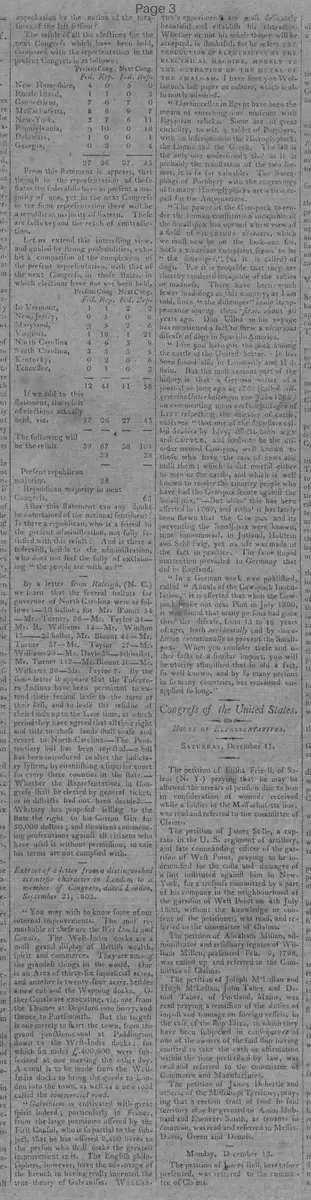
" You may wish to know some of our internal improvements. The most remarkable of these are the Wet Docks and Canals. The Wet-India docks are a most grand display of British wealth, spirit and commerce. They are among the grandest things in the world. One is an Area of thirty-six superficial acres, and another is twenty-four acres, besides a new cut and the Wapping docks. Other Canals are executing, viz. one from the Thames at Deptford into Surrey, and thence to Portsmouth. But the largest is one merely to skirt the town, from the grand junction-canal at Paddington down to the West-India docks; for which six miles £400,000 were subscribed at one meeting the other day.
A canal is to be made from the West-India docks to bring the goods to London into the town, as well as a new road called the commercial road.
" Galvanism is cultivated with great spirit indeed; particularly in France, from the large premiums offered by the First Consul, who is so partial to the subject, that he has offered 2,400 livres to the person who shall make the greatest improvement in it. The English philosophers, however, have the advantage of the French in having really invented the true theory of Galvanism. Wollaston's experiments are not delicately beautiful and establish his character.
Whether or not his whole theory will be accepted, is doubtful, for he refers THE PRODUCTION OF ELECTRICITY BY THE ELECTRICAL MACHINE, MERELY TO THE OXYDATION OF THE METAL OF THE AMALGAM. I have sent you Wollaston's last paper on colours, which is also much admired.
" Our successes in Egypt have been the means of enriching our museum with Egyptian reliques. Some are of great curiosity, to wit. a tablet of Porphyry, with an inscription in the Hieroglyphick, the Coptic and the Greek. The last is the only one understood; tho' as it is probably the translation of the two former, it is so far valuable. The Sarcophagi of Porphyry with the engravings of so many Hieroglyphicks are a rich repast for the Antiquarians.
" The power of the Cow-pock to render the human constitution incapable of the Small-pox has opened a new view of a field of vicarious diseases, which we must now be on the look-out for.
Such a vicarious complaint seems to be "the distemper," (as it is called) of dogs. For it is probable that they are thereby rendered incapable of the rabies or madness. There have been much fewer mad-dogs in this country, as I am told, since "the distemper" made its appearance among them: first, about 40 years ago. Don Ulloa in his voyage has mentioned a fact to shew a vicarious disease of dogs in Spanish-America.
" I see you have got the pock among the cattle of the United States. It has been found also in Lombardy and Holstein. But the most curious part of the history is that a German writer of a journal as long ago as 1769 (called Allgemeine Unterhaltungen von Fuchs 17.68) on commenting upon certain passages of Livy respecting the diseases of cattle, observes " that one of the disorders called Scabies by Livy, affects both Men and cattle, and seems to be the disorder named Cow-pox, well Known to those who have the care of cows and milk them ; which is not mortal either to men or the cattle, and which is well known to render the country people who have had the Cow-pox secure against the Small-pox." But altho' this has been asserted in 1769, and altho' it has lately been shewn that the Cow pox and its preventing the Small-pox were known; time immemorial, in Jutland, Holstein and Schleswig, yet no use was made of the fact in practice. The same stupid inattention prevailed in Germany that did in England.
" In a German work now published, called " Annals of the Cow-pock Inoculation," it is asserted that when the Cow-pock broke out near Plon in July 1800, it was found that many persons had gone thro' the disease, from 13 to 46 years of age, both accidentally and by inoculation intentionally to prevent the Small-pox. When you consider these and other facts of a similar import, you will be utterly astonished that so old a fact, so well known, and by so many persons in so many countries, has remained un-applied so long."
What sub-type of article is it?
What keywords are associated?
What entities or persons were involved?
Where did it happen?
Foreign News Details
Primary Location
London
Event Date
September 21, 1802
Key Persons
Outcome
british museums enriched with egyptian relics; cow-pox recognized as preventing small-pox, known historically but unused until recently
Event Details
Letter describes British internal improvements including West India Docks covering 36 and 24 acres, various canals like one from Paddington to docks with £400,000 subscribed, and a commercial road. Galvanism advanced in France with premiums from First Consul, but English theory by Wollaston preferred. Successes in Egypt brought relics like Porphyry tablet with hieroglyphics and sarcophagi to museums. Cow-pox inoculation prevents small-pox, with historical references from 1769 German journal and practices in Jutland, Holstein, Schleswig; recent outbreak near Plon in 1800 confirmed intentional use.