Thank you for visiting SNEWPapers!
Sign up free
Gazette Of The United States
Philadelphia, Philadelphia County, Pennsylvania
What is this article about?
Report from London on July 30 details the defeat of royalist forces in Quiberon Bay, France, where mutinous French troops defected to General Hoche, leading to the capture or destruction of about 8,000 men. British fleet under Lord Bridport faces desertions and unreliable Chouans; Belleisle refuses surrender.
Clipping
OCR Quality
Full Text
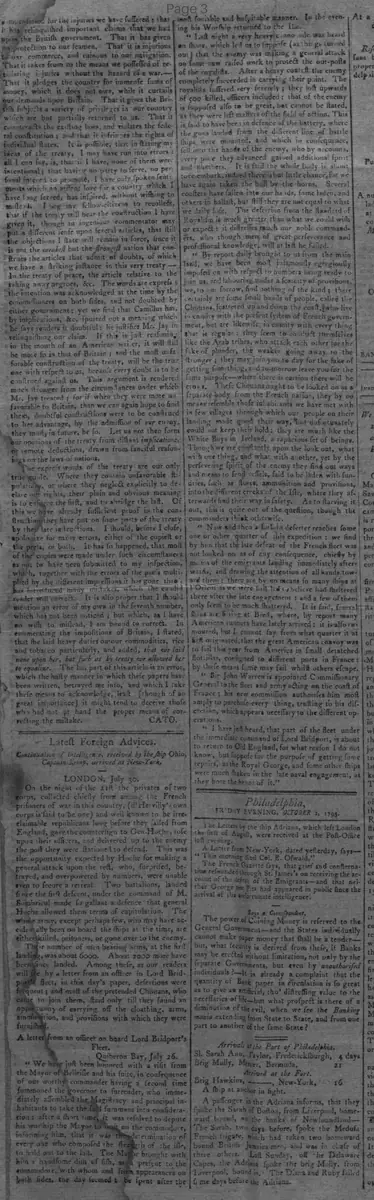
Continuation of Intelligence, received by the ship Ohio
Captain Kemp, arrived at New-York.
LONDON, July 30.
On the night of the 21st the privates of two
corps, collected chiefly from among the French
prisoners of war in this country, (d'Hervilly's own
corps is said to be one) and well known to be irre-
claimable republicans long before they sailed from
England, gave the countersign to Gen. Hoche, rose
upon their officers, and delivered up to the enemy
the post they were stationed to defend. This was
the opportunity expected by Hoche for making a
general attack upon the rest, who, surprised, be-
trayed, and overpowered by numbers, were unable
ven to secure a retreat. Two battalions, landed
since the first descent, under the command of M.
Sombreuil made so gallant a defence that general
Hoche allowed them terms of capitulation. The
whole army, except perhaps a few, who may have ac-
cidentally been on board the ships at the time, are
either killed, prisoners, or gone over to the enemy.
Their number of men bearing arms, at the first
landing, was about 6000. About 2000 more have
been since landed. Among these, as our readers
will see by a letter from an officer in Lord Brid-
port's fleet, in this day's paper, desertions were
frequent; and most of the pretended Chouans, who
came to join them, staid only till they found an
opportunity of carrying off the cloathing, arms,
ammunition, and provisions with which they were
furnished.
A letter from an officer on board Lord Bridport's
Fleet.
Quiberon Bay, July 26.
We have just been honored with a visit from
the Mayor of Belleisle and his suite, in consequence
of our worthy commander having a second time
summoned the governor to surrender, who imme-
diately assembled the Magistracy and principal in-
habitants to take the said summons into considera-
tion: after a short time, it was resolved to depute
his worship the Mayor to wait on the commodore,
informing him, that it was the determination of
every one who composed the strength of the isle.
to hold out to the last. The Mayor brought with
him a handsome dish of fish, as a present to the
commodore, with whom and from appearances on
both sides, the day seemed to be spent after the
inost sociable and hospitable manner. In the even-
ing his Worship returned to the Isle.
Last night a very heavy cannonade was heard
on shore, which led us to suppose (as things turned
out) that the enemy was making a general attack
on some new raised work to protect the out-posts
of the royalists. After a heavy contest the enemy
completely succeeded in carrying their point. The
royalists suffered very severely; they lost upwards
of 200 killed, officers included: that of the enemy
is supposed also to be great, but cannot be stated,
as they were left masters of the field of action. This
is said to have been in defence of the battery, where
the guns landed from the different line of battle
ships were mounted, and which in consequence,
fell into the hands of the enemy, who by accounts,
every pace they advanced gained additional spirit
and numbers. It is said the whole body is about
to re-embark, indeed there is but little chance, for we
have again taken the bull by the horns. Several
coasters have fallen into our hands, some laden, and
others in ballast, but still they are not equal to what
we daily lose. The desertion from the standard of
Royalism is much greater than what we could wish
or expect: it distresses much our noble commanders,
who though men of great perseverance and
professional knowledge, will at last be foiled.
By report daily brought to us from the main
land, we have been most infamously egregiously
imposed on with respect to numbers being ready to
join us, and labouring under a scarcity of provisions,
we, to our sorrow, find nothing of the kind; there
certainly are some small bands of people, called the
Chouans, scattered up and down the coast, who live
in enmity with the present system of French govern-
ment, but are likewise in enmity with every thing
that is regular: they seem to conduct themselves
like the Arab tribes, who attack each other for the
sake of plunder, the weaker going away to the
stronger; they may join you to day for the sake of
getting some thing, and to-morrow leave you for the
same purpose-where there is carrion there will be
vultures. These Chouans ought to be looked on as a
separate body from the French nation, they by no
means resemble those inhabitants we have met with
in few villages through which our people on their
landing made good their way, but unfortunately
could not keep their hold: they are much like the
White Boys in Ireland, a rapacious set of beings.
Though we are constantly upon the look out, what
with one thing, and what with another, yet by the
persevering spirit of the enemy they find out ways
and means to send vessels, said to be laden with un-
dries, such as stores, ammunition and provisions,
into the different creeks of the Isle, where they af-
terwards find their way in safety. As to starving it
out, this is quite out of the question, though the
commanders think otherwise.
Now and then a forlorn deserter reaches some
one or other quarter of this expedition: we find
by him that the late defeat of the French fleet was
not looked on as of any consequence, chiefly by
the means of the emigrants landing immediately after-
wards, and drawing the attention of all hands tow-
ard them: there are by no means so many ships at
L'Orient as we were first led to believe had sheltered
there after the late engagement: and a few of them
only seem to be much shattered. It is said, several
ships are lying at Brest, where, by report many
American runners have lately arrived: it is also ru-
moured, but I cannot say from what quarter it first
originated, that the great American convoy was
to sail this year from America in small detached
flotillas, consigned to different ports in France:
by these means some may suffer whilst others escape.
Sir John Warren is appointed Commissary
General to the fleet and army acting on the coast of
France; his new commission authorizes him most
amply to purchase every thing, trusting to his di-
cretion, which appears necessary to the different op-
crations.
I have just heard, that part of the fleet under
the immediate command of Lord Bridport, is about
to return to Old England, for what reason I do not
know, but suppose for the purpose of getting some
repairs, as the Royal George, and some other ships
were much shaken in the late naval engagement, as
they bore the brunt of it.
What sub-type of article is it?
What keywords are associated?
What entities or persons were involved?
Where did it happen?
Foreign News Details
Primary Location
Quiberon Bay
Event Date
July 21 To July 30, 1795
Key Persons
Outcome
royalists: upwards of 200 killed in one engagement, whole army of about 8000 either killed, prisoners, or defected; enemy losses great but unspecified. battery captured by enemy; potential re-embarkation; frequent desertions and unreliable chouans.
Event Details
Mutinous French troops defected to Gen. Hoche on the night of the 21st, enabling a general attack on royalist forces, leading to surprise, betrayal, and overpowering; two battalions under M. Sombreuil capitulated after gallant defense. Letter from Quiberon Bay on July 26 reports Belleisle's refusal to surrender, heavy cannonade resulting in royalist defeat and loss of battery, high desertions from royalism, unreliable Chouans, French supply successes, and fleet movements including partial return for repairs.