Thank you for visiting SNEWPapers!
Sign up free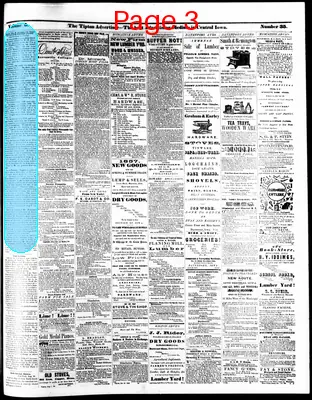
Story
September 4, 1858
The Tipton Advertiser
Tipton, Cedar County, Iowa
What is this article about?
William H. Herndon critiques the Dred Scott decision in a speech to the Young Men's Republican Club, arguing that ruling negroes as non-citizens bars federal suits between whites and negroes, leaving whites without legal recourse for debts or disputes.
Clipping

OCR Quality
82%
Good
Full Text
Volume 5
Speech of Wm. H. Herndon—An Important View of the Dred Scott Decision,
of the speech delivered by W. H. Herndon, Esq., delivered before the Young Men's Republican Club, on last Thursday evening.
We have already given a short sketch from the Illinois State Journal,
There was one point made by Mr. Herndon in reference to the Dred Scott decision, which besides being startling view the Dred Scott case which decides that negroes are not citizens, under the Constitution of the United States.
personal suits in the Circuit Courts the Supreme Court in the above case,
It is known that under the ruling must be between citizens of the United States. The following, from the second section of the third article of the Constitution is the provision:
The judicial power shall extend to all cases in law or equity arising under this Constitution, the Laws of the United States, treaties, etc., to all cases between citizens of different States, etc.
In pursuance of the Constitution, and soon after it was adopted, Congress executed the power above specified by passing an act, of which the following is one of the provisions:
The Circuit Courts shall have original cognizance, concurrent with the Courts of the several States, of all suits of a civil nature at common law or in equity, where the suit is between a citizen of the State where the suit is brought and a citizen of another State, etc.
This law was passed in 1789, and is almost literally copied from the Constitution, necessarily conforming to it and limited by it throughout. We ask our readers to mark well the wording of the clause: between citizens of the different States. It will be seen that it is necessary that both parties to the suit, not only the plaintiff but the defendant, must be citizens.
Now, the Supreme Court, in the Dred Scott case, has decided that a negro is not a citizenship within the meaning of the above clause of the Constitution; that he cannot sue in the United States Courts because he is not a citizen. As however by the terms of the Constitution, both parties to the suit must be citizens.
if the negro is incapable of suing he is equally incapable of being sued. If he cannot be plaintiff in the action, neither can he be defendant, for he is no more a citizen in the one position than the other.
Let us illustrate. Suppose a negro of Illinois owes a white man of Missouri a thousand dollars, which he refuses to pay. The white man brings suit in the United States Court against the negro to recover the debt. Upon the trial, in spite of himself, he is thrown out of court and loses his debt, because the suit is not between citizens. One is a citizen, and the other is a negro; and according to the Dred Scott decision, the courts can give him no remedy. The Judge tells the white man—Go out of court; you have sued a negro: it is decided that a negro is not a citizen, and the Constitution says all suits must be between citizens. The Constitution is the supreme law of the land and must be obeyed. Go out of Court.
Such is an outline of Mr. Herndon's argument which he elaborated at length and fortified by the strongest authorities.
We believe Mr. Herndon's point cannot be controverted; and that the Dred Scott decision, which places a disability upon negroes by saying that they are not citizens, works a most glaring wrong and outrage upon the white man, by leaving him without redress against them in the U. S. Courts, and by taking the negro wholly irresponsible for his contracts.
We ask intelligent men to examine this dictum of the Supreme Court, in the Dred Scott case, now so boldly endorsed and defended by Mr. Douglas, and ask themselves whither the Democracy are tending. Is this government made for white men that they cannot be protected in their rights in their own courts?
Speech of Wm. H. Herndon—An Important View of the Dred Scott Decision,
of the speech delivered by W. H. Herndon, Esq., delivered before the Young Men's Republican Club, on last Thursday evening.
We have already given a short sketch from the Illinois State Journal,
There was one point made by Mr. Herndon in reference to the Dred Scott decision, which besides being startling view the Dred Scott case which decides that negroes are not citizens, under the Constitution of the United States.
personal suits in the Circuit Courts the Supreme Court in the above case,
It is known that under the ruling must be between citizens of the United States. The following, from the second section of the third article of the Constitution is the provision:
The judicial power shall extend to all cases in law or equity arising under this Constitution, the Laws of the United States, treaties, etc., to all cases between citizens of different States, etc.
In pursuance of the Constitution, and soon after it was adopted, Congress executed the power above specified by passing an act, of which the following is one of the provisions:
The Circuit Courts shall have original cognizance, concurrent with the Courts of the several States, of all suits of a civil nature at common law or in equity, where the suit is between a citizen of the State where the suit is brought and a citizen of another State, etc.
This law was passed in 1789, and is almost literally copied from the Constitution, necessarily conforming to it and limited by it throughout. We ask our readers to mark well the wording of the clause: between citizens of the different States. It will be seen that it is necessary that both parties to the suit, not only the plaintiff but the defendant, must be citizens.
Now, the Supreme Court, in the Dred Scott case, has decided that a negro is not a citizenship within the meaning of the above clause of the Constitution; that he cannot sue in the United States Courts because he is not a citizen. As however by the terms of the Constitution, both parties to the suit must be citizens.
if the negro is incapable of suing he is equally incapable of being sued. If he cannot be plaintiff in the action, neither can he be defendant, for he is no more a citizen in the one position than the other.
Let us illustrate. Suppose a negro of Illinois owes a white man of Missouri a thousand dollars, which he refuses to pay. The white man brings suit in the United States Court against the negro to recover the debt. Upon the trial, in spite of himself, he is thrown out of court and loses his debt, because the suit is not between citizens. One is a citizen, and the other is a negro; and according to the Dred Scott decision, the courts can give him no remedy. The Judge tells the white man—Go out of court; you have sued a negro: it is decided that a negro is not a citizen, and the Constitution says all suits must be between citizens. The Constitution is the supreme law of the land and must be obeyed. Go out of Court.
Such is an outline of Mr. Herndon's argument which he elaborated at length and fortified by the strongest authorities.
We believe Mr. Herndon's point cannot be controverted; and that the Dred Scott decision, which places a disability upon negroes by saying that they are not citizens, works a most glaring wrong and outrage upon the white man, by leaving him without redress against them in the U. S. Courts, and by taking the negro wholly irresponsible for his contracts.
We ask intelligent men to examine this dictum of the Supreme Court, in the Dred Scott case, now so boldly endorsed and defended by Mr. Douglas, and ask themselves whither the Democracy are tending. Is this government made for white men that they cannot be protected in their rights in their own courts?
What sub-type of article is it?
Historical Event
Curiosity
What themes does it cover?
Justice
Social Manners
What keywords are associated?
Dred Scott Decision
Herndon Speech
Citizenship
Supreme Court
Federal Courts
Negro Rights
White Remedies
What entities or persons were involved?
Wm. H. Herndon
W. H. Herndon
Mr. Douglas
Where did it happen?
Young Men's Republican Club, Illinois
Story Details
Key Persons
Wm. H. Herndon
W. H. Herndon
Mr. Douglas
Location
Young Men's Republican Club, Illinois
Event Date
Last Thursday Evening
Story Details
Herndon argues that the Dred Scott decision, by denying citizenship to negroes, prevents federal courts from hearing suits involving them, thus denying whites legal remedies against negroes for debts, as both parties must be citizens under the Constitution.