Thank you for visiting SNEWPapers!
Sign up free
Editorial
November 1, 1854
Weekly North Carolina Standard
Raleigh, Wake County, North Carolina
What is this article about?
Editorial responds to Petersburg Intelligencer on slavery crisis, advocating Constitutional Union party but emphasizing Northern Democrats' reliability over Whigs, citing support for key laws and quoting anti-slavery Whig Jacob Collamer, urging alliance to preserve Union and Southern rights.
Clipping
OCR Quality
85%
Good
Full Text
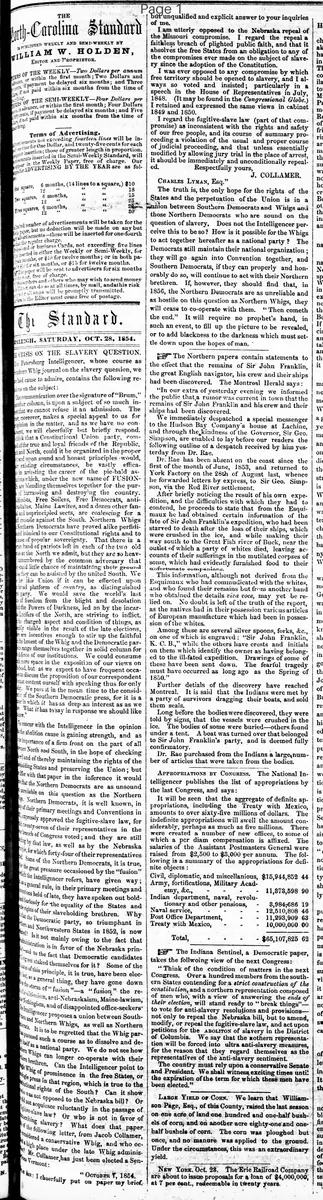
THE CRISIS ON THE SLAVERY QUESTION.
The Petersburg Intelligencer, whose course as a Southern Whig journal on the slavery question, we had cause to admire, contains the following remarks on the subject:
The communication over the signature of "Brutus," in another column, is upon a subject of so much importance that we cannot refuse it an admission. The writer, moreover, makes a special appeal to us for our opinion in the matter, and as we have no conceit, we will cheerfully but briefly respond.
We think that a Constitutional Union party, composed of the true and loyal friends of the Republic, North and South, could it be organized in the proper way and upon sound and honest principles, would, under existing circumstances, be vastly efficacious in arresting the career of the pie-bald assassins which, under the new name of FUSION, are blending themselves together for the purpose of harassing and destroying the country. Freesoilers, Free Democrats, anti-slavery Whigs, Maine Lawmen, and a dozen other fanatical and unprincipled sects, are coalescing for a crusade against the South. Northern Whigs and Northern Democrats have proved alike perfidious and inimical to our Constitutional rights and to the principle of popular sovereignty. That there is a band of patriots left in each of the two old parties—at the North we admit, but there are so over-numbered by the common adversary that they have little chance of maintaining their ground unless they can be assisted by the united South. We are for preserving this Union if it can be effected upon the broad platform of country, as distinguished from party. We would save the world's last citadel of freedom from the blight and desolation which the Powers of Darkness, led on by the incarnate Lucifers of the North, are striving to inflict.
The changed aspect and condition of things, as now visible in the result of the late elections, are incentives enough to stir up the faithful remnant of the Whig and the Democratic ranks to rouse themselves together in solid column for the defence of our institutions. We could consume more space in the exposition of our views on this subject, but as we expect to have frequent occasion to discuss the proposition of our correspondent, we content ourselves with speaking thus for the present.
We pass it in the mean time to the consideration of the Southern Democratic press, for it is a question in which it has as deep an interest as we have. What it has to say in response we should like to hear.
We concur with the Intelligencer in the opinion that the abolition cause is gaining strength, and in the importance of a firm front on the part of all conservative men North and South, in the hope of checking its onward and thereby maintaining the rights of the slaveholding States and preserving the Union; but we do not concur with that paper in the inference it would draw that the Northern Democrats are as unsound and unreliable on this question as the Northern Whigs.
Northern Democrats, it is well known, in nearly all of their primary meetings and Conventions have expressly approved the fugitive-slave law, for twenty-seven of their representatives in the lower branch of Congress voted for it; and they are still standing by that law, as well as by the Nebraska bill, for which forty-four of their representatives voted.
Some of the Northern Democrats, it is true, have under the pressure occasioned by the fusion which the Intelligencer refers to, in their primary meetings and conventions held for the nomination of their candidates, staked their principles on it. Some of the fusion candidates have been elected; but as a general thing, they have gone down before the storm of "fusion"—a storm of anti-Nebraskaism, Maine-lawism, Nothingism, and of disappointed ambition. The fusion men and Northern Whigs encourage a proposed union between South and Northern Democrats.
It is to be regretted that the Whig party has pursued such a course as to dissolve and destroy itself as a national party. Northern Whigs can no longer co-operate with their Southern brethren. Can the Intelligencer point to a single Northern Whig of prominence in the free States, who is true to the constitutional rights of the South? Can it show us one who was not opposed to the Nebraska bill? Or who is in favor of the fugitive-slave law? Or who is not in favor of proscribing slavery?
Of the following we had considered a conservative Whig, and who occupied a high place under the late Whig administration—Mr. Collamer has just been elected a Senator from Vermont:
What does that paper say of the following letter, from Jacob Collamer, of Vermont:
"October 7, 1854.
SIR: I cheerfully put on paper my brief, but unqualified and explicit answer to your inquiries of me.
I am utterly opposed to the Nebraska repeal of the Missouri compromise. I regard the repeal a faithless breach of plighted public faith, and that it absolves the free States from an obligation to any of the compromises ever made on the subject of slavery since the adoption of the Constitution.
I was ever opposed to any compromise by which free territory should be opened to slavery, and I always so voted and insisted; particularly in a speech in the House of Representatives in July, 1848. (It may be found in the Congressional Globe.)
I retained and expressed the same views in cabinet 1849 and 1850.
I regard the fugitive-slave law (part of that compromise) as inconsistent with the rights and safety of our free people, and its course of summary proceeding a violation of the usual and proper course of judicial proceeding, and that unless essentially modified by allowing jury trial in the place of arrest, it should be immediately and unconditionally repealed.
Respectfully yours,
J. COLLAMER.
Charles Lyman, Esq."
The truth is, the only hope for the rights of the States and the perpetuation of the Union is in a union between Southern Democrats and Whigs and those Northern Democrats who are sound on the question of slavery. Does not the Intelligencer perceive this to be so? How is it possible for the Whigs to act together hereafter as a national party? The Democrats still maintain their national organization; they will go again into Convention together, and Southern Democrats, if they can properly and honorably do so, will continue to act with their Northern brethren. If, however, they should find that, in 1856, the Northern Democrats are as unreliable and as hostile on this question as Northern Whigs, they will cease to co-operate with them. "Then cometh the end." It will require no prophet's hand, in such an event, to fill up the picture to be revealed, or to add blackness to the darkness which must settle down upon the hopes of man.
The Petersburg Intelligencer, whose course as a Southern Whig journal on the slavery question, we had cause to admire, contains the following remarks on the subject:
The communication over the signature of "Brutus," in another column, is upon a subject of so much importance that we cannot refuse it an admission. The writer, moreover, makes a special appeal to us for our opinion in the matter, and as we have no conceit, we will cheerfully but briefly respond.
We think that a Constitutional Union party, composed of the true and loyal friends of the Republic, North and South, could it be organized in the proper way and upon sound and honest principles, would, under existing circumstances, be vastly efficacious in arresting the career of the pie-bald assassins which, under the new name of FUSION, are blending themselves together for the purpose of harassing and destroying the country. Freesoilers, Free Democrats, anti-slavery Whigs, Maine Lawmen, and a dozen other fanatical and unprincipled sects, are coalescing for a crusade against the South. Northern Whigs and Northern Democrats have proved alike perfidious and inimical to our Constitutional rights and to the principle of popular sovereignty. That there is a band of patriots left in each of the two old parties—at the North we admit, but there are so over-numbered by the common adversary that they have little chance of maintaining their ground unless they can be assisted by the united South. We are for preserving this Union if it can be effected upon the broad platform of country, as distinguished from party. We would save the world's last citadel of freedom from the blight and desolation which the Powers of Darkness, led on by the incarnate Lucifers of the North, are striving to inflict.
The changed aspect and condition of things, as now visible in the result of the late elections, are incentives enough to stir up the faithful remnant of the Whig and the Democratic ranks to rouse themselves together in solid column for the defence of our institutions. We could consume more space in the exposition of our views on this subject, but as we expect to have frequent occasion to discuss the proposition of our correspondent, we content ourselves with speaking thus for the present.
We pass it in the mean time to the consideration of the Southern Democratic press, for it is a question in which it has as deep an interest as we have. What it has to say in response we should like to hear.
We concur with the Intelligencer in the opinion that the abolition cause is gaining strength, and in the importance of a firm front on the part of all conservative men North and South, in the hope of checking its onward and thereby maintaining the rights of the slaveholding States and preserving the Union; but we do not concur with that paper in the inference it would draw that the Northern Democrats are as unsound and unreliable on this question as the Northern Whigs.
Northern Democrats, it is well known, in nearly all of their primary meetings and Conventions have expressly approved the fugitive-slave law, for twenty-seven of their representatives in the lower branch of Congress voted for it; and they are still standing by that law, as well as by the Nebraska bill, for which forty-four of their representatives voted.
Some of the Northern Democrats, it is true, have under the pressure occasioned by the fusion which the Intelligencer refers to, in their primary meetings and conventions held for the nomination of their candidates, staked their principles on it. Some of the fusion candidates have been elected; but as a general thing, they have gone down before the storm of "fusion"—a storm of anti-Nebraskaism, Maine-lawism, Nothingism, and of disappointed ambition. The fusion men and Northern Whigs encourage a proposed union between South and Northern Democrats.
It is to be regretted that the Whig party has pursued such a course as to dissolve and destroy itself as a national party. Northern Whigs can no longer co-operate with their Southern brethren. Can the Intelligencer point to a single Northern Whig of prominence in the free States, who is true to the constitutional rights of the South? Can it show us one who was not opposed to the Nebraska bill? Or who is in favor of the fugitive-slave law? Or who is not in favor of proscribing slavery?
Of the following we had considered a conservative Whig, and who occupied a high place under the late Whig administration—Mr. Collamer has just been elected a Senator from Vermont:
What does that paper say of the following letter, from Jacob Collamer, of Vermont:
"October 7, 1854.
SIR: I cheerfully put on paper my brief, but unqualified and explicit answer to your inquiries of me.
I am utterly opposed to the Nebraska repeal of the Missouri compromise. I regard the repeal a faithless breach of plighted public faith, and that it absolves the free States from an obligation to any of the compromises ever made on the subject of slavery since the adoption of the Constitution.
I was ever opposed to any compromise by which free territory should be opened to slavery, and I always so voted and insisted; particularly in a speech in the House of Representatives in July, 1848. (It may be found in the Congressional Globe.)
I retained and expressed the same views in cabinet 1849 and 1850.
I regard the fugitive-slave law (part of that compromise) as inconsistent with the rights and safety of our free people, and its course of summary proceeding a violation of the usual and proper course of judicial proceeding, and that unless essentially modified by allowing jury trial in the place of arrest, it should be immediately and unconditionally repealed.
Respectfully yours,
J. COLLAMER.
Charles Lyman, Esq."
The truth is, the only hope for the rights of the States and the perpetuation of the Union is in a union between Southern Democrats and Whigs and those Northern Democrats who are sound on the question of slavery. Does not the Intelligencer perceive this to be so? How is it possible for the Whigs to act together hereafter as a national party? The Democrats still maintain their national organization; they will go again into Convention together, and Southern Democrats, if they can properly and honorably do so, will continue to act with their Northern brethren. If, however, they should find that, in 1856, the Northern Democrats are as unreliable and as hostile on this question as Northern Whigs, they will cease to co-operate with them. "Then cometh the end." It will require no prophet's hand, in such an event, to fill up the picture to be revealed, or to add blackness to the darkness which must settle down upon the hopes of man.
What sub-type of article is it?
Slavery Abolition
Partisan Politics
Constitutional
What keywords are associated?
Slavery Crisis
Constitutional Union
Northern Democrats
Northern Whigs
Nebraska Bill
Fugitive Slave Law
Abolitionists
Union Preservation
What entities or persons were involved?
Petersburg Intelligencer
Brutus
Northern Whigs
Northern Democrats
Jacob Collamer
Southern Democrats
Southern Whigs
Editorial Details
Primary Topic
Crisis On The Slavery Question And Reliability Of Northern Parties
Stance / Tone
Supportive Of Southern Rights And Union With Sound Northern Democrats Against Abolitionists
Key Figures
Petersburg Intelligencer
Brutus
Northern Whigs
Northern Democrats
Jacob Collamer
Southern Democrats
Southern Whigs
Key Arguments
A Constitutional Union Party Could Counter Fusionists And Abolitionists Threatening The Union.
Northern Democrats Are More Reliable Than Northern Whigs On Slavery Issues, Having Supported The Fugitive Slave Law And Nebraska Bill.
Many Northern Democrats Have Affirmed These Laws In Meetings Despite Fusion Pressures.
Northern Whigs Oppose Nebraska Bill, Fugitive Slave Law, And Favor Proscribing Slavery.
Jacob Collamer's Letter Shows Opposition To Nebraska Repeal And Calls For Fugitive Slave Law Repeal.
Hope Lies In Union Between Southern Democrats/Whigs And Sound Northern Democrats To Preserve Union And States' Rights.