Thank you for visiting SNEWPapers!
Sign up free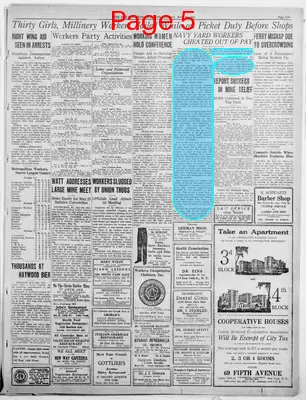
Story
May 21, 1928
The Daily Worker
Chicago, Cook County, Illinois
What is this article about?
In the late 19th century, U.S. Navy yard workers won an eight-hour day but were denied overtime pay for summer months despite promises. After years of exploitation and poverty, widows and children seek $324,000 in back wages via a congressional bill, highlighting government betrayal.
Clipping
OCR Quality
98%
Excellent
Full Text
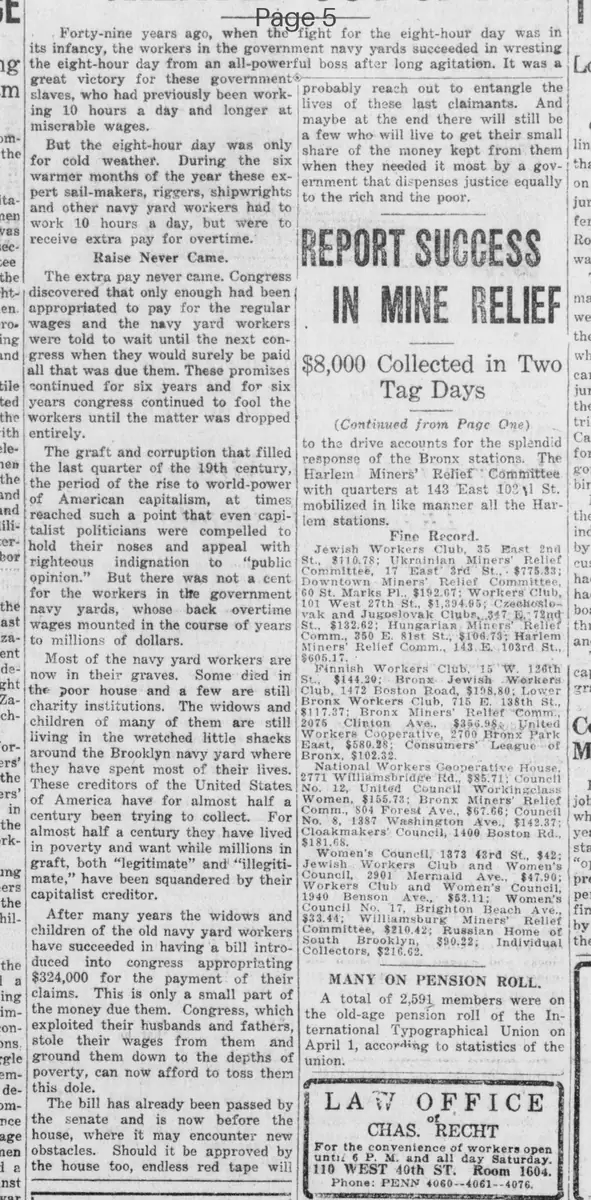
Forty-nine years ago, when the fight for the eight-hour day was in its infancy, the workers in the government navy yards succeeded in wresting the eight-hour day from an all-powerful boss after long agitation. It was a great victory for these government slaves, who had previously been working 10 hours a day and longer at miserable wages.
But the eight-hour day was only for cold weather. During the six warmer months of the year these expert sail-makers, riggers, shipwrights and other navy yard workers had to work 10 hours a day, but were to receive extra pay for overtime.
Raise Never Came.
The extra pay never came. Congress discovered that only enough had been appropriated to pay for the regular wages and the navy yard workers were told to wait until the next congress when they would surely be paid all that was due them. These promises continued for six years and for six years congress continued to fool the workers until the matter was dropped entirely.
The graft and corruption that filled the last quarter of the 19th century, the period of the rise to world-power of American capitalism, at times reached such a point that even capitalist politicians were compelled to hold their noses and appeal with righteous indignation to "public opinion." But there was not a cent for the workers in the government navy yards, whose back overtime wages mounted in the course of years to millions of dollars.
Most of the navy yard workers are now in their graves. Some died in the poor house and a few are still charity institutions. The widows and children of many of them are still living in the wretched little shacks around the Brooklyn navy yard where they have spent most of their lives.
These creditors of the United States of America have for almost half a century been trying to collect. For almost half a century they have lived in poverty and want while millions in graft, both "legitimate" and "illegitimate," have been squandered by their capitalist creditor.
After many years the widows and children of the old navy yard workers have succeeded in having a bill introduced into congress appropriating $324,000 for the payment of their claims. This is only a small part of the money due them. Congress, which exploited their husbands and fathers, stole their wages from them and ground them down to the depths of poverty, can now afford to toss them this dole.
The bill has already been passed by the senate and is now before the house, where it may encounter new obstacles. Should it be approved by the house too, endless red tape will probably reach out to entangle the lives of these last claimants. And maybe at the end there will still be a few who will live to get their small share of the money kept from them when they needed it most by a government that dispenses justice equally to the rich and the poor.
But the eight-hour day was only for cold weather. During the six warmer months of the year these expert sail-makers, riggers, shipwrights and other navy yard workers had to work 10 hours a day, but were to receive extra pay for overtime.
Raise Never Came.
The extra pay never came. Congress discovered that only enough had been appropriated to pay for the regular wages and the navy yard workers were told to wait until the next congress when they would surely be paid all that was due them. These promises continued for six years and for six years congress continued to fool the workers until the matter was dropped entirely.
The graft and corruption that filled the last quarter of the 19th century, the period of the rise to world-power of American capitalism, at times reached such a point that even capitalist politicians were compelled to hold their noses and appeal with righteous indignation to "public opinion." But there was not a cent for the workers in the government navy yards, whose back overtime wages mounted in the course of years to millions of dollars.
Most of the navy yard workers are now in their graves. Some died in the poor house and a few are still charity institutions. The widows and children of many of them are still living in the wretched little shacks around the Brooklyn navy yard where they have spent most of their lives.
These creditors of the United States of America have for almost half a century been trying to collect. For almost half a century they have lived in poverty and want while millions in graft, both "legitimate" and "illegitimate," have been squandered by their capitalist creditor.
After many years the widows and children of the old navy yard workers have succeeded in having a bill introduced into congress appropriating $324,000 for the payment of their claims. This is only a small part of the money due them. Congress, which exploited their husbands and fathers, stole their wages from them and ground them down to the depths of poverty, can now afford to toss them this dole.
The bill has already been passed by the senate and is now before the house, where it may encounter new obstacles. Should it be approved by the house too, endless red tape will probably reach out to entangle the lives of these last claimants. And maybe at the end there will still be a few who will live to get their small share of the money kept from them when they needed it most by a government that dispenses justice equally to the rich and the poor.
What sub-type of article is it?
Historical Event
Tragedy
What themes does it cover?
Misfortune
Betrayal
Justice
What keywords are associated?
Eight Hour Day
Navy Yard Workers
Overtime Pay
Government Betrayal
Labor Exploitation
Back Wages
Congressional Bill
Where did it happen?
Brooklyn Navy Yard
Story Details
Location
Brooklyn Navy Yard
Event Date
Last Quarter Of The 19th Century
Story Details
Navy yard workers won eight-hour day in cold months but were promised and denied overtime pay for summer work over six years, leading to millions in unpaid wages amid government corruption. Decades later, widows and children push a bill for partial repayment.