Thank you for visiting SNEWPapers!
Sign up free
Palladium Of Virginia And The Pacific Monitor
Lewisburg, Greenbrier County, West Virginia
What is this article about?
The Irish Catholic Association issues a farewell address to the people of Ireland upon its dissolution by law, reflecting on its achievements in uniting Catholics, petitioning for emancipation, restoring tranquility, and noting parliamentary progress toward emancipation despite suppression.
Merged-components note: continuation of the Farewell Address of the Irish Catholic Association across pages 2 and 3
Clippings
1 of 2
OCR Quality
Full Text
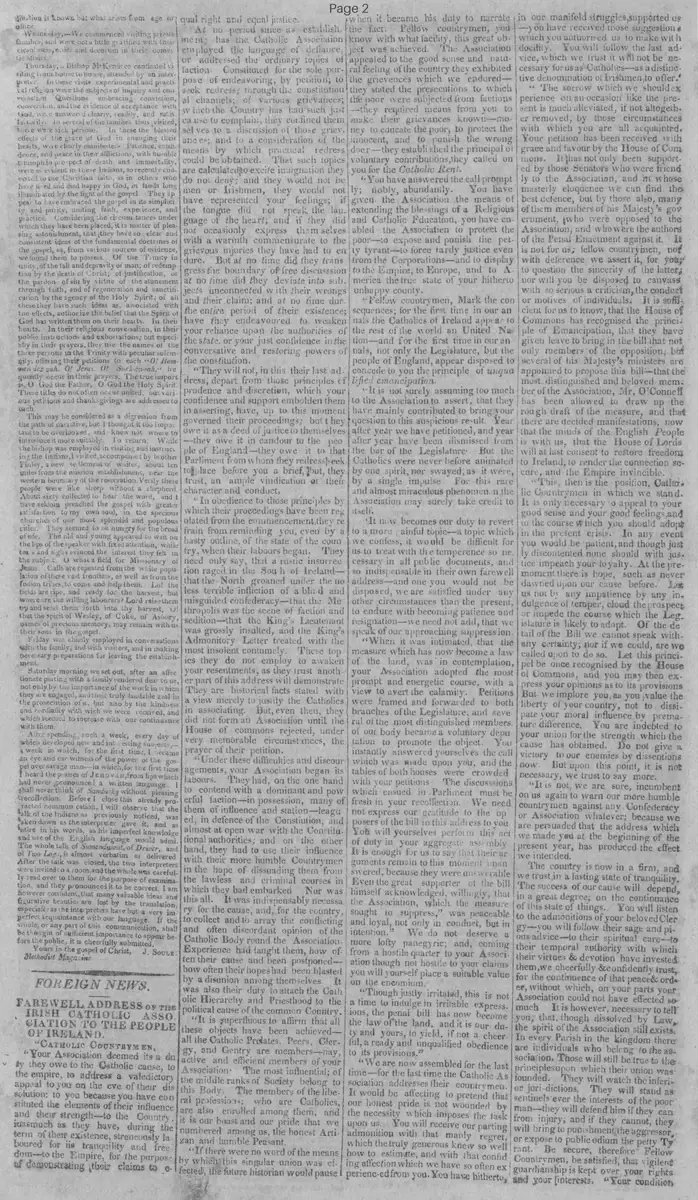
FAREWELL ADDRESS OF THE IRISH CATHOLIC ASSOCIATION TO THE PEOPLE OF IRELAND.
"CATHOLIC COUNTRYMEN,
"Your Association deemed it a duty they owe to the Catholic cause, to the empire, to address a valedictory appeal to you on the eve of their dissolution: to you because you have constituted the elements of their influence and their strength—to the Country, inasmuch as they have, during the term of their existence, strenuously laboured for its tranquility and freedom—to the Empire, for the purpose of demonstrating their claims to equal rights and equal justice.
At no period since its establishment has the Catholic Association employed the language of defiance, or addressed the ordinary topics of faction. Constituted for the sole purpose of endeavoring, by petition, to seek redress, through the constitutional channels, of various grievances, which the Country has had such just cause to complain, they confined themselves to a discussion of those grievances; and to a consideration of the means by which practical redress could be obtained. That such topics are calculated to excite indignation they do not deny; and they would not be men or Irishmen, they would not have represented your feelings: if the tongue did not speak the language of the heart; and if they did not occasionally express themselves with a warmth commensurate to the grievous injuries they have had to endure. But at no time did they transgress the boundary of free discussion; at no time did they deviate into subjects unconnected with their wrongs and their claims; and at no time during the entire period of their existence, have they endeavoured to weaken your reliance upon the authorities of the state, or your just confidence in the conservative and restoring powers of the constitution.
"They will not, in this their last address, depart from those principles of prudence and discretion, which your confidence and support embolden them in asserting, have, up to this moment governed their proceedings; but they owe it as a deed of justice to themselves—they owe it in candour to the people of England—they owe it to that Parliament from whom they redress seek—to place before you a brief, but, they trust, an ample vindication of their character and conduct.
"In obedience to those principles by which their proceedings have been regulated from the commencement, they refrain from reminding you, even by a hasty outline, of the state of the country, when their labours began. They need only say, that a rustic insurrection raged in the South of Ireland—that the North groaned under the no less terrible infliction of a blind and misguided confederacy—that the Metropolis was the scene of faction and sedition—that the King's Lieutenant was grossly insulted, and the King's Admonitory Letter treated with the most insolent contumely. These topics they do not employ to awaken your resentments, as they trust another part of this address will demonstrate. They are historical facts stated with a view merely to justify the Catholics in associating. But, even then, they did not form an Association until the House of Commons rejected, under very memorable circumstances, the prayer of their petition.
"Under these difficulties and discouragements, your Association began its labours. They had, on the one hand to contend with a dominant and powerful faction—in possession, many of them of influence and station—leagued in defence of the Constitution, and almost at open war with the Constitutional authorities; and on the other hand, they had to use their influence with their more humble Countrymen in the hope of dissuading them from the lawless and criminal courses in which they had embarked. Nor was this all. It was indispensably necessary for the cause, and, for the country, to collect and to array the conflicting and often discordant opinion of the Catholic Body round the Association. Experience had taught them, how often their cause had been postponed—how often their hopes had been blasted by a disunion among themselves. It was also their duty to attach the Catholic Hierarchy and Priesthood to the political cause of the common Country.
"It is superfluous to affirm that all these objects have been achieved—all the Catholic Prelates, Peers, Clergy, and Gentry are members—nay, active and efficient members of your Association: The most influential of the middle ranks of Society belong to this Body. The members of the liberal professions, who are Catholics, are also enrolled among them, and it is our boast and our pride that we numbered among us, the honest Artisan and humble Peasant.
"If there were no word of the means by which this singular union was effected, the future historian would pause when it became his duty to narrate the fact. Fellow countrymen, you know with what facility, this great object was achieved. The Association appealed to the good sense and natural feeling of the country they exhibited the grievances which we endured—they stated the persecutions to which the poor were subjected from factions—they required means from you to make their grievances known—money to educate the poor, to protect the innocent, and to punish the wrong doer—they established the principle of voluntary contributions, they called on you for the Catholic Rent.
You have answered the call promptly, nobly, abundantly. You have given the Association the means of extending the blessings of a Religious and Catholic Education, you have enabled the Association to protect the poor—to expose and punish the petty tyrant—to force tardy justice even from the Corporations—and to display to the Empire, to Europe, and to America the true state of your hitherto unhappy country.
"Fellow countrymen, Mark the consequences; for the first time in our annals the Catholics of Ireland appear to the rest of the world a United Nation—and for the first time in our annals, not only the Legislature, but the people of England, appear disposed to concede to you the principle of unqualified emancipation.
—It is not surely assuming too much to the Association to assert, that they have mainly contributed to bring your question to this auspicious result. Year after year we have petitioned, and year after year have been dismissed from the bar of the Legislature. But the Catholics were never before animated by one spirit, nor swayed, as it were, by a single impulse. For this rare and almost miraculous phenomenon the Association may surely take credit to itself.
It now becomes our duty to revert to a more painful topic—a topic which we confess, it would be difficult for us to treat with the temperance so necessary in all public documents, and so indispensable in their own farewell address—and one you would not be disposed, we are satisfied under any other circumstances than the present, to endure with becoming patience and resignation—we need not add, that we speak of our approaching suppression.
"When it was intimated, that the measure which has now become a law of the land, was in contemplation, your Association adopted the most prompt and energetic course, with a view to avert the calamity. Petitions were framed and forwarded to both branches of the Legislature, and several of the most distinguished members of our body became a voluntary deputation to promote the object. You instantly answered the call which was made upon you, and the tables of both houses were crowded with your petitions. The discussions which ensued in Parliament must be fresh in your recollection. We need not express our gratitude to the opposers of the bill in this address to you. You will yourselves perform this act of duty in your aggregate assembly. It is enough for us to say that their arguments remain to this moment unanswered, because they were unanswerable. Even the great supporter of the bill himself acknowledged, willingly, that the Association, which the measure sought to suppress, was peaceable and loyal, not only in conduct, but in intention. We do not deserve a more lofty panegyric; and, coming from a hostile quarter to your Association though not hostile to your claims you will yourself place a suitable value on the encomium.
"Though justly irritated, this is not a time to indulge in irritable expressions, the penal bill has now become the law of the land, and it is our duty and yours, to yield, if not a cheerful, a ready and unqualified obedience to its provisions.
"We are now assembled for the last time—for the last time the Catholic Association addresses their countrymen. It would be affecting to pretend that our honest pride is not wounded by the necessity which imposes the task upon us. You will receive our parting admonition with that manly regret, which the truly generous know so well how to estimate, and with that confiding affection which we have so often experienced from you. You have hitherto, in our manifold struggles, supported us—you have ever received our suggestions which you authorised us to make with docility. You will follow the last advice, which we trust it will not be necessary for us as Catholics—us as a distinctive denomination of Irishmen, to offer.
The sorrow which we should experience on an occasion like the present is much alleviated, if not altogether removed, by those circumstances with which you are all acquainted. Your petition has been received with grace and favour by the House of Commons. It has not only been supported by those Senators who were friendly to the Association, and in whose masterly eloquence we can find the best defence, but by those also, many of them members of his Majesty's government, who were opposed to the Association, and who were the authors of the Penal Enactment against it. It is not for us, fellow countrymen, not with deference we assert it, for you; to question the sincerity of the latter, nor will you be disposed to canvass with so serious a criticism, the conduct or motives of individuals. It is sufficient for us to know, that the House of Commons has recognised the principle of Emancipation, that they have given leave to bring in the bill that not only members of the opposition, but several of his Majesty's ministers are appointed to propose this bill—that the most distinguished and beloved member of the Association, Mr. O'Connell has been allowed to draw up the rough draft of the measure, and that there are decided manifestations, now that the minds of the English People is with us, that the House of Lords will at last consent to restore freedom to Ireland, to render the connection secure and the Empire invincible.
"This, then is the position, Catholic Countrymen in which we stand. It is only necessary to appeal to your good sense and your good feelings, and to the course which you should adopt in the present crisis. In any event you would be patient, and though justly discontented none should with justice impeach your loyalty. At the present moment there is hope, such as never dawned upon our cause before. Let us not by any impatience by any indulgence of temper, cloud the prospect or impede the course which the Legislature is likely to adopt. Of the details of the Bill we cannot speak with any certainty; nor if we could, are we called upon to do so. Let this principle be once recognised by the House of Commons, and you may then express your opinions as to its provisions. But we implore you, as you value the liberty of your country, not to dissipate your moral influence by premature difference. You are indebted to your union for the strength which the cause has obtained. Do not give a victory to our enemies by dissensions now. But upon this point, it is not necessary, we trust to say more.
"It is not, we are sure, incumbent on us again to warn our more humble countrymen against any Confederacy or Association whatever; because we are persuaded that the address which we made you at the beginning of the present year, has produced the effect we intended. The country is now in a firm, and we trust, in a lasting state of tranquility. The success of our cause will depend, in a great degree, on the continuance of this state of things. You will listen to the admonitions of your beloved Clergy—you will follow their sage and pious advice—to their spiritual care—to their temporal authority with which their virtues & devotion have invested them, we cheerfully & confidently trust, for the continuance of that peace & order, without which, on your parts your Association could not have effected so much. It is however, necessary to tell you, that, though dissolved by Law, the spirit of the Association still exists. In every Parish in the kingdom there are individuals who belong to the association. Those will still be true to the principles upon which their union was founded. They will watch the inferior jurisdictions. They will stand as sentinels over the interests of the poor man—they will defend him if they can from injury, and if they cannot, they will bring to punishment the aggressor, or expose to public odium the petty Tyrant. Be secure, therefore Fellow Countrymen, be satisfied, that vigilant guardianship is kept over your rights and your interests. "Your condition
will, beyond a doubt, be anchored.
The country is becoming prosperous—employment is becoming more general—English Capital is about to be invested in our soil, our Mines, and with a view to the promotion of our Manufacturers. It shall be our business, for you have enabled us to do so—and the law which has just passed does not prevent it—to afford your youth the means of Catholic Education. To the prosecution of this great object many of our Body have devoted themselves, and you may rest satisfied that the system will be carried into complete effect, when we shall be able to conclude our previous arrangements.
Fellow Countrymen—Let this be our motto, Oblivion of injuries, attachment to the British Constitution; and loyalty to the king—Farewell!
What sub-type of article is it?
What keywords are associated?
What entities or persons were involved?
Where did it happen?
Foreign News Details
Primary Location
Ireland
Key Persons
Outcome
dissolution of the irish catholic association by penal law; recognition of catholic emancipation principle by house of commons; leave to bring in emancipation bill; improved tranquility and unity among catholics; prospects for full emancipation.
Event Details
The Irish Catholic Association delivers a farewell address upon its impending dissolution, vindicating its peaceful and constitutional efforts to unite Catholics, petition for redress of grievances, promote education and protection of the poor via Catholic Rent, restore national tranquility, and advance emancipation. It urges continued unity, loyalty, and patience amid suppression, highlighting parliamentary support for emancipation and the association's achievements in unifying the Catholic body including clergy, gentry, and common people.