Thank you for visiting SNEWPapers!
Sign up free
Daily Richmond Whig
Richmond, Virginia
What is this article about?
Hon. Philip Doddridge's speech in Virginia on constitutional reform for equal representation, support for tariff and internal improvements, critique of Jackson's policies including Maysville veto, and toasts at Halifax County anniversary celebrating republican principles.
Merged-components note: These components form a single continuous political speech by Hon. Philip Doddridge, split across columns; text flows sequentially without break.
Clipping
OCR Quality
Full Text
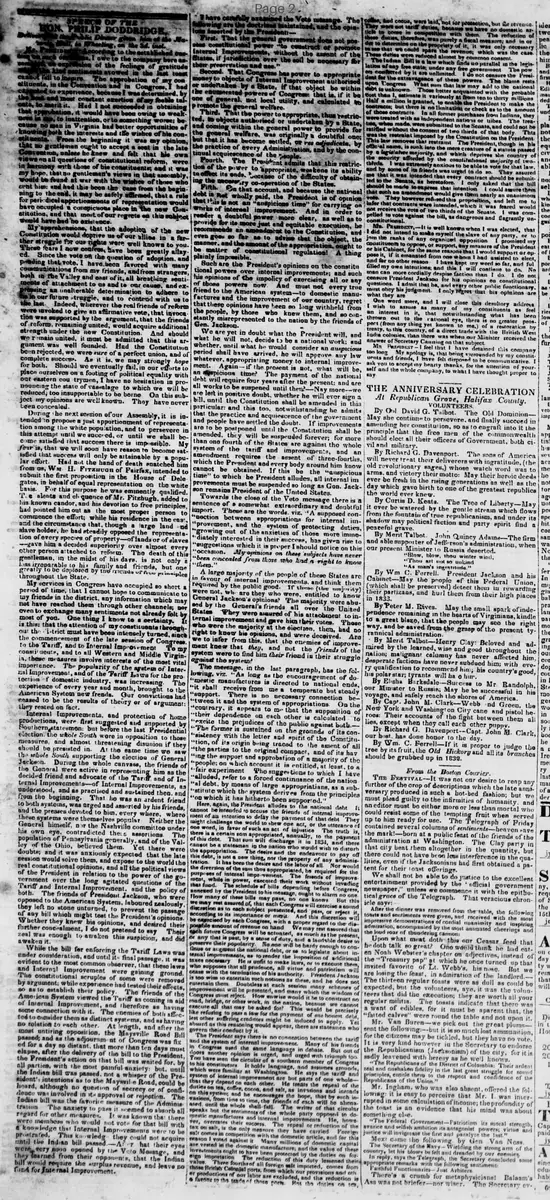
According to the established custom, I owe to the company here an expression of the feelings of gratitude kind sentiments avowed in the last toast cannot fail to inspire. The approbation of my constituents, in the Convention and in Congress, I had expected to experience, because I was determined, by the seat and most constant exertion of my feeble talents, to merit it. Had I not succeeded in obtaining that approbation, it would have been owing to weakness in me, to inattention, or to something worse; because no man in Virginia had better opportunities of knowing both the interests and the wishes of his constituents.
From the beginning it was my opinion, that no gentleman ought to accept a seat in the late Convention, unless he knew and felt that his own views on all questions of constitutional reform, were in harmony with those of his constituents; and it was my hope, that no gentleman's views in that assembly, would be found at war with the wishes of those who sent him: and had this been the case from the beginning to the end, it may be safely affirmed, that a rule for periodical apportionments of representation would have occupied a conspicuous place in the new Constitution, and that most of our regrets on this subject would have had no existence.
My apprehensions, that the adoption of the new Constitution would deprive us of our allies in a further struggle for our rights were well known to you. These fears I now confess, have been greatly allayed. Since the vote on the question of adoption, and pending that vote, I have been favored with many communications from my friends, and from strangers, both in the Valley and east of it, all breathing sentiments of attachment to us and to our cause, and expressing an unalterable determination to adhere to us in our future struggle, and to contend with us to the last. Indeed, wherever the real friends of reform were invoked to give an affirmative vote, that invocation was supported by the argument, that the friends of reform, remaining united, would acquire additional strength under the new Constitution. And should we remain united, it must be admitted that this argument was well founded. Had the Constitution been rejected, we were sure of a perfect union, and of complete success.
As it is, we may strongly hope for both. Should we eventually fail, in our efforts to place ourselves on a footing of political equality with our eastern countrymen, I have no hesitation in pronouncing the state of vassalage to which we will be reduced; too insupportable to be borne. On this subject my opinions are well known. They have never been concealed.
During the next session of our Assembly, it is intended to propose a just apportionment of representation among the white population, and to persevere in this attempt until we succeed, or until we shall become satisfied that success there is impossible. My fear is, that we will soon have reason to become satisfied that success will only be attainable by a popular effort. Had not the hand of death snatched him from us, WM. H. Fitzhugh of Fairfax, intended to submit the first proposition in the House of Delegates, in behalf of equal representation on the white basis. For this purpose he was eminently qualified. The talents and eloquence of Mr. Fitzhugh, added to his known candor, and his devotion to free principles, had pointed him out as the most proper person to commence the effort; while his residence in the east, and the circumstance that, though a large land and slave holder, he had steadily opposed the representation of every species of property—of lands or of slaves—gave him a decided superiority over almost every other person attached to reform. The death of this gentleman, in the midst of his days, is not only a loss irreparable to his family and friends, but one greatly to be deplored by the friends of free principles throughout the State.
My services in Congress have occupied so short a period of time, that I cannot hope to communicate to my friends in the district, any information which may not have reached them through other channels; nor even to exchange many sentiments not already felt by most of you. One thing I know to a certainty. It is this: that the attention of my constituents throughout the district must have been intensely turned, since the commencement of the late session of Congress, to the Tariff, and to Internal Improvement. To my constituents, and to all Western and Middle Virginia, these measures involve interests of the most vital importance. The popularity of the system of Internal Improvement, and of the Tariff Laws for the protection of domestic industry, was increasing. The experience of every year and month, brought to the American System new friends. Our convictions had ceased to be the results of theory or of argument: they rested on fact.
Internal Improvements, and protection of home productions, were first suggested and supported by Southern statesmen: but before the last Presidential election, the whole South were in opposition to those measures, and almost threatening disunion if they should be persisted in. At the same time we saw the whole South supporting the election of General Jackson. During the whole canvass, the friends of the General were active in representing him as the decided friend and advocate of the Tariff, and of Internal Improvements—of Internal Improvements, as understood, and as practised and sustained then, and from the beginning. That he was an ardent friend to both systems, was urged and asserted by his friends, and the presses devoted to him, everywhere, where these systems were themselves popular. Neither the General himself, nor the Nashville committee under his own eye, contradicted these assertions. The population of Pennsylvania generally, and of the Valley of the Ohio, believed them. Yet there were doubts; and it was anxiously expected that the late session would solve them, and expose to the world the real constitutional opinions, and all the political views of the President in relation to the power of the government over the long agitated questions of the Tariff and Internal Improvement, and the policy of both. The friends of President Jackson, who were opposed to the American System, laboured zealously. They left no stone unturned, to prevent the passage of any bill which might test the President's opinions. Whether they knew his opinions, and desired their further concealment, I do not pretend to say. Their zeal was enough to awaken this suspicion, and did awaken it.
While the bill for enforcing the Tariff Laws was under consideration, and until its final passage, it was evident to the most common observer, that these laws and Internal Improvement were gaining ground. The constitutional scruples of some were removed by argument; while experience had tested their effects, so as to establish their policy. The friends of the American System viewed the Tariff as coming in aid of Internal Improvement, and therefore as having some connection with it. The enemies of both affected to consider them as distinct systems, and as having no relation to each other. At length, and after the most untiring opposition, the Maysville Road Bill passed; and as the adjournment of Congress was fixed for a day so distant, that more than ten days must elapse, after the delivery of the bill to the President, the President's action on that bill was waited for, by all parties, with the most painful anxiety: but, until the Indian bill was passed, not a whisper of the President's intentions as to the Maysville Road, could be heard, although no question of secrecy or of confidence was involved in it—approval or rejection. The Indian bill was the favorite measure of the Administration. The anxiety to pass it seemed to absorb all regard for other measures. It was known that there were members who would not vote for that bill with a knowledge that Internal Improvements were to be prostrated. This knowledge they could not acquire until the Indian bill passed. At that their eyes were very soon opened by the Veto Message, and they learned from their opponents, that the Indian bill would require the surplus revenue, and leave no fund for Internal Improvement.
I have carefully examined the Veto message. The following are the doctrines maintained, and the opinions asserted by the President.
First. That the federal government does not possess constitutional power to construct or promote Internal Improvements, without the assent of the States, if jurisdiction over the soil be necessary for their preservation and use.
Second. That Congress has power to appropriate money to objects of Internal Improvement authorised or undertaken by a State, if that object be within the enumerated powers of Congress: that is, if it be one of general, not local utility, and calculated to promote the general welfare.
Third. That the power to appropriate, thus restricted, to objects authorised or undertaken by State, and coming within the general power to provide for the general welfare, was originally a doubtful one; but that it has become settled, or res adjudicata, by the practice of every Administration, and by the continual acquiescence of the people.
Fourth. The President admits that this restriction of the power to appropriate, weakens its ability to effect its ends, because of the difficulty of obtaining the necessary co-operation of the States.
Fifth. On that account, and because the national debt is not wholly paid, the President is of opinion that this is not an "auspicious time" for carrying on works of internal improvement. And in order to render a doubtful power more clear, as well as to provide for its more just and equitable execution, he recommends an amendment to the Constitution, and even goes so far as to advise that the object, the manner, and the amount of the appropriation, ought to be matter of constitutional regulation! A thing plainly impossible.
Such are the President's opinions on the constitutional powers over internal improvements; and such his opinions of the impolicy of exercising all or any of those powers now. And must not every true friend to the American system—to domestic manufactures and the improvement of our country, regret that these opinions have been so long withheld from the people, by those who knew them, and so constantly misrepresented to the nation by the friends of Gen. Jackson.
We are yet in doubt what the President will, and what he will not, decide to be a national work: and whether, until what he would consider an auspicious period shall have arrived, he will approve any law whatever, appropriating money to internal improvement. Again—if the present is not, what will be, an auspicious time? The payment of the national debt will require four years after the present: and are all works to be suspended until then?—Nay more—we are left in positive doubt, whether he will ever sign a bill, until the Constitution shall be amended in this particular: and this too, notwithstanding he admits that the practice and acquiescence of the government and people have settled the doubt. If improvements are to be postponed until the Constitution shall be amended, they will be suspended forever; for more than one fourth of the States are against the whole system of the tariff and improvements, and an amendment requires the assent of three-fourths, which the President and every body around him know cannot be obtained. If this be the "auspicious time" to which the President alludes, all internal improvements must be suspended so long as Gen. Jackson remains President of the United States.
Towards the close of the Veto message there is a sentence of somewhat extraordinary and doubtful import. These are the words, viz. "A supposed connection between appropriations for internal improvement, and the system of protecting duties, growing out of the anxieties of those more immediately interested in their success, has given rise to suggestions which it is proper I should notice on this occasion. My opinions on these subjects have never been concealed from those who had a right to know them."
A large majority of the people of these States are in favour of internal improvements, and think them required by the public good. If these (the majority) were not, who are they who were, entitled to know General Jackson's opinions? The majority were abused by the General's friends all over the United States. They were assured of his attachment to internal improvement and gave him their votes. Those who were the majority at the election, then, had no right to know his opinions, and were deceived. Are we to infer from this, that the enemies of improvement knew that they, and not the friends of the system were to find him their friend in their struggle against the system?
The message, in the last paragraph, has the following, viz. "As long as the encouragement of domestic manufactures is directed to national ends, it shall receive from me a temperate but steady support. There is no necessary connection between it and the system of appropriations. On the contrary, it appears to me that the supposition of their dependence on each other is calculated to excite the prejudices of the public against both. The former is sustained on the grounds of its consistency with the letter and spirit of the Constitution, of its origin being traced to the assent of all the parties to the original compact, and of its having the support and approbation of a majority of the people; on which account it is entitled, at least, to a fair experiment. The suggestions to which I have alluded, refer to a forced continuance of the national debt, by means of large appropriations, as a substitute which the system derives from the principles on which it has hitherto been supported."
Here, again, the President alludes to the national debt. It cannot be intended to accuse the friends of internal improvement of an intention to delay the payment of that debt. They might challenge the world to show one act, or the utterance of one word, in favor of such an act of injustice. There is a certain sum appropriated, annually, to the payment of this debt. That sum will discharge it in 1834, and there cannot be a statesman in the nation who would wish to disturb the appropriation.
The truth is, the desire and the endeavour to pay off this debt, is not a new thing, nor the property of any administration. It has been the desire and the labor of all. Nor would the diversion of the sum thus appropriated, be required for the purposes of internal improvement. The friends of improvement, while in power, executed their work without invading that fund. The schedule of bills depending before Congress, annexed by the President to his message, ought to alarm no one. How many of these bills may pass, no one knows. But this we may rest assured of, that each Congress will exercise a sound discretion as to each subject presented, and pass, or reject it, according to its importance or merit. And this discretion will be exercised by each Congress, with a proper regard to the disposable amount of revenue on hand. We may rest assured that each future Congress will be actuated, as much as the present, or any that is past, by sense of duty, and a laudable desire to preserve their popularity. No one will be hardy enough to continue or augment the national debt, or so to legislate about internal improvements, as to render the imposition of additional taxes necessary. He is unfit to make laws, or to execute them, who supposes that all prudence, all virtue and patriotism will cease with the termination of his authority. President Jackson is too wise to entertain such notions as these, and he does not entertain them. Doubtless at each session many schemes of improvement will be presented, and many which the wisdom of Congress must reject. How unwise would it be to construct no road, bridge, or other work, in the nation, because we cannot execute all that may be asked for? This would be precisely like refusing to pass a law for the payment of one honest debt, lest other suffering creditors might be induced to apply. Yet absurd as this reasoning would appear, there are statesmen who govern their conduct by it.
The President says there is connection between the tariff and the system of internal improvement. Many of his friends in Congress used the same language in debate. But out of debate, another opinion is urged, and urged with triumph too.
You have seen the circular of a southern member of Congress to his constituents. It holds language, and assumes grounds, which were familiar at Washington. He says the tariff and system of internal improvement are but parts of one whole—that they depend on each other. He treats the repeal of the duties on tea, coffee, cocoa, and salt, as invasions and inroads on this system; and he encourages the hope, that by such invasions, from time to time, the friends of each will be alienated, until the whole shall fall. The writer of that circular speaks but the sentiments of the whole party opposed to domestic manufactures and internal improvements. He, however, overrates their success. The repeal or reduction of the tax on salt, is the only measure they have carried. Salt comes in competition with the domestic article, and for this reason I voted against it. Many millions of domestic capital are vested in the domestic manufacture; and the value of these investments ought to have been protected by the duties on foreign importation. The reduction of this duty lessened their value. Three fourths of all foreign salt imported, comes from those British Colonial ports, from which our provisions and other productions of our labor are excluded, and the reduction is a favour to the trade of those ports. But the duties on tea, coffee and cocoa, were laid, not for protection, but for revenue. They were not tariff duties, because we have no domestic article to come in competition with them. The reduction of these duties, therefore, was purely a fiscal measure; and in order to determine on the propriety of it, it was only necessary to see that we could spare the revenue; which was the case. These duties were reduced almost by common consent.
The Indian Bill is a law which finds no parallel in the legislation of any free state; under any free government. The powers conferred by it are unlimited. I do not censure the President for the extravagance of these powers. The blame rests upon Congress. What sum that may add to the national debt is unknown. Those better acquainted with the probable cost than I, estimate it variously at from ten to thirty millions. Half a million is granted, to enable the President to make the contracts; but there is no limitation or check as to the amount of those contracts. In all former purchases from Indians, they were treated with as independent nations or tribes. The treaties when made, were submitted to the Senate, and could not be ratified without the consent of two thirds of that body. This was the restraint imposed by the Constitution on the President. This law removes that restraint. The President, though in his official name, is sunk into the mere creature of a statute passed by a legislative majority, and which deprives the country of the security afforded by the constitutional majority of two-thirds. I was extremely anxious to be able to vote for that law, and by some of its friends was urged to do so. They assured me that it was intended that every contract should be submitted to the Senate, as heretofore. They only asked that the bill should be made to express that intention. I could assure them that such an amendment would give them nearly an unanimous vote. They however refused this proposition, and left me to infer that contracts were intended, which it was feared would not receive the vote of two thirds of the Senate. Compelled to vote against the bill, as dangerous and flagrantly unconstitutional.
Mr. Speaker,—It is well known when I was elected, that I did not intend to make myself the slave of any organized opposition party, or to promise my constituents to oppose, or support, the measures of the President or his Cabinet, for the same reason that I would support or oppose it, if it emanated from one whom I had assisted to elect, and for no other reason. I have kept my word so far, and fulfilled my own intentions; and this I will continue to do. No man can more cordially despise faction than I do. I do not censure President Jackson for his opinions on constitutional questions. I admit that he, and every other public functionary, must obey his judgment. I only regret that his opinions are what they are.
One word more, and I will close this desultory address. I wish to assure as many of my constituents as feel an interest in it, that notwithstanding what has been thrown out to the rational eye, there is no greater prospect (from any thing yet known to me.) of a restoration by treaty, to this country, of a direct trade with the British West India colonies, than there was when our Minister received the answer of Secretary Canning on that subject.
Mr. Speaker—I feel that I have detained this company too long. My apology is, that being surrounded by my constituents and friends, I have felt disposed to be communicative. I ask you to accept my hearty thanks, for the attention of yourself and the whole company, to what I have thought proper to say.
THE ANNIVERSARY CELEBRATION
At Republican Grove, Halifax County.
VOLUNTEERS.
By Col. David G. Talbot. The Old Dominion—May she continue to persevere, and finally succeed in amending her constitution, so as to engraft into it the principle that the free men of the commonwealth should elect all their officers of Government, both civil and military.
By Richard G. Davenport. The sons of America will never treat their deliverers with ingratitude, (the old revolutionary sages,) whose watch word was to arms, and victory their motto: May their heroic deeds ever be fresh in the rising generations as well as the day which gave birth to one of the greatest republics the world ever knew.
By Curtis D. Keats. The Tree of Liberty—May it ever be watered by the gentle stream which flows from the fountain of true republicanism, and under its shadow may political faction and party spirit find a peaceful grave.
By Merit Talbot. John Quincy Adams—The firm and able supporter of Jefferson's administration, when our present Minister to Russia deserted.
"Blow, blow, thou winter wind,
Thou art not so unkind
As man's ingratitude."
By Wm. C. Ferrell. "President Jackson and his Cabinet—May the people of this Federal Union, (which shall be preserved) detect them in rewarding their partisans, and hurl them from their high places in 1833."
By Peter M. Rives. May the small spark of independence remaining in the hearts of Virginians, kindle to a great blaze, that the people may see the right way, and be saved from the grasp of the present tyrannical administration.
By Merit Talbot—Henry Clay: Beloved and admired by the learned, wise and good throughout the nation; malignant calumny has never affected him. Desperate factions have never subdued him; with every qualification to recommend him; his country's good, his polar star; tyrants will hate him.
By Elisha Barksdale—Success to Mr. Randolph, our Minister to Russia; May he be successful in his voyage, and safely reach the shores of America.
By Capt. John M. Clark—Webb and Green, the New York and Washington City cane and pistol heroes: Their accounts of the fight between them all lies, except when they call each other puppy.
By Richard G. Davenport—Capt. John M. Clark, our host, has done honor to the day.
By Wm. C. Ferrell—If it is proper to judge the tree by its fruit, the Old Hickory and all its branches should be grubbed up in 1832.
What sub-type of article is it?
What themes does it cover?
What keywords are associated?
What entities or persons were involved?
Where did it happen?
Story Details
Key Persons
Location
Virginia, Republican Grove, Halifax County
Story Details
Hon. Philip Doddridge delivers a speech expressing gratitude to constituents, advocating for constitutional reform for equal representation based on white population, lamenting the death of WM. H. Fitzhugh, supporting tariff and internal improvements, criticizing President Jackson's veto of the Maysville Road Bill and views on Indian Bill, and concluding with toasts at the anniversary celebration.