Thank you for visiting SNEWPapers!
Sign up free
Story
March 22, 1896
Fort Worth Gazette
Fort Worth, Tarrant County, Texas
What is this article about?
William P. Stedman, now a messenger in the U.S. Agricultural Department, recounts his role in capturing Confederate President Jefferson Davis near Abbeville, Ga., on May 3, 1865, as Davis fled in disguise.
Clipping
OCR Quality
95%
Excellent
Full Text
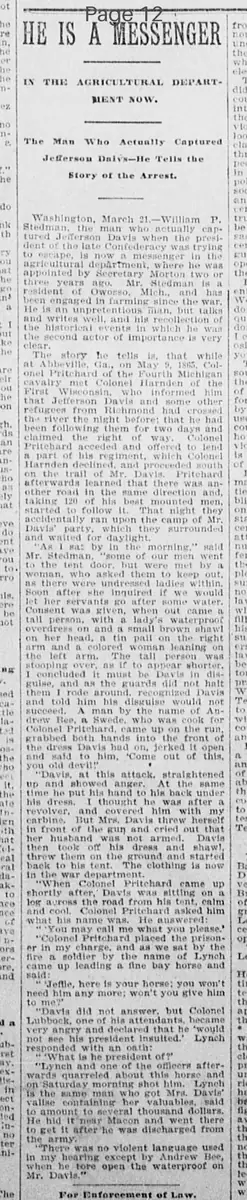
HE IS A MESSENGER
IN THE AGRICULTURAL DEPARTMENT NOW.
The Man
Who
Actually Captured
Jefferson Davis—He Tells the
Story of the Arrest.
Washington, March 21.—William P.
Stedman, the man who actually captured
Jefferson Davis when the president
of the late Confederacy was trying
to escape, is now a messenger in the
agricultural department, where he was
appointed by Secretary Morton two or
three years ago.
Mr. Stedman is a
resident of Owosso, Mich., and has
been engaged in farming since the war.
He is an unpretentious man, but talks
and writes well, and his recollection of
the historical events in which he was
the second actor of importance is very
clear.
The story he tells is, that while
at Abbeville, Ga., on May 3, 1865, Colonel
Pritchard of the Fourth Michigan
cavalry met Colonel Harnden of the
First Wisconsin, who informed him
that Jefferson Davis and some other
refugees from Richmond had crossed
the river the night before; that he had
been following them for two days and
claimed the right of way. Colonel
Pritchard acceded and offered to lend
a part of his regiment, which Colonel
Harnden declined, and proceeded south
on the trail of Mr. Davis. Pritchard
afterwards learned that there was another
road in the same direction and,
taking 120 of his best mounted men,
started to follow it. That night they
accidentally ran upon the camp of Mr.
Davis' party, which they surrounded
and waited for daylight.
"As I sat by in the morning," said
Mr. Stedman, "some of our men went
to the tent door, but were met by a
woman, who asked them to keep out,
as there were undressed ladies within.
Soon after she inquired if we would
let her servants go after some water.
Consent was given, when out came a
tall person, with a lady's waterproof
overdress on and a small brown shawl
on her head, a tin pail on the right
arm and a colored woman leaning on
the left arm. The tall person was
stooping over, as if to appear shorter.
I concluded it must be Davis in disguise,
and as the guards did not halt
them I rode around, recognized Davis
and told him his disguise would not
succeed. A man by the name of Andrew
Bee, a Swede, who was cook for
Colonel Pritchard, came up on the run,
grabbed both hands into the front of
the dress Davis had on, jerked it open
and said to him, 'Come out of this,
you old devil!'
"Davis, at this attack, straightened
up and showed anger. At the same
time he put his hand to his back under
his dress. I thought he was after a
revolver, and covered him with my
carbine. But Mrs. Davis threw herself
in front of the gun and cried out that
her husband was 'not armed.' Davis
then took off his dress and shawl,
threw them on the ground and started
back to his tent. The clothing is now
in the war department.
"When Colonel Pritchard came up
shortly after, Davis was sitting on a
log across the road from his tent, calm
and cool. Colonel Pritchard asked him
what his name was. He answered:
"'You may call me what you please.'
"Colonel Pritchard placed the prisoner
in my charge, and as we sat by the
fire a soldier by the name of Lynch
came up leading a fine bay horse and
said:
"'Jeffie, here is your horse; you won't
need him any more; won't you give him
to me?'
"Davis did not answer, but Colonel
Lubbock, one of his attendants, became
very angry and declared that he 'would
not see his president insulted.' Lynch
responded with an oath:
"'What is he president of?'
"Lynch and one of the officers afterwards
quarreled about this horse and
on Saturday morning shot him. Lynch
is the same man who got Mrs. Davis'
valise containing her valuables (said
to amount to several thousand dollars).
He hid it near Macon and went there
to get it after he was discharged from
the army.
"There was no violent language used
in my hearing except by Andrew Bee,
when he tore open the waterproof on
Mr. Davis."
IN THE AGRICULTURAL DEPARTMENT NOW.
The Man
Who
Actually Captured
Jefferson Davis—He Tells the
Story of the Arrest.
Washington, March 21.—William P.
Stedman, the man who actually captured
Jefferson Davis when the president
of the late Confederacy was trying
to escape, is now a messenger in the
agricultural department, where he was
appointed by Secretary Morton two or
three years ago.
Mr. Stedman is a
resident of Owosso, Mich., and has
been engaged in farming since the war.
He is an unpretentious man, but talks
and writes well, and his recollection of
the historical events in which he was
the second actor of importance is very
clear.
The story he tells is, that while
at Abbeville, Ga., on May 3, 1865, Colonel
Pritchard of the Fourth Michigan
cavalry met Colonel Harnden of the
First Wisconsin, who informed him
that Jefferson Davis and some other
refugees from Richmond had crossed
the river the night before; that he had
been following them for two days and
claimed the right of way. Colonel
Pritchard acceded and offered to lend
a part of his regiment, which Colonel
Harnden declined, and proceeded south
on the trail of Mr. Davis. Pritchard
afterwards learned that there was another
road in the same direction and,
taking 120 of his best mounted men,
started to follow it. That night they
accidentally ran upon the camp of Mr.
Davis' party, which they surrounded
and waited for daylight.
"As I sat by in the morning," said
Mr. Stedman, "some of our men went
to the tent door, but were met by a
woman, who asked them to keep out,
as there were undressed ladies within.
Soon after she inquired if we would
let her servants go after some water.
Consent was given, when out came a
tall person, with a lady's waterproof
overdress on and a small brown shawl
on her head, a tin pail on the right
arm and a colored woman leaning on
the left arm. The tall person was
stooping over, as if to appear shorter.
I concluded it must be Davis in disguise,
and as the guards did not halt
them I rode around, recognized Davis
and told him his disguise would not
succeed. A man by the name of Andrew
Bee, a Swede, who was cook for
Colonel Pritchard, came up on the run,
grabbed both hands into the front of
the dress Davis had on, jerked it open
and said to him, 'Come out of this,
you old devil!'
"Davis, at this attack, straightened
up and showed anger. At the same
time he put his hand to his back under
his dress. I thought he was after a
revolver, and covered him with my
carbine. But Mrs. Davis threw herself
in front of the gun and cried out that
her husband was 'not armed.' Davis
then took off his dress and shawl,
threw them on the ground and started
back to his tent. The clothing is now
in the war department.
"When Colonel Pritchard came up
shortly after, Davis was sitting on a
log across the road from his tent, calm
and cool. Colonel Pritchard asked him
what his name was. He answered:
"'You may call me what you please.'
"Colonel Pritchard placed the prisoner
in my charge, and as we sat by the
fire a soldier by the name of Lynch
came up leading a fine bay horse and
said:
"'Jeffie, here is your horse; you won't
need him any more; won't you give him
to me?'
"Davis did not answer, but Colonel
Lubbock, one of his attendants, became
very angry and declared that he 'would
not see his president insulted.' Lynch
responded with an oath:
"'What is he president of?'
"Lynch and one of the officers afterwards
quarreled about this horse and
on Saturday morning shot him. Lynch
is the same man who got Mrs. Davis'
valise containing her valuables (said
to amount to several thousand dollars).
He hid it near Macon and went there
to get it after he was discharged from
the army.
"There was no violent language used
in my hearing except by Andrew Bee,
when he tore open the waterproof on
Mr. Davis."
What sub-type of article is it?
Historical Event
Military Action
Biography
What themes does it cover?
Justice
Bravery Heroism
Triumph
What keywords are associated?
Jefferson Davis
Capture
Disguise
Civil War
William Stedman
Confederate President
Military Arrest
What entities or persons were involved?
William P. Stedman
Jefferson Davis
Colonel Pritchard
Mrs. Davis
Andrew Bee
Colonel Harnden
Colonel Lubbock
Lynch
Where did it happen?
Abbeville, Ga.
Story Details
Key Persons
William P. Stedman
Jefferson Davis
Colonel Pritchard
Mrs. Davis
Andrew Bee
Colonel Harnden
Colonel Lubbock
Lynch
Location
Abbeville, Ga.
Event Date
May 3, 1865
Story Details
William P. Stedman recounts capturing Jefferson Davis in disguise near Abbeville, Ga., on May 3, 1865, while serving under Colonel Pritchard of the Fourth Michigan cavalry. Davis attempted to escape dressed as a woman, but was recognized and arrested without violence, except for Bee tearing his disguise.