Thank you for visiting SNEWPapers!
Sign up free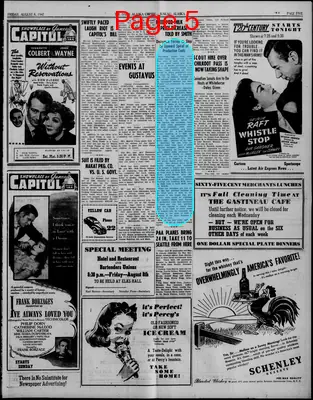
The Daily Alaska Empire
Juneau, Juneau County, Alaska
What is this article about?
In Juneau, Alaska, dairymen led by L. H. Smith announce a reluctant milk price increase next Monday due to rising production costs, including shipped feed at July 1947 rates, amid a poor local hay crop. Even at the new price, Juneau milk remains Alaska's cheapest.
Clipping
OCR Quality
Full Text
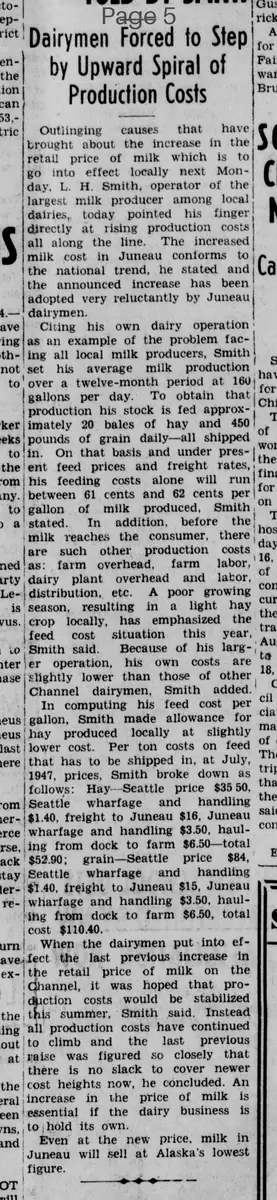
Outlining causes that have brought about the increase in the retail price of milk which is to go into effect locally next Monday, L. H. Smith, operator of the largest milk producer among local dairies, today pointed his finger directly at rising production costs all along the line. The increased milk cost in Juneau conforms to the national trend, he stated and the announced increase has been adopted very reluctantly by Juneau dairymen.
Citing his own dairy operation as an example of the problem facing all local milk producers, Smith set his average milk production over a twelve-month period at 160 gallons per day. To obtain that production his stock is fed approximately 20 bales of hay and 450 pounds of grain daily-all shipped in. On that basis and under present feed prices and freight rates, his feeding costs alone will run between 61 cents and 62 cents per gallon of milk produced, Smith stated. In addition, before the milk reaches the consumer, there are such other production costs as: farm overhead, farm labor, dairy plant overhead and labor, distribution, etc. A poor growing season, resulting in a light hay crop locally, has emphasized the feed cost situation this year, Smith said.
Because of his larger operation, his own costs are slightly lower than those of other Channel dairymen, Smith added. In computing his feed cost per gallon, Smith made allowance for hay produced locally at slightly lower cost. Per ton costs on feed that has to be shipped in, at July, 1947, prices, Smith broke down as follows: Hay--Seattle price $35.50. Seattle wharfage and handling $1.40, freight to Juneau $16, Juneau wharfage and handling $3.50, hauling from dock to farm $6.50-total $52.90; grain-Seattle price $84, Seattle wharfage and handling $1.40, freight to Juneau $15, Juneau wharfage and handling $3.50, hauling from dock to farm $6.50, total cost $110.40.
When the dairymen put into effect the last previous increase in the retail price of milk on the Channel, it was hoped that production costs would be stabilized this summer, Smith said. Instead all production costs have continued to climb and the last previous raise was figured so closely that there is no slack to cover newer cost heights now, he concluded. An increase in the price of milk is essential if the dairy business is to hold its own.
Even at the new price. milk in Juneau will sell at Alaska's lowest figure.
What sub-type of article is it?
What keywords are associated?
What entities or persons were involved?
Where did it happen?
Domestic News Details
Primary Location
Juneau
Event Date
Next Monday
Key Persons
Outcome
milk retail price increase adopted reluctantly; even at new price, milk in juneau sells at alaska's lowest figure.
Event Details
L. H. Smith explains rising production costs, including feed shipped in, leading to increased retail milk price in Juneau conforming to national trend. His dairy produces 160 gallons daily, with feeding costs at 61-62 cents per gallon; poor hay crop worsens situation. Breakdown of shipped feed costs provided for July 1947. Previous increase insufficient for ongoing cost climbs.