Thank you for visiting SNEWPapers!
Sign up free
The New Hampshire Gazette
Portsmouth, Rockingham County, New Hampshire
What is this article about?
Detailed eyewitness account of the 1793 yellow fever epidemic in Philadelphia, imported from Hispaniola and possibly Marseilles, causing over 4,000 deaths, mass desertions, and heroic responses by figures like Stephen Girard and Peter Helm at Bush Hill Hospital.
Clipping
OCR Quality
Full Text
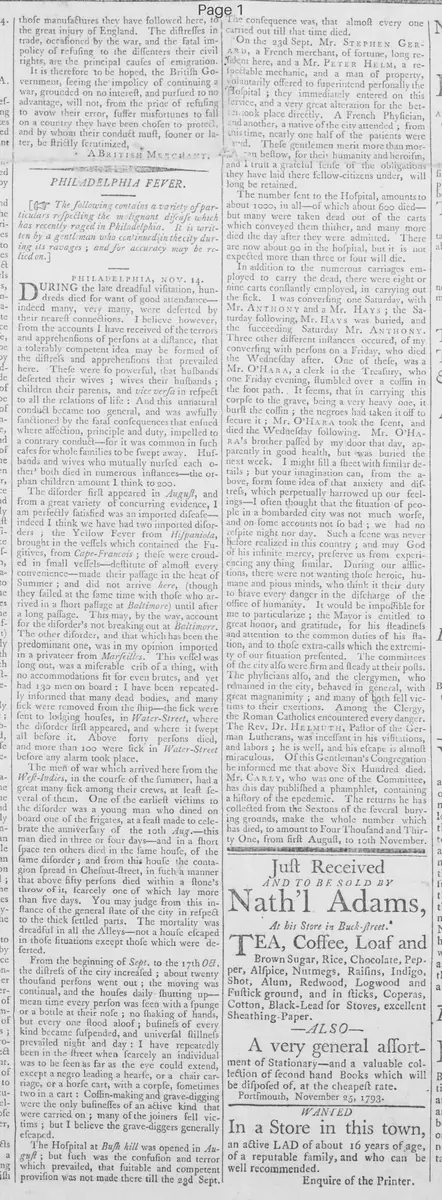
[The following contains a variety of particulars respecting the malignant disease which has recently raged in Philadelphia. It is written by a gentleman who continued in the city during its ravages; and for accuracy may be relied on.]
PHILADELPHIA, NOV. 14.
DURING the late dreadful visitation, hundreds died for want of good attendance—indeed many, very many, were deserted by their nearest connections. I believe however, from the accounts I have received of the terrors and apprehensions of persons at a distance, that a tolerably competent idea may be formed of the distress and apprehensions that prevailed here. These were so powerful, that husbands deserted their wives; wives their husbands; children their parents, and vice versa in respect to all the relations of life: And this unnatural conduct became too general, and was awfully sanctioned by the fatal consequences that ensued where affection, principle and duty, impelled to a contrary conduct—for it was common in such cases for whole families to be swept away. Husbands and wives who mutually nursed each other both died in numerous instances—the orphan children amount I think to 200.
The disorder first appeared in August, and from a great variety of concurring evidence, I am perfectly satisfied was an imported disease—indeed I think we have had two imported disorders; the Yellow Fever from Hispaniola, brought in the vessels which contained the Fugitives, from Cape-Francois; these were crowded in small vessels—destitute of almost every convenience—made their passage in the heat of Summer; and did not arrive here, (though they sailed at the same time with those who arrived in a short passage at Baltimore) until after a long passage. This may, by the way, account for the disorder's not breaking out at Baltimore.
The other disorder, and that which has been the predominant one, was in my opinion imported in a privateer from Marseilles. This vessel was long out, was a miserable crib of a thing, with no accommodations fit for even brutes, and yet had 130 men on board: I have been repeatedly informed that many dead bodies, and many sick were removed from the ship—the sick were sent to lodging houses, in Water-Street, where the disorder first appeared, and where it swept all before it. Above forty persons died, and more than 100 were sick in Water-Street before any alarm took place.
The men of war which arrived here from the West-Indies, in the course of the summer, had a great many sick among their crews, at least several of them. One of the earliest victims to the disorder was a young man who dined on board one of the frigates, at a feast made to celebrate the anniversary of the 10th Aug.—this man died in three or four days—and in a short space ten others died in the same house, of the same disorder; and from this house the contagion spread in Chestnut-street, in such a manner that above fifty persons died within a stone's throw of it, scarcely one of which lay more than five days. You may judge from this instance of the general state of the city in respect to the thick settled parts. The mortality was dreadful in all the Alleys—not a house escaped in those situations except those which were deserted.
From the beginning of Sept. to the 17th Oct. the distress of the city increased; about twenty thousand persons went out; the moving was continual, and the houses daily shutting up—mean time every person was seen with a sponge or a bottle at their nose; no shaking of hands, but every one stood aloof; business of every kind became suspended, and universal stillness prevailed night and day: I have repeatedly been in the street when scarcely an individual was to be seen as far as the eye could extend, except a negro leading a hearse, or a chair carriage, or a horse cart, with a corpse, sometimes two in a cart: Coffin-making and grave-digging were the only businesses of an active kind that were carried on; many of the joiners fell victims; but I believe the grave-diggers generally escaped.
The Hospital at Bush hill was opened in August; but such was the confusion and terror which prevailed, that suitable and competent provision was not made there till the 23d Sept. The consequence was, that almost every one carried out till that time died.
On the 23d Sept. Mr. STEPHEN GIRARD, a French merchant, of fortune, long resident here, and a Mr. PETER HELM, a respectable mechanic, and a man of property, voluntarily offered to superintend personally the Hospital: they immediately entered on this service, and a very great alteration for the better took place directly. A French Physician, and another, a native of the city attended; from this time, nearly one half of the patients were saved. These gentlemen merit more than mortals can bestow, for their humanity and heroism, and I trust a grateful sense of the obligations they have laid their fellow-citizens under, will long be retained.
The number sent to the Hospital, amounts to about 1000, of which about 600 died—but many were taken dead out of the carts which conveyed them thither, and many more died the day after they were admitted. There are now about 90 in the hospital, but it is not expected more than three or four will die.
In addition to the numerous carriages employed to carry the dead, there were eight or nine carts constantly employed, in carrying out the sick. I was conversing one Saturday, with Mr. Anthony and a Mr. Hays: the Saturday following, Mr. Hays was buried, and the succeeding Saturday Mr. ANTHONY.
Three other different instances occurred, of my conversing with persons on a Friday, who died the Wednesday after. One of these, was a Mr. O'HARA, a clerk in the Treasury, who one Friday evening, stumbled over a coffin in the foot path. It seems, that in carrying this corpse to the grave, being a very heavy one, it burst the coffin; the negroes had taken it off to secure it; Mr. O'HARA took the scent, and died the Wednesday following. Mr. O'HARA's brother passed by my door that day, apparently in good health, but was buried the next week. I might fill a sheet with similar details; but your imagination can, from the above, form some idea of that anxiety and distress, which perpetually harrowed up our feelings—I often thought that the situation of people in a bombarded city was not much worse, and on some accounts not so bad; we had no respite night nor day. Such a scene was never before realized in this country; and may God of his infinite mercy, preserve us from experiencing any thing similar. During our afflictions, there were not wanting those heroic, humane and pious minds, who think it their duty to brave every danger in the discharge of the office of humanity. It would be impossible for me to particularize; the Mayor is entitled to great honor, and gratitude, for his steadiness and attention to the common duties of his station, and to those extra-calls which the extremity of our situation presented. The committees of the city also were firm and steady at their posts. The physicians also, and the clergymen, who remained in the city, behaved in general, with great magnanimity; and many of both fell victims to their exertions. Among the Clergy, the Roman Catholics encountered every danger. The Rev. Dr. HELMUTH, Pastor of the German Lutherans, was incessant in his visitations, and labors; he is well, and his escape is almost miraculous. Of this Gentleman's Congregation he informed me that above Six Hundred died.
Mr. CARRY, who was one of the Committee, has this day published a pamphlet, containing a history of the epidemic. The returns he has collected from the Sextons of the several burying grounds, make the whole number which has died, to amount to Four Thousand and Thirty One, from first August, to 10th November.
What sub-type of article is it?
What keywords are associated?
What entities or persons were involved?
Where did it happen?
Domestic News Details
Primary Location
Philadelphia
Event Date
August To 10th November 1793
Key Persons
Outcome
over 4,000 deaths total; about 600 died at bush hill hospital out of 1,000 admitted; 200 orphans; many families wiped out; 20,000 residents fled.
Event Details
Yellow fever epidemic imported via ships from Hispaniola and a privateer from Marseilles; spread rapidly in Water Street and alleys; caused mass desertions, business suspension, and high mortality; Bush Hill Hospital improved under Girard and Helm from Sept 23, saving half the patients; heroic efforts by officials, clergy, and physicians.