Thank you for visiting SNEWPapers!
Sign up free
The Democratic Whig
Columbus, Lowndes County, Mississippi
What is this article about?
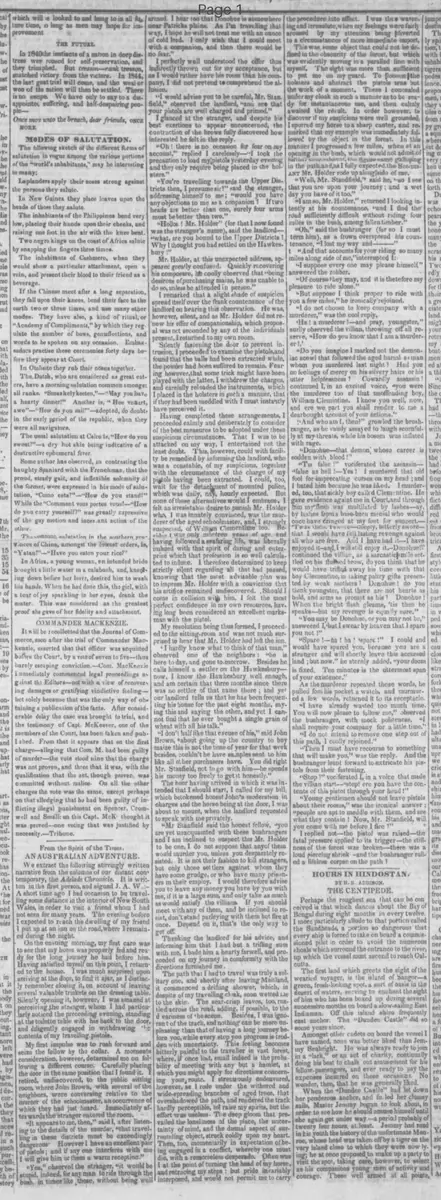
From the Spirit of the Times. AN AUSTRALIAN ADVENTURE. We extract the following stirringly written narrative from the columns of our distant contemporary, the Adelaide Chronicle. It is written in the first person, and signed J. A. W.:— A short time ago I had occasion to be travelling some distance in the interior of New South Wales, in order to visit a friend whom I had not seen for many years. The evening before I expected to reach the dwelling of my friend I put up at an inn on the road, where I remained during the night. On the ensuing morning, my first care was to see that my horse was properly fed and ready for the long journey he had before him. Having satisfied myself on this point, I returned to the house. I was much surprised upon arriving at the door, to find it ajar, as I distinctly remember closing it, on account of leaving several valuable trinkets on the dressing table. Silently opening it, however, I was amazed at perceiving the stranger, whom I had particularly noticed the preceding evening, standing at the toilette table with his back to the door, and diligently engaged in withdrawing the contents of my travelling pistols. My first impulse was to rush forward and seize the fellow by the collar. A moment's consideration, however, determined me on following a different course. Carefully placing the door in the same position that I found it, I retired, undiscovered, to the public sitting room, where John Brown, with several of the neighbors, were conversing relative to the murder of the schoolmaster, an occurrence of which they had just heard. Immediately afterwards the stranger entered the room. "It appears to me, then," said I, after listening to the details of the murder, "that travelling in these districts must be exceedingly dangerous. However I have an excellent pair of pistols; and if any one interferes with me I will give him or them a warm reception." "Yes," observed the stranger, "it would be stupid, indeed, for any man to ride through the bush, in times like these, without being well armed. I hear too that Donohue is somewhere near Patricks plains. As I'm travelling that way, I hope he will not treat me with an ounce of cold lead. I only wish that I could meet with a companion, and then there would be no fear." I perfectly well understood the offer thus indirectly thrown out for my acceptance, but as I would rather have his room than his company, I did not pretend to comprehend the allusion. "I would advise you to be careful, Mr. Stanfield," observed the landlord, "and see that your pistols are well charged and primed." I glanced at the stranger, and despite his best exertions to appear unconcerned, the contraction of the brow fully discovered how interested he felt in the reply. "Oh! there is no occasion for fear on my account," replied I carelessly—"I took the precaution to load my pistols yesterday evening and they only require being placed in the holsters." "You're travelling towards the Upper Districts then, I presume sir?" said the stranger, addressing himself to me; "would you have any objections to me as a companion? If two heads are better than one, surely four arms must be better than two." "Hollo! Mr. Holder" (for that I now found was the stranger's name), said the landlord—"what, are you bound to the Upper Districts! Why I thought you had settled on the Hawkesbury!" Mr. Holder, at this unexpected address, appeared greatly confused. Quickly recovering his composure, he coolly observed that "being desirous of purchasing maize, he was unable to do so, unless he attended in person." I remarked that a slight shade of suspicion spread itself over the frank countenance of the landlord on hearing this observation. He was, however, silent, and as Mr. Holder did not renew his offer of companionship, which proposal was not seconded by any of the individuals present, I returned to my own room. Silently fastening the door to prevent intrusion, I proceeded to examine the pistols, and found that the balls had been extracted while, the powder had been suffered to remain. Fearing however, that some trick might have been played with the latter, I withdrew the charges, and carefully reloaded the instruments, which I placed in the holsters in such a manner, that if they had been meddled with I must instantly have perceived it. Having completed these arrangements, I proceeded calmly and deliberately to consider of the best measures to be adopted under these suspicious circumstances. That I was to be attacked on my way, I entertained not the least doubt. This, however, could with facility be remedied by informing the landlord, who was a constable, of my suspicions, together with the circumstance of the charge of my pistols having been extracted. I could, too, wait for the detachment of mounted police which was daily, nay, hourly expected." But none of these alternatives would I embrace. I felt an irresistible desire to punish Mr. Holder who, I was innately convinced, was the murderer of the aged schoolmaster, and, I strongly suspected, of William Clementine too. Besides I was only nineteen years of age, and having followed a seafaring life, was liberally imbued with that spirit of daring and enterprise which that profession is so well calculated to induce. I therefore determined to keep strictly silent regarding all that had passed, knowing that the most advisable plan was to impress Mr. Holder with a conviction that his artifice remained undiscovered. Should I come in collision with him, I felt the most perfect confidence in my own resources, having long been considered an excellent marksman with the pistol. My resolution being thus formed, I proceeded to the sitting-room and was not much surprised to hear that Mr. Holder had left the inn. "I hardly know what to think of that man," observed one of the neighbors: "he is here to day, and gone to-morrow. Besides he calls himself a settler on the Hawkesbury—now, I know the Hawkesbury well enough, and am certain that three months since there was no settler of that name there; and yet our landlord tells us that he has been frequenting his house for the past eight months, saying this and saying the other, and yet I cannot find that he ever bought a single grain of wheat with all his talk." "I don't half like that excuse of his," said John Brown, "about going up the country to buy maize this is not the time of year for that work besides, couldn't he have samples sent to him like all other purchasers have. You did right Mr. Stanfield, not to go with him—he spends his money too freely to get it honestly." The hour having arrived in which it was intended that I should start, I called for my bill, which betokened honest John's moderation in charges and the horse being at the door, I was about to mount, when the landlord requested to speak with me privately. "Mr Stanfield said the honest fellow, "you are yet unacquainted with these bushrangers and I am inclined to suspect this Mr. Holder to be one, I do not suppose that any of them would murder you, unless you desperately resisted. It is not their fashion to kill strangers, but only those settlers against whom they have some grudge, or who have many prisoners in their employ, I would therefore advise you to leave any money you have by you with me, if it is a large sum, and only take as much as would satisfy the villains If you should meet with any of them, and be inclined to resist, don't stand parleying with them but fire at once. Depend on it, that's the only way to get off." Thanking the landlord for his advice, and informing him that I had but a trifling sum with me, I bade him a hearty farewell, and proceeded on my journey in conformity with the directions furnished me. The path that I had to travel was truly a solitary one, and shortly after leaving Maitland, it commenced a drizzling shower, which, in despite of my travelling cloak, soon wetted me to the skin. The sear-crisp leaves, too, rustled across the road, adding, if possible, to the dreariness of the scene. Besides, I was ignorant of the track, and nothing can be more unpleasant than that of having a long journey before you, while every step you progress is trodden with uncertainty. This feeling becomes bitterly painful to the traveller in vast forests, where, if once lost, small indeed is the probability of meeting with any but a hamlet, at which you might apply for directions concerning your route. I strenuously endeavored, however, as I rode under the withered and wide-spreading branches of aged trees, that overshadowed the path, and rendered the track hardly perceptible, to raise my spirits, but the effort was useless. The deep gloom that prevailed the loneliness of the place, the uncertainty of mind, and the dismal aspect of surrounding object, struck coldly upon my heart. Then, too, momentarily in expectation of being engaged in a conflict, whereby one must die, with a remorseless desperado. Often was I at the point of turning the head of my horse, and retracing my steps : but pride invariably interposed, and would not permit me to carry the procedure into effect. I was thus wavering and irresolute, when my feelings were fairly aroused by my attention being diverted to a circumstance of more immediate import. This was some object that could not be defined in the obscurity of the forest, but which was evidently moving in a parallel line with myself. The sight was more than sufficient to put me on my guard. To loosen the holsters and abstract the pistols was but the work of a moment. These I concealed under my cloak in such a manner as to be ready for instantaneous use, and then calmly awaited the result. In order however, to discover if my suspicions were well grounded, I spurred my horse to a sharp canter, and remarked that my example was immediately followed by the object in the forest. In this manner I progressed a few miles, when at an opening in the bush, which would not admit of further concealment, the figure came galloping in the path, and, as I fully expected, the SUSPICIOUS Mr. Holder rode up alongside of me. "Well, Mr. Stanfield," said he, "so I see that you are upon your journey; and a wet day you have of it too." "I am so, Mr. Holder." returned I looking intently at his countenance, 'and I find the road sufficiently difficult without riding four miles in the bush, among fallen timber." "Oh," said the bushranger (for so I must term him), as a frown overspread his countenance, "I lost my way and—" "And that accounts for your riding so many miles along side of me," interrupted I: "—I suppose every one may please himself" answered the robber. "Of course they may, and it is therefore my pleasure to ride alone." But suppose I think proper to ride with you a few miles," he ironically rejoined. "I do not choose to keep company with a murderer," was the cool reply. "Ha! a murderer!—and pray, youngster," surlily observed the villain, throwing off all reserve, "how do you know that I am a murderer?" "Do you imagine I marked not the demoniac scowl that followed the aged harmless man whom you murdered last night! Had you no feelings of mercy on his silvery hairs or his utter helplessness! Cowardly assassin!" continued I, in an excited voice, you were the murderer too of that unoffending boy, William Clementine, I know you well, now, and ere we part you shall render to me a dearbought account of your actions." "And who am I, then!" growled the bushranger, as he vainly essayed to laugh scornfully at my threats, while his bosom was inflated with rage. "Donohue—that demon whose career is sodden with blood!" "Tis false!" vociferated the assassin—false as hell!—Yes! I murdered that old fool for imprecating curses on my head : and I hated him because he was liked, I murdered, too, that sickly boy called Clementine. He gave evidence against me in Court, and through him my flesh was mutilated by lashes—ay, by lashes from a base-born menial who would once have cringed at my feet for support. Then, I deeply, bitterly swore—that I would have full lasting revenge against all who are free. And I have had it—I have enjoyed it—and I will still enjoy it.—Donohue!! continued the villain, as a sarcastic smile settled on his flushed brow, do you think that he would have trifled away his time with that boy Clementine, in taking paltry gifts presented by weak mothers? Donohue! do you think youngster, that there are not hearts as bold, and arms as prompt as his! Donohue! When the bright flash gleams, 'tis then he speaks—but my revenge is equally sure." "You may be Donohue, or you may not be," answered I—but I swear by heaven that I spare you not!" "Spare!—ha! ha! 'spare!' I could and would have spared you, because you are a stranger and will shortly leave this accursed land; but now," he sternly added, "your doom is fixed. Ten minutes is the uttermost span of your existence." As the murderer repeated these words, he pulled from his pocket a watch, and murmured a few words, returned it to its receptacle. "I have already wasted too much time. You will now please to follow me," observed the bushranger, with mock politeness. "I shall require your company for a little time." "I do not intend to remove one step out of this path," I coolly rejoined. "Then I must have recourse to something that will make you," was the reply. And the bushranger leant forward to extricate his pistols from their fastening. "Stop!" vociferated I. in a voice that made the villain start—"stop! ere you have the contents of this pistol through your head!" I replied not—the pistol was raised—the fatal pressure applied to its trigger—the stillness of the forest was broken—there was a loud piercing shriek—and the bushranger rolled a lifeless corpse on the path!
Clipping
OCR Quality
Full Text
AN AUSTRALIAN ADVENTURE.
We extract the following stirringly written narrative from the columns of our distant contemporary, the Adelaide Chronicle. It is written in the first person, and signed J. A. W.:—
A short time ago I had occasion to be travelling some distance in the interior of New South Wales, in order to visit a friend whom I had not seen for many years. The evening before I expected to reach the dwelling of my friend I put up at an inn on the road, where I remained during the night.
On the ensuing morning, my first care was to see that my horse was properly fed and ready for the long journey he had before him. Having satisfied myself on this point, I returned to the house. I was much surprised upon arriving at the door, to find it ajar, as I distinctly remember closing it, on account of leaving several valuable trinkets on the dressing table. Silently opening it, however, I was amazed at perceiving the stranger, whom I had particularly noticed the preceding evening, standing at the toilette table with his back to the door, and diligently engaged in withdrawing the contents of my travelling pistols.
My first impulse was to rush forward and seize the fellow by the collar. A moment's consideration, however, determined me on following a different course. Carefully placing the door in the same position that I found it, I retired, undiscovered, to the public sitting room, where John Brown, with several of the neighbors, were conversing relative to the murder of the schoolmaster, an occurrence of which they had just heard. Immediately afterwards the stranger entered the room.
"It appears to me, then," said I, after listening to the details of the murder, "that travelling in these districts must be exceedingly dangerous. However I have an excellent pair of pistols; and if any one interferes with me I will give him or them a warm reception."
"Yes," observed the stranger, "it would be stupid, indeed, for any man to ride through the bush, in times like these, without being well armed. I hear too that Donohue is somewhere near Patricks plains. As I'm travelling that way, I hope he will not treat me with an ounce of cold lead. I only wish that I could meet with a companion, and then there would be no fear."
I perfectly well understood the offer thus indirectly thrown out for my acceptance, but as I would rather have his room than his company, I did not pretend to comprehend the allusion.
"I would advise you to be careful, Mr. Stanfield," observed the landlord, "and see that your pistols are well charged and primed."
I glanced at the stranger, and despite his best exertions to appear unconcerned, the contraction of the brow fully discovered how interested he felt in the reply.
"Oh! there is no occasion for fear on my account," replied I carelessly—"I took the precaution to load my pistols yesterday evening and they only require being placed in the holsters."
"You're travelling towards the Upper Districts then, I presume sir?" said the stranger, addressing himself to me; "would you have any objections to me as a companion? If two heads are better than one, surely four arms must be better than two."
"Hollo! Mr. Holder" (for that I now found was the stranger's name), said the landlord—"what, are you bound to the Upper Districts! Why I thought you had settled on the Hawkesbury!"
Mr. Holder, at this unexpected address, appeared greatly confused. Quickly recovering his composure, he coolly observed that "being desirous of purchasing maize, he was unable to do so, unless he attended in person."
I remarked that a slight shade of suspicion spread itself over the frank countenance of the landlord on hearing this observation. He was, however, silent, and as Mr. Holder did not renew his offer of companionship, which proposal was not seconded by any of the individuals present, I returned to my own room.
Silently fastening the door to prevent intrusion, I proceeded to examine the pistols, and found that the balls had been extracted while, the powder had been suffered to remain. Fearing however, that some trick might have been played with the latter, I withdrew the charges, and carefully reloaded the instruments, which I placed in the holsters in such a manner, that if they had been meddled with I must instantly have perceived it.
Having completed these arrangements, I proceeded calmly and deliberately to consider of the best measures to be adopted under these suspicious circumstances. That I was to be attacked on my way, I entertained not the least doubt. This, however, could with facility be remedied by informing the landlord, who was a constable, of my suspicions, together with the circumstance of the charge of my pistols having been extracted. I could, too, wait for the detachment of mounted police which was daily, nay, hourly expected." But none of these alternatives would I embrace. I felt an irresistible desire to punish Mr. Holder who, I was innately convinced, was the murderer of the aged schoolmaster, and, I strongly suspected, of William Clementine too. Besides I was only nineteen years of age, and having followed a seafaring life, was liberally imbued with that spirit of daring and enterprise which that profession is so well calculated to induce. I therefore determined to keep strictly silent regarding all that had passed, knowing that the most advisable plan was to impress Mr. Holder with a conviction that his artifice remained undiscovered. Should I come in collision with him, I felt the most perfect confidence in my own resources, having long been considered an excellent marksman with the pistol.
My resolution being thus formed, I proceeded to the sitting-room and was not much surprised to hear that Mr. Holder had left the inn.
"I hardly know what to think of that man," observed one of the neighbors: "he is here to day, and gone to-morrow. Besides he calls himself a settler on the Hawkesbury—now, I know the Hawkesbury well enough, and am certain that three months since there was no settler of that name there; and yet our landlord tells us that he has been frequenting his house for the past eight months, saying this and saying the other, and yet I cannot find that he ever bought a single grain of wheat with all his talk."
"I don't half like that excuse of his," said John Brown, "about going up the country to buy maize this is not the time of year for that work besides, couldn't he have samples sent to him like all other purchasers have. You did right Mr. Stanfield, not to go with him—he spends his money too freely to get it honestly."
The hour having arrived in which it was intended that I should start, I called for my bill, which betokened honest John's moderation in charges and the horse being at the door, I was about to mount, when the landlord requested to speak with me privately.
"Mr Stanfield said the honest fellow, "you are yet unacquainted with these bushrangers and I am inclined to suspect this Mr. Holder to be one, I do not suppose that any of them would murder you, unless you desperately resisted. It is not their fashion to kill strangers, but only those settlers against whom they have some grudge, or who have many prisoners in their employ, I would therefore advise you to leave any money you have by you with me, if it is a large sum, and only take as much as would satisfy the villains If you should meet with any of them, and be inclined to resist, don't stand parleying with them but fire at once. Depend on it, that's the only way to get off."
Thanking the landlord for his advice, and informing him that I had but a trifling sum with me, I bade him a hearty farewell, and proceeded on my journey in conformity with the directions furnished me.
The path that I had to travel was truly a solitary one, and shortly after leaving Maitland, it commenced a drizzling shower, which, in despite of my travelling cloak, soon wetted me to the skin. The sear-crisp leaves, too, rustled across the road, adding, if possible, to the dreariness of the scene. Besides, I was ignorant of the track, and nothing can be more unpleasant than that of having a long journey before you, while every step you progress is trodden with uncertainty. This feeling becomes bitterly painful to the traveller in vast forests, where, if once lost, small indeed is the probability of meeting with any but a hamlet, at which you might apply for directions concerning your route. I strenuously endeavored, however, as I rode under the withered and wide-spreading branches of aged trees, that overshadowed the path, and rendered the track hardly perceptible, to raise my spirits, but the effort was useless. The deep gloom that prevailed the loneliness of the place, the uncertainty of mind, and the dismal aspect of surrounding object, struck coldly upon my heart. Then, too, momentarily in expectation of being engaged in a conflict, whereby one must die, with a remorseless desperado. Often was I at the point of turning the head of my horse, and retracing my steps : but pride invariably interposed, and would not permit me to carry the procedure into effect. I was thus wavering and irresolute, when my feelings were fairly aroused by my attention being diverted to a circumstance of more immediate import. This was some object that could not be defined in the obscurity of the forest, but which was evidently moving in a parallel line with myself. The sight was more than sufficient to put me on my guard. To loosen the holsters and abstract the pistols was but the work of a moment. These I concealed under my cloak in such a manner as to be ready for instantaneous use, and then calmly awaited the result. In order however, to discover if my suspicions were well grounded, I spurred my horse to a sharp canter, and remarked that my example was immediately followed by the object in the forest. In this manner I progressed a few miles, when at an opening in the bush, which would not admit of further concealment, the figure came galloping in the path, and, as I fully expected, the SUSPICIOUS Mr. Holder rode up alongside of me.
"Well, Mr. Stanfield," said he, "so I see that you are upon your journey; and a wet day you have of it too."
"I am so, Mr. Holder." returned I looking intently at his countenance, 'and I find the road sufficiently difficult without riding four miles in the bush, among fallen timber."
"Oh," said the bushranger (for so I must term him), as a frown overspread his countenance, "I lost my way and—"
"And that accounts for your riding so many miles along side of me," interrupted I:
"—I suppose every one may please himself"
answered the robber.
"Of course they may, and it is therefore my pleasure to ride alone."
But suppose I think proper to ride with you a few miles," he ironically rejoined.
"I do not choose to keep company with a murderer," was the cool reply.
"Ha! a murderer!—and pray, youngster," surlily observed the villain, throwing off all reserve, "how do you know that I am a murderer?"
"Do you imagine I marked not the demoniac scowl that followed the aged harmless man whom you murdered last night! Had you no feelings of mercy on his silvery hairs or his utter helplessness! Cowardly assassin!" continued I, in an excited voice, you were the murderer too of that unoffending boy, William Clementine, I know you well, now, and ere we part you shall render to me a dearbought account of your actions."
"And who am I, then!" growled the bushranger, as he vainly essayed to laugh scornfully at my threats, while his bosom was inflated with rage.
"Donohue—that demon whose career is sodden with blood!"
"Tis false!" vociferated the assassin—false as hell!—Yes! I murdered that old fool for imprecating curses on my head : and I hated him because he was liked, I murdered, too, that sickly boy called Clementine. He gave evidence against me in Court, and through him my flesh was mutilated by lashes—ay, by lashes from a base-born menial who would once have cringed at my feet for support. Then, I deeply, bitterly swore—that I would have full lasting revenge against all who are free. And I have had it—I have enjoyed it—and I will still enjoy it.—Donohue!! continued the villain, as a sarcastic smile settled on his flushed brow, do you think that he would have trifled away his time with that boy Clementine, in taking paltry gifts presented by weak mothers? Donohue! do you think youngster, that there are not hearts as bold, and arms as prompt as his! Donohue! When the bright flash gleams, 'tis then he speaks—but my revenge is equally sure."
"You may be Donohue, or you may not be," answered I—but I swear by heaven that I spare you not!"
"Spare!—ha! ha! 'spare!' I could and would have spared you, because you are a stranger and will shortly leave this accursed land; but now," he sternly added, "your doom is fixed. Ten minutes is the uttermost span of your existence."
As the murderer repeated these words, he pulled from his pocket a watch, and murmured a few words, returned it to its receptacle.
"I have already wasted too much time. You will now please to follow me," observed the bushranger, with mock politeness. "I shall require your company for a little time."
"I do not intend to remove one step out of this path," I coolly rejoined.
"Then I must have recourse to something that will make you," was the reply. And the bushranger leant forward to extricate his pistols from their fastening.
"Stop!" vociferated I. in a voice that made the villain start—"stop! ere you have the contents of this pistol through your head!"
I replied not—the pistol was raised—the fatal pressure applied to its trigger—the stillness of the forest was broken—there was a loud piercing shriek—and the bushranger rolled a lifeless corpse on the path!
What sub-type of article is it?
What themes does it cover?
What keywords are associated?
What entities or persons were involved?
Where did it happen?
Story Details
Key Persons
Location
Interior Of New South Wales, Near Patricks Plains And Maitland
Story Details
Traveler J.A.W., known as Mr. Stanfield, suspects inn guest Mr. Holder of tampering with his pistols and murdering a schoolmaster and William Clementine. On a solitary bush journey, Holder reveals himself as bushranger Donohue, confesses his crimes, and attempts to rob Stanfield, who shoots him dead in self-defense.