Thank you for visiting SNEWPapers!
Sign up free
Richmond Daily Times
Richmond, Virginia
What is this article about?
U.S. Senate debate on February 13 on a joint resolution to create the brevet rank of Lieutenant General for eminent services, primarily honoring General Scott's Mexican War achievements. After discussion, the resolution passed 32-20.
Clipping
OCR Quality
Full Text
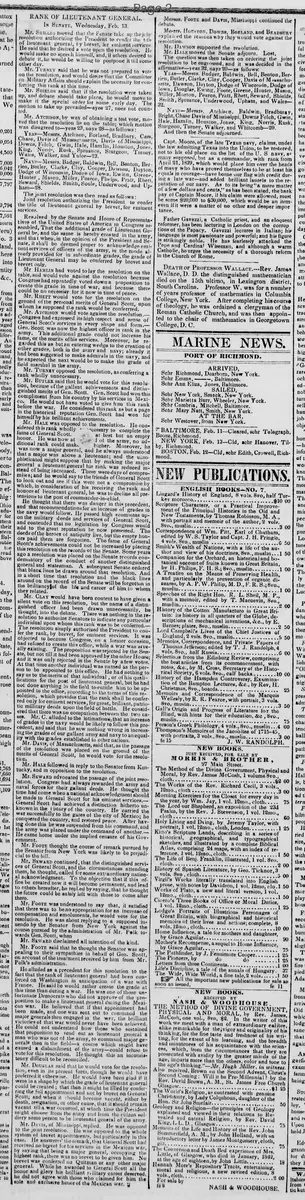
In Senate, Wednesday, Feb. 13.
Mr. Shields moved that the Senate take up the joint resolution authorizing the President to confer the title of lieutenant general, by brevet, for eminent services.
He said that he desired a vote upon the resolution. He would make no speech himself, and, if others desired to debate it, he would be willing to postpone it till some other day.
Mr. Turney said that he was not prepared to vote on the resolution, and would desire that the Committee on Military Affairs should explain the necessity for conferring this rank at this time.
Mr. Shields said that if the resolution were taken up, and debate should take place, he would move to make it the special order for some early day. The motion to take up prevailed—ayes 27, noes not counted.
Mr. Atchison, by way of obtaining a test vote, moved that the resolution lie on the table; which motion was disagreed to—yeas 23, nays 28—as follows:
Yeas—Messrs. Atchison, Borland, Bradbury, Cass, Chase, Davis of Massachusetts, Davis of Mississippi, Downs, Felch, Gwin, Hale, Hamlin, Houston, Jones, King, Norris, Rusk, Spruance, Sturgeon, Wales, Walker, and Yulee—23.
Turney
Nays—Messrs. Badger, Baldwin, Bell, Benton, Berrien, Butler, Clarke, Clay, Cooper, Dawson, Dayton, Dodge of Wisconsin, Dodge of Iowa, Ewing, Greene, Hunter, Mason, Miller, Pearce, Phelps, Pratt, Rhett, Seward, Shields, Smith, Soule, Underwood, and Upham—28.
The joint resolution was then read as follows:
Joint resolution authorizing the President to confer the title of lieutenant general by brevet, for eminent services.
Resolved by the Senate and House of Representatives of the United States of America in Congress assembled, That the additional grade of Lieutenant General be, and the same is hereby created in the army, and that when, in the opinion of the President and Senate, it shall be deemed proper to acknowledge eminent services of officers of the army, in the mode already provided for in subordinate grades, the grade of Lieutenant General may be conferred by brevet and brevet only.
Mr. Hamlin had voted to lay the resolution on the table, and would vote against the resolution because Congress had repeatedly voted down a proposition to create this grade in time of war, and because there could be no necessity for it now in time of peace.
Mr. Rhett would vote for the resolution on the ground of the personal merits of General Scott, upon whom he supposed the rank would be conferred.
Mr. Atchison would vote against the resolution.—Congress had expressed its high respect and sense of General Scott's services in every shape and form.—Gen. Scott was now the highest officer in rank in the army. This additional grade could not increase his fame, or the merits of his services. Moreover, he regarded this as but an entering wedge to the creation of other grades, both in the army and navy; already it had been suggested to make admirals in the navy, and he expected the next would be to make the grade of field marshal in the army.
Mr. Turney opposed the resolution, as conferring a rank wholly unnecessary.
Mr. Butler said that he would vote for this resolution, because of the gallant achievements and distinguished merits of Gen. Scott. Gen. Scott had won this compliment from his country by his services in Mexico. He would not have voted to give him this rank before the war. He considered this rank as but a page in the historical reputation Gen. Scott had won for himself by his brilliant achievements.
Mr. Hale was opposed to the resolution. He considered this rank wholly unnecessary to complete the fame of General Scott. At best but an empty honor. He was now at the head of the army, no additional rank could make him higher. Moreover, he was now a major general, and he always understood that a major was above a lieutenant; and the unsophisticated might suppose that by making the major general a lieutenant general his rank was reduced instead of being increased. These were days of compromises; and he would say to the friends of General Scott to look out and see if this were not a compromise by which, in consideration of his receiving the rank and honors of lieutenant general, he was to decline all pretensions to the post of commander-in-chief.
He thought that there was danger in this precedent, and that recommendations for an increase of grades in the navy would follow. He passed high encomiums upon the military deeds and services of General Scott and contended that no legislation by Congress would add to the great reputation he now possessed. The deeds of the heroes of antiquity live, but the empty honors paid them are forgotten. The fame of General Scott's achievements could not be increased by placing this resolution on the records of the Senate. Some years ago a resolution was placed on the Senate records condemnatory of the conduct of another distinguished general and statesman. A subsequent Senate ordered that black lines be drawn around that resolution. And in a short time that resolution and the black lines around on the record of the Senate will be forgotten in the brilliancy of the life and career of him to whom they related.
Mr. Clay would have been content to have given silent vote on this resolution, but the name of a distinguished officer had been drawn unnecessarily, he thought, into the debate. There was nothing in the resolution to authorize Senators to indicate any particular individual upon whom this rank was to be conferred.—The resolution simply authorized the President to confer the rank, by brevet, for eminent services. It was objected to because Congress, on a former occasion, had refused to create this office, while a war was actually existing. The proposition was rejected by the Senate, but not till it had been approved by the other House; and it was only rejected in the Senate by a few votes.
At that time another individual was named as the person to be appointed to this office. He had nothing to say as to the merits of that individual, or of his qualifications for the post of lieutenant general, but he had not done anything in the field to entitle him to be appointed to the office, according to the terms of this resolution, which provides that the rank shall be conferred only for eminent services, for great, brilliant, patriotic military deeds upon the field of battle. He considered that there was no comparison between the two cases. Mr. C. alluded to the intimations, that an increase of grades in the navy would be likely to follow this precedent, and said that he saw nothing wrong in increasing the grades of our gallant army and navy to an equality with the grades established in other nations.
Mr. Davis, of Massachusetts, said that, as the passage of the resolution was placed on the ground of the merits of General Scott, he would vote for the resolution.
Mr. Hale followed in reply to the Senator from Kentucky, and in opposition to the resolution.
Mr. Seward advocated the passage of the joint resolution. Congress had always rewarded the army and naval forces for their gallant deeds. He thought the time had come when a national acknowledgment should be made to General Scott for his eminent services.—General Scott had achieved a distinction hitherto unknown in the history of the country. He carried the war successfully to the gates of the city of Mexico; he conquered the year, and restored peace. After having done this he was suspended from his command, and the army was placed under the command of another.—He came home under the implied censure of his Government.
Mr. Foote thought the course of remark pursued by the Senator from New York was likely to be prejudicial to the bill.
Mr. Seward continued, that the distinguished services of General Scott, and the circumstances attending them, he thought, called for some extraordinary national acknowledgment. To the objection that if this office be created now it will become permanent, and lead to others hereafter, he replied by saying, that he thought the future could be safely left with those to come after them.
Mr. Foote was understood to say that, if satisfied that there was to be no appropriation for an increase of compensation and emoluments, he would vote for the resolution. He was about replying to a supposed innuendo by the Senator from New York against the course pursued by the administration of Mr. Polk towards Gen. Scott, when
Mr. Seward disclaimed all intention of the kind.
Mr. Foote said that he thought the Senator was appealing to their sympathies in behalf of Gen. Scott, on account of the treatment received by him from Mr. Polk's administration.
He alluded as a precedent for this resolution to the fact that the rank of lieutenant general had been conferred on Washington in anticipation of a war with France. He said he would rather create the grade at this time than during a war. He was one of those unfortunate Democrats who did not approve of the proposition to make a lieutenant general during the Mexican war. He believed that if that appointment had been made, and one was sent out to command the major generals then engaged in the war, the brilliant victories of that war would never have been achieved.
He could not understand how those who sustained that proposition to send out as lieutenant general a man who was not of the army, to command major generals then in the field—a course which might have caused a disbandment of the army—could refuse to vote for this resolution. He thought this an inconsistency difficult to be reconciled.
Mr. Douglas said that he would vote for the resolution, even in its present form, though he would have preferred it otherwise. He would have been glad if it were in a shape by which the grade of lieutenant general could be created; that then it might be filled by conferring the full appointment and not by brevet on General Scott; and when it should become vacant, either by death, resignation, or other cause, that it should remain vacant till a war occurred, at which time the President might choose from the army and from the citizen soldiery some person to be lieutenant general of the army.
Mr. Davis, of Mississippi, replied. He was opposed to the joint resolution. He was opposed to the whole system of brevet appointments, but particularly in this case. He answered the remark, that General Scott had received no brevet for his services in the Mexican war, by saying that being a major general, occupying the highest rank, there was no brevet to be given him. No brevet was conferred on Quitman or any other major general. While he awarded to General Scott all the honor and glory his brilliant military career deserved, he did not agree with those who claimed for him the sole and exclusive honor of the Mexican war.
Messrs. Foote and Davis, Mississippi continued the debate.
Messrs. Houston, Downs, Borland, and Bradbury explained the reasons why they would vote against the resolution.
Mr. Dawson supported the resolution.
Mr. Hale moved the Senate adjourn. Lost,
The question was then taken on ordering the joint resolution to be engrossed, and it was decided in the affirmative—yeas 32, nays 20—as follows:
Yeas—Messrs. Badger, Baldwin, Bell, Benton, Berrien, Butler, Clarke, Clay, Cooper, Davis of Massachusetts, Dawson, Dayton, Dodge of Wisconsin, Dodge of Iowa, Douglas, Ewing, Foote, Greene, Hunter, Mason, Miller, Morton, Pearce, Pratt, Rhett, Seward, Shields, Smith, Spruance, Underwood, Upham, and Wales—32.
Nays—Messrs. Atchison, Baldwin, Bradbury, Bright, Chase, Davis of Mississippi, Downs, Felch, Gwin, Hale, Hamlin, Houston, Jones, King, Norris, Rusk, Sturgeon, Turney, Walker, and Whitcomb—20.
And then the Senate adjourned.
What sub-type of article is it?
What keywords are associated?
What entities or persons were involved?
Domestic News Details
Event Date
Wednesday, Feb. 13.
Key Persons
Outcome
the joint resolution passed in the senate by a vote of 32 yeas to 20 nays.
Event Details
The Senate debated and voted on a joint resolution to create the brevet rank of Lieutenant General for eminent services in the army, with discussion centering on honoring General Scott's Mexican War achievements versus concerns over necessity, precedents, and potential for additional ranks. Key arguments included recognition of Scott's merits, opposition due to peacetime context, and comparisons to prior rejections during war.