Thank you for visiting SNEWPapers!
Sign up free
Literary
October 17, 1912
The Loup City Northwestern
Loup City, Sherman County, Nebraska
What is this article about?
Excerpt from 'The Lady of the Mount' by Frederic S. Islam, a historical romance set on a rock-bound island fortress off France during Louis XVI's reign. Synopsis outlines Countess Elise's encounters with a noble peasant boy, her education in Paris, and adventures involving a mysterious Black Seigneur. Narrative depicts her interactions with suitors, explorations, and a ride to the woods.
Clipping
OCR Quality
85%
Good
Full Text
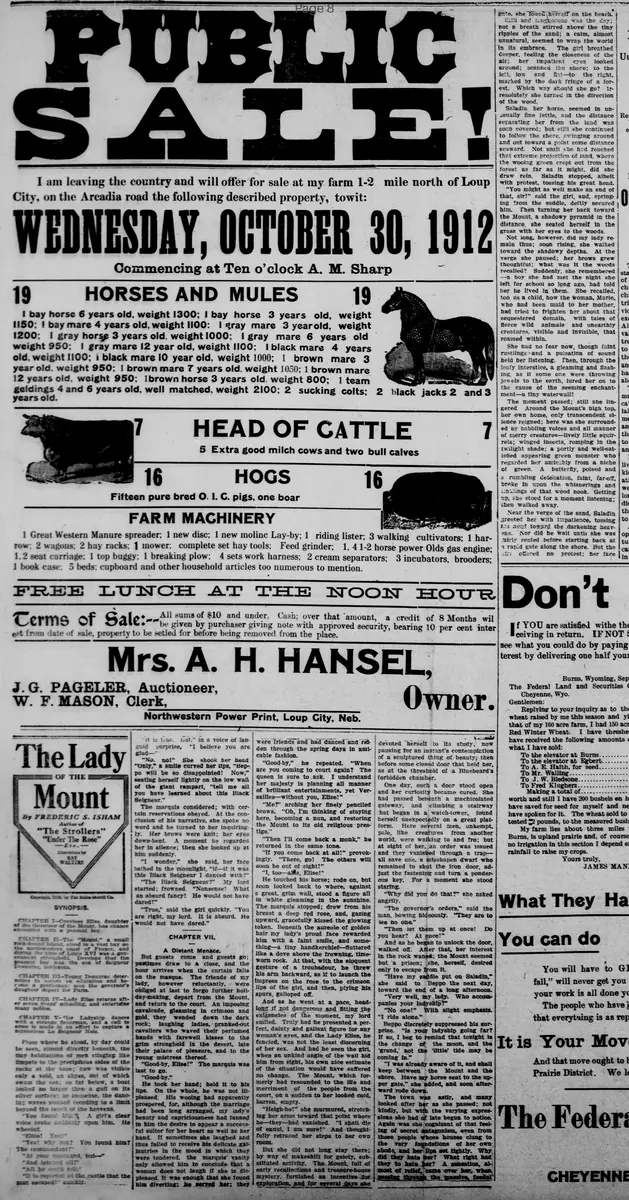
The Lady of the Mount
By Frederic S. Islam
"The Strollers"
*Later The Rose*
fss,**
RaY
Synopsis
CHAPTER I-Countess Elise, daughter of the Governor of the Mount, has chance encounter with a peasant boy.
CHAPTER I-The Mount, a small rock-bound island, stood in a vast bay on the southwestern coast of France, and during the time of Louis XVI was a government stronghold. Develops that the peasant boy was the son of Seigneur Desaurac, nobleman.
CHAPTER II-Young Desaurac determines to secure an education and become a gentleman; sees the governor's daughter depart for Paris.
CHAPTER IV-Lady Elise returns after seven years' schooling, and entertains many nobles.
CHAPTER V-Her Ladyship dances with a strange fisherman, and a call to arms is made in an effort to capture a mysterious Le Seigneur Noir.
From where he stood, by day could be seen, almost directly beneath, the tiny habitations of men clinging like limpets to the precipitous sides of the rocks at the base; now was visible only a void, an abyss, out of which swam the sea; so far below, a boat looked no larger than a gull on its silver surface: so immense, the dancing waves seemed receding to a limit beyond the reach of the heavens.
"You found him!" A girl's clear voice broke abruptly upon him. He wheeled.
"Elise! Yes!"
"Yes! why not? You found him! The commandant?"
"At your command, but--"
"And learned all he could tell--"
"It is reported at the castle that the guest escaped!" quickly.
"It is true, but," in a voice of languid surprise, "I believe you are glad--"
"No. no!" She shook her head.
"Only," a smile curved her lips, "Beppo will be so disappointed! Now," seating herself lightly on the low wall of the giant rampart, "tell me all you have learned about this Black Seigneur."
The marquis considered; with certain reservations obeyed. At the conclusion of his narrative, she spoke no word and he turned to her inquiringly. Her brows were knit; her eyes down-bent. A moment he regarded her in silence; then she looked up at him suddenly.
"I wonder," she said, her face bathed in the moonlight, "if-if it was this Black Seigneur I danced with?"
"The Black Seigneur?" My lord started: frowned. "Nonsense! What an absurd fancy! He would not have dared!"
"True," said the girl quickly. "You are right, my lord. It is absurd. He would not have dared."
CHAPTER VII.
A Distant Menace.
But guests come and guests go; pastimes draw to a close, and the hour arrives when the curtain falls on the masque.
The friends of my lady, however reluctantly, were obliged at last to forgo further holiday-making, depart from the Mount, and return to the court. An imposing cavalcade, gleaming in crimson and gold, they wended down the dark rock; laughing ladies, pranked-out cavaliers who waved their perfumed handkerchiefs with farewell kisses to the grim stronghold in the desert, late their palace of pleasure, and to the young mistress thereof.
"Good-by, Elise!" The marquis was last to go.
"Good-by."
He took her hand; held it to his lips. On the whole, he was not ill-pleased. His wooing had apparently prospered, for, although the marriage had been long arranged, my lady's beauty and capriciousness had fanned in him the desire to appear a successful suitor for her heart as well as her hand. If sometimes she laughed and thus failed to receive his delicate gallantries in the mood in which they were tendered, the marquis' vanity only allowed him to conclude that a woman does not laugh if she is displeased. It was enough that she found him diverting: he served her; they were friends and had danced and ridden through the spring days in amiable fashion.
"Good-by," he repeated. "When are you coming to court again? The queen is sure to ask. I understand her majesty is planning all manner of brilliant entertainments, yet Versailles--without you, Elise!"
"Me?" arching her finely penciled brows.
"Oh, I'm thinking of staying here, becoming a nun, and restoring the Mount to its old religious prestige."
"Then I'll come back a monk," he returned in the same tone.
"If you come back at all!" provokingly. There, go! The others will soon be out of sight!"
"I, too--adieu, Elise!"
He touched his horse; rode on, but soon looked back to where, against a great, grim wall, stood a figure all in white gleaming in the sunshine.
The marquis stopped; drew from his breast a deep red rose, and, gazing upward, gracefully kissed the glowing token. Beneath the aureole of golden hair my lady's proud face rewarded him with a faint smile, and something--a tiny handkerchief--fluttered like a dove above the frowning, time-worn rock. At that, with the eloquent gesture of a troubadour, he threw his arm backward, as if to launch the impress on the rose to the crimson lips of the girl, and then, plying his spurs, galloped off.
And as he went at a pace, headlong if not dangerous and fitting the exigencies of the moment, my lord smiled. Truly had he presented a perfect, dainty and gallant figure for any woman's eyes, and the Lady Elise, he fancied, was not the least discerning of her sex. And had he seen the girl, when an unkind angle of the wall hid him from sight, his own nice estimate of the situation would have suffered no change. The Mount, which formerly had resounded to the life and merriment of the people from the court, on a sudden to her looked cold, barren, empty.
"Heigh-ho!" she murmured, stretching her arms toward that point where he--they--had vanished. "I shall die of ennui, I am sure!" And thoughtfully retraced her steps to her own room.
But she did not long stay there; by way of makeshift for gaiety, substituted activity. The Mount, full of early recollections and treasure-house of mystery, furnished an incentive for exploration, and for several days she devoted herself to its study; now pausing for an instant's contemplation of a sculptured thing of beauty, then before some closed door that held her, as at the threshold of a Bluebeard's forbidden chamber.
One day, such a door stood open and her curiosity became piqued. She had passed beneath a machicolated gateway, and climbing a stairway that began in a watch-tower, found herself unexpectedly on a great platform. Here several men, unkempt, pale, like creatures from another world, were walking to and fro: but at sight of her, an order was issued and they vanished through a trap all save one, a misshapen dwarf who remained to shut the iron door, adjust the fastening and turn a ponderous key. For a moment she stood staring.
"Why did you do that?" she asked angrily.
"The governor's orders," said the man, bowing hideously. "They are to see no one."
"Then let them up at once! Do you hear? At once!"
And as he began to unlock the door, walked off. After that, her interest in the rock waned; the Mount seemed but a prison; she, herself, desired only to escape from it.
"Have my saddle put on Saladin," she said to Beppo the next day, toward the end of a long afternoon.
"Very well, my lady. Who accompanies your ladyship?"
"No one!" With slight emphasis. "I ride alone."
Beppo discreetly suppressed his surprise. "Is your ladyship going far? If so, I beg to remind that tonight is the change of the moon, and the 'grand,' not the little' tide may be coming in."
"I was already aware of it, and shall keep between the Mount and the shore. Have my horse sent to the upper gate," she added, and soon afterward rode down.
The town was astir, and many looked after her as she passed; not kindly, but with the varying expressions she had of late begun to notice. Again was she cognizant of that feeling of secret antagonism, even from these people whose houses clung to the very foundations of her own abode, and her lips set tightly. Why did they hate her? What right had they to hate her? A sensation, almost of relief came over her, when passing through the massive, feudal gate, she found herself on the beach.
Still and languorous was the day; not a breath stirred above the tiny ripples of the sand; a calm, almost unnatural, seemed to wrap the world in its embrace. The girl breathed deeper, feeling the closeness of the air; her impatient eyes looked around; scanned the shore; to the left, low and flat--to the right, marked by the dark fringe of a forest. Which way should she go? Irresolutely she turned in the direction of the wood.
Saladin, her horse, seemed in unusually fine fettle, and the distance separating her from the land was soon covered; but still she continued to follow the shore, swinging around and out toward a point some distance seaward. Not until she had reached that extreme projection of land, where the wooing green crept out from the forest as far as it might, did she draw rein. Saladin stopped, albeit with protest, tossing his great head.
"You might as well make an end of that, sir!" said the girl, and, springing from the saddle, deftly secured him. Then turning her back toward the Mount, a shadowy pyramid in the distance, she seated herself in the grass with her eyes to the woods.
Not long, however, did my lady remain thus; soon rising, she walked toward the shadowy depths. At the verge she paused; her brows grew thoughtful: what was it the woods recalled? Suddenly, she remembered--a boy she had met the night she left for school so long ago, had told her he lived in them. She recalled, too as a child, how the woman, Marie, who had been maid to her mother, had tried to frighten her about that sequestered domain, with tales of fierce wild animals and unearthly creatures, visible and invisible, that roamed within.
She had no fear now, though faint rustlings--and a pulsation of sound held her listening. Then, through the leafy interstice, a gleaming and flashing, as if some one were throwing jewels to the earth, lured her on to the cause of the seeming enchantment--a tiny waterfall!
The moment passed; still she lingered. Around the Mount's high top, her own home, only transcendent silence reigned; here was she surrounded by babbling voices and all manner of merry creatures--lively little squirrels; winged insects, romping in the twilight shade; a portly and well-satisfied appearing green monster who regarded her amiably from a niche of green. A butterfly, poised and a rumbling detonation, faint, far-off, broke in upon the whisperings and linings of that wood nook. Getting up, she stood for a moment listening; then walked away.
Near the verge of the sand, Saladin greeted her with impatience, tossing his head toward the darkening heavens. Nor did he wait until she was fairly seated before starting back at a rapid gait along the shore. But the girl offered no protest; her face
By Frederic S. Islam
"The Strollers"
*Later The Rose*
fss,**
RaY
Synopsis
CHAPTER I-Countess Elise, daughter of the Governor of the Mount, has chance encounter with a peasant boy.
CHAPTER I-The Mount, a small rock-bound island, stood in a vast bay on the southwestern coast of France, and during the time of Louis XVI was a government stronghold. Develops that the peasant boy was the son of Seigneur Desaurac, nobleman.
CHAPTER II-Young Desaurac determines to secure an education and become a gentleman; sees the governor's daughter depart for Paris.
CHAPTER IV-Lady Elise returns after seven years' schooling, and entertains many nobles.
CHAPTER V-Her Ladyship dances with a strange fisherman, and a call to arms is made in an effort to capture a mysterious Le Seigneur Noir.
From where he stood, by day could be seen, almost directly beneath, the tiny habitations of men clinging like limpets to the precipitous sides of the rocks at the base; now was visible only a void, an abyss, out of which swam the sea; so far below, a boat looked no larger than a gull on its silver surface: so immense, the dancing waves seemed receding to a limit beyond the reach of the heavens.
"You found him!" A girl's clear voice broke abruptly upon him. He wheeled.
"Elise! Yes!"
"Yes! why not? You found him! The commandant?"
"At your command, but--"
"And learned all he could tell--"
"It is reported at the castle that the guest escaped!" quickly.
"It is true, but," in a voice of languid surprise, "I believe you are glad--"
"No. no!" She shook her head.
"Only," a smile curved her lips, "Beppo will be so disappointed! Now," seating herself lightly on the low wall of the giant rampart, "tell me all you have learned about this Black Seigneur."
The marquis considered; with certain reservations obeyed. At the conclusion of his narrative, she spoke no word and he turned to her inquiringly. Her brows were knit; her eyes down-bent. A moment he regarded her in silence; then she looked up at him suddenly.
"I wonder," she said, her face bathed in the moonlight, "if-if it was this Black Seigneur I danced with?"
"The Black Seigneur?" My lord started: frowned. "Nonsense! What an absurd fancy! He would not have dared!"
"True," said the girl quickly. "You are right, my lord. It is absurd. He would not have dared."
CHAPTER VII.
A Distant Menace.
But guests come and guests go; pastimes draw to a close, and the hour arrives when the curtain falls on the masque.
The friends of my lady, however reluctantly, were obliged at last to forgo further holiday-making, depart from the Mount, and return to the court. An imposing cavalcade, gleaming in crimson and gold, they wended down the dark rock; laughing ladies, pranked-out cavaliers who waved their perfumed handkerchiefs with farewell kisses to the grim stronghold in the desert, late their palace of pleasure, and to the young mistress thereof.
"Good-by, Elise!" The marquis was last to go.
"Good-by."
He took her hand; held it to his lips. On the whole, he was not ill-pleased. His wooing had apparently prospered, for, although the marriage had been long arranged, my lady's beauty and capriciousness had fanned in him the desire to appear a successful suitor for her heart as well as her hand. If sometimes she laughed and thus failed to receive his delicate gallantries in the mood in which they were tendered, the marquis' vanity only allowed him to conclude that a woman does not laugh if she is displeased. It was enough that she found him diverting: he served her; they were friends and had danced and ridden through the spring days in amiable fashion.
"Good-by," he repeated. "When are you coming to court again? The queen is sure to ask. I understand her majesty is planning all manner of brilliant entertainments, yet Versailles--without you, Elise!"
"Me?" arching her finely penciled brows.
"Oh, I'm thinking of staying here, becoming a nun, and restoring the Mount to its old religious prestige."
"Then I'll come back a monk," he returned in the same tone.
"If you come back at all!" provokingly. There, go! The others will soon be out of sight!"
"I, too--adieu, Elise!"
He touched his horse; rode on, but soon looked back to where, against a great, grim wall, stood a figure all in white gleaming in the sunshine.
The marquis stopped; drew from his breast a deep red rose, and, gazing upward, gracefully kissed the glowing token. Beneath the aureole of golden hair my lady's proud face rewarded him with a faint smile, and something--a tiny handkerchief--fluttered like a dove above the frowning, time-worn rock. At that, with the eloquent gesture of a troubadour, he threw his arm backward, as if to launch the impress on the rose to the crimson lips of the girl, and then, plying his spurs, galloped off.
And as he went at a pace, headlong if not dangerous and fitting the exigencies of the moment, my lord smiled. Truly had he presented a perfect, dainty and gallant figure for any woman's eyes, and the Lady Elise, he fancied, was not the least discerning of her sex. And had he seen the girl, when an unkind angle of the wall hid him from sight, his own nice estimate of the situation would have suffered no change. The Mount, which formerly had resounded to the life and merriment of the people from the court, on a sudden to her looked cold, barren, empty.
"Heigh-ho!" she murmured, stretching her arms toward that point where he--they--had vanished. "I shall die of ennui, I am sure!" And thoughtfully retraced her steps to her own room.
But she did not long stay there; by way of makeshift for gaiety, substituted activity. The Mount, full of early recollections and treasure-house of mystery, furnished an incentive for exploration, and for several days she devoted herself to its study; now pausing for an instant's contemplation of a sculptured thing of beauty, then before some closed door that held her, as at the threshold of a Bluebeard's forbidden chamber.
One day, such a door stood open and her curiosity became piqued. She had passed beneath a machicolated gateway, and climbing a stairway that began in a watch-tower, found herself unexpectedly on a great platform. Here several men, unkempt, pale, like creatures from another world, were walking to and fro: but at sight of her, an order was issued and they vanished through a trap all save one, a misshapen dwarf who remained to shut the iron door, adjust the fastening and turn a ponderous key. For a moment she stood staring.
"Why did you do that?" she asked angrily.
"The governor's orders," said the man, bowing hideously. "They are to see no one."
"Then let them up at once! Do you hear? At once!"
And as he began to unlock the door, walked off. After that, her interest in the rock waned; the Mount seemed but a prison; she, herself, desired only to escape from it.
"Have my saddle put on Saladin," she said to Beppo the next day, toward the end of a long afternoon.
"Very well, my lady. Who accompanies your ladyship?"
"No one!" With slight emphasis. "I ride alone."
Beppo discreetly suppressed his surprise. "Is your ladyship going far? If so, I beg to remind that tonight is the change of the moon, and the 'grand,' not the little' tide may be coming in."
"I was already aware of it, and shall keep between the Mount and the shore. Have my horse sent to the upper gate," she added, and soon afterward rode down.
The town was astir, and many looked after her as she passed; not kindly, but with the varying expressions she had of late begun to notice. Again was she cognizant of that feeling of secret antagonism, even from these people whose houses clung to the very foundations of her own abode, and her lips set tightly. Why did they hate her? What right had they to hate her? A sensation, almost of relief came over her, when passing through the massive, feudal gate, she found herself on the beach.
Still and languorous was the day; not a breath stirred above the tiny ripples of the sand; a calm, almost unnatural, seemed to wrap the world in its embrace. The girl breathed deeper, feeling the closeness of the air; her impatient eyes looked around; scanned the shore; to the left, low and flat--to the right, marked by the dark fringe of a forest. Which way should she go? Irresolutely she turned in the direction of the wood.
Saladin, her horse, seemed in unusually fine fettle, and the distance separating her from the land was soon covered; but still she continued to follow the shore, swinging around and out toward a point some distance seaward. Not until she had reached that extreme projection of land, where the wooing green crept out from the forest as far as it might, did she draw rein. Saladin stopped, albeit with protest, tossing his great head.
"You might as well make an end of that, sir!" said the girl, and, springing from the saddle, deftly secured him. Then turning her back toward the Mount, a shadowy pyramid in the distance, she seated herself in the grass with her eyes to the woods.
Not long, however, did my lady remain thus; soon rising, she walked toward the shadowy depths. At the verge she paused; her brows grew thoughtful: what was it the woods recalled? Suddenly, she remembered--a boy she had met the night she left for school so long ago, had told her he lived in them. She recalled, too as a child, how the woman, Marie, who had been maid to her mother, had tried to frighten her about that sequestered domain, with tales of fierce wild animals and unearthly creatures, visible and invisible, that roamed within.
She had no fear now, though faint rustlings--and a pulsation of sound held her listening. Then, through the leafy interstice, a gleaming and flashing, as if some one were throwing jewels to the earth, lured her on to the cause of the seeming enchantment--a tiny waterfall!
The moment passed; still she lingered. Around the Mount's high top, her own home, only transcendent silence reigned; here was she surrounded by babbling voices and all manner of merry creatures--lively little squirrels; winged insects, romping in the twilight shade; a portly and well-satisfied appearing green monster who regarded her amiably from a niche of green. A butterfly, poised and a rumbling detonation, faint, far-off, broke in upon the whisperings and linings of that wood nook. Getting up, she stood for a moment listening; then walked away.
Near the verge of the sand, Saladin greeted her with impatience, tossing his head toward the darkening heavens. Nor did he wait until she was fairly seated before starting back at a rapid gait along the shore. But the girl offered no protest; her face
What sub-type of article is it?
Prose Fiction
What themes does it cover?
Love Romance
Social Manners
Political
What keywords are associated?
Historical Romance
French Nobility
Island Fortress
Countess Elise
Black Seigneur
Marquis Suitor
Mount Island
What entities or persons were involved?
By Frederic S. Islam
Literary Details
Title
The Lady Of The Mount
Author
By Frederic S. Islam
Key Lines
"I Wonder," She Said, Her Face Bathed In The Moonlight, "If If It Was This Black Seigneur I Danced With?"
"Good By, Elise!" The Marquis Was Last To Go.
"Heigh Ho!" She Murmured, Stretching Her Arms Toward That Point Where He They Had Vanished. "I Shall Die Of Ennui, I Am Sure!"
Why Did They Hate Her? What Right Had They To Hate Her?