Thank you for visiting SNEWPapers!
Sign up free
Literary
March 26, 1892
The Ohio Democrat
Logan, Hocking County, Ohio
What is this article about?
An article explains the origin of Persian embroidery in the custom requiring women to veil their faces and eyes outdoors for safety and anonymity. The lattice-work veils, called chuddah, are intricately embroidered on white cambric, showcasing women's needlework skills.
Clipping
OCR Quality
98%
Excellent
Full Text
TO CONCEAL THE EYES.
Embroidery Owes Its Origin to a Peculiar Persian Custom.
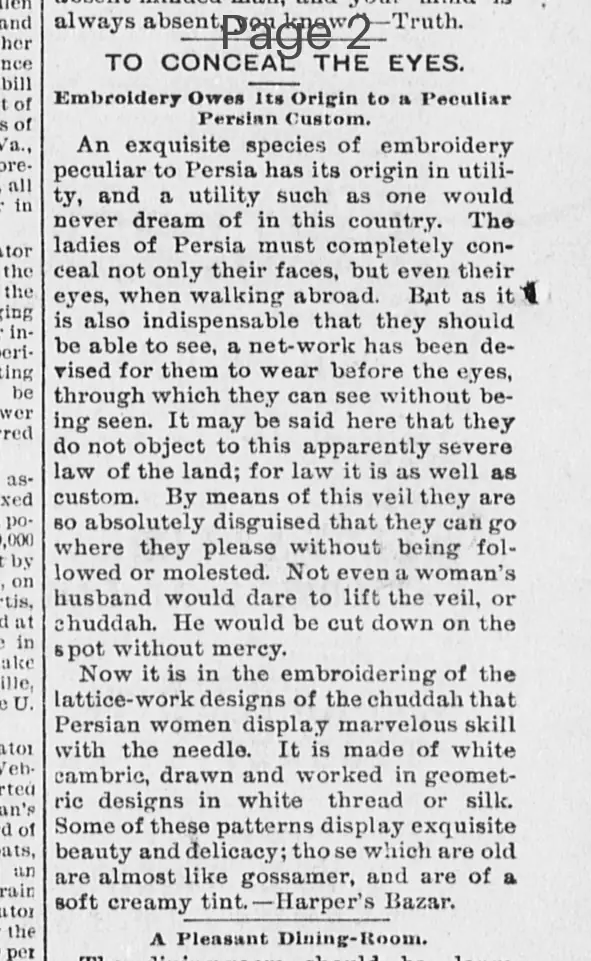
An exquisite species of embroidery peculiar to Persia has its origin in utility, and a utility such as one would never dream of in this country. The ladies of Persia must completely conceal not only their faces, but even their eyes, when walking abroad. But as it is also indispensable that they should be able to see, a net-work has been devised for them to wear before the eyes, through which they can see without being seen. It may be said here that they do not object to this apparently severe law of the land; for law it is as well as custom. By means of this veil they are so absolutely disguised that they can go where they please without being followed or molested. Not even a woman's husband would dare to lift the veil, or chuddah. He would be cut down on the spot without mercy.
Now it is in the embroidering of the lattice-work designs of the chuddah that Persian women display marvelous skill with the needle. It is made of white cambric, drawn and worked in geometric designs in white thread or silk. Some of these patterns display exquisite beauty and delicacy; those which are old are almost like gossamer, and are of a soft creamy tint.—Harper's Bazar.
Embroidery Owes Its Origin to a Peculiar Persian Custom.
An exquisite species of embroidery peculiar to Persia has its origin in utility, and a utility such as one would never dream of in this country. The ladies of Persia must completely conceal not only their faces, but even their eyes, when walking abroad. But as it is also indispensable that they should be able to see, a net-work has been devised for them to wear before the eyes, through which they can see without being seen. It may be said here that they do not object to this apparently severe law of the land; for law it is as well as custom. By means of this veil they are so absolutely disguised that they can go where they please without being followed or molested. Not even a woman's husband would dare to lift the veil, or chuddah. He would be cut down on the spot without mercy.
Now it is in the embroidering of the lattice-work designs of the chuddah that Persian women display marvelous skill with the needle. It is made of white cambric, drawn and worked in geometric designs in white thread or silk. Some of these patterns display exquisite beauty and delicacy; those which are old are almost like gossamer, and are of a soft creamy tint.—Harper's Bazar.
What sub-type of article is it?
Essay
What themes does it cover?
Social Manners
What keywords are associated?
Persian Embroidery
Veiling Custom
Chuddah
Lattice Work
Women Safety
What entities or persons were involved?
Harper's Bazar
Literary Details
Title
To Conceal The Eyes.
Author
Harper's Bazar
Subject
Persian Veiling Customs And Embroidery Origin
Key Lines
The Ladies Of Persia Must Completely Conceal Not Only Their Faces, But Even Their Eyes, When Walking Abroad.
By Means Of This Veil They Are So Absolutely Disguised That They Can Go Where They Please Without Being Followed Or Molested.
Not Even A Woman's Husband Would Dare To Lift The Veil, Or Chuddah. He Would Be Cut Down On The Spot Without Mercy.
Now It Is In The Embroidering Of The Lattice Work Designs Of The Chuddah That Persian Women Display Marvelous Skill With The Needle.