Thank you for visiting SNEWPapers!
Sign up free
Literary
November 25, 1919
The Silver State
Winnemucca, Humboldt County, Nevada
What is this article about?
Historical essay on Thanksgiving origins in New England, from Pilgrim feasts to modern traditions, featuring poems by Pope and Minna Irving, and excerpts from Edward Winslow's letter describing the 1621 celebration with Massasoit and Indians.
Clipping
OCR Quality
95%
Excellent
Full Text
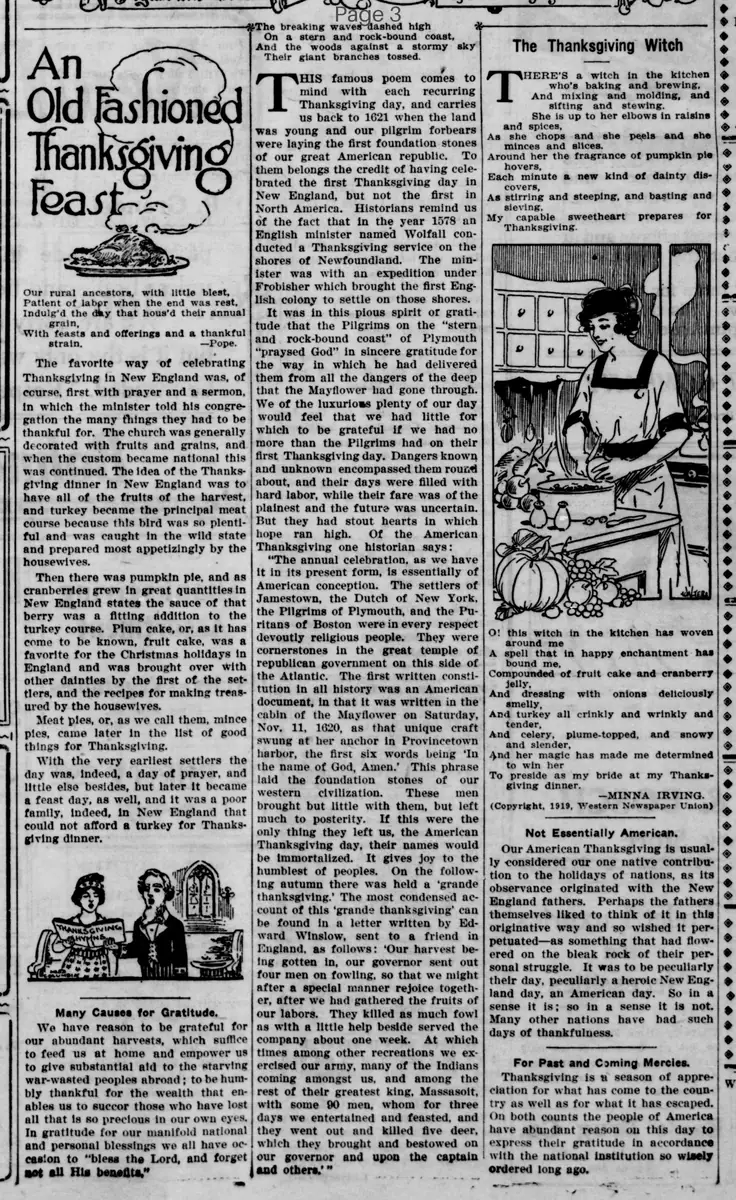
An Old Fashioned Thanksgiving Feast
Our rural ancestors, with little blest,
Patient of labor when the end was rest,
Indulg'd the day that hous'd their annual grain,
With feasts and offerings and a thankful strain.
-Pope.
The favorite way of celebrating Thanksgiving in New England was, of course, first with prayer and a sermon, in which the minister told his congregation the many things they had to be thankful for. The church was generally decorated with fruits and grains, and when the custom became national this was continued. The idea of the Thanksgiving dinner in New England was to have all of the fruits of the harvest, and turkey became the principal meat course because this bird was so plentiful and was caught in the wild state and prepared most appetizingly by the housewives.
Then there was pumpkin pie, and as cranberries grew in great quantities in New England states the sauce of that berry was a fitting addition to the turkey course. Plum cake, or, as it has come to be known, fruit cake, was a favorite for the Christmas holidays in England and was brought over with other dainties by the first of the settlers, and the recipes for making treasured by the housewives.
Meat pies, or, as we call them, mince pies, came later in the list of good things for Thanksgiving.
With the very earliest settlers the day was, indeed, a day of prayer, and little else besides, but later it became a feast day, as well, and it was a poor family, indeed, in New England that could not afford a turkey for Thanksgiving dinner.
Many Causes for Gratitude.
We have reason to be grateful for our abundant harvests, which suffice to feed us at home and empower us to give substantial aid to the starving war-wasted peoples abroad: to be humbly thankful for the wealth that enables us to succor those who have lost all that is so precious in our own eyes.
In gratitude for our manifold national and personal blessings we all have occasion to "bless the Lord, and forget not all His benefits,"
The breaking waves dashed high On a stern and rock-bound coast,
And the woods against a stormy sky Their giant branches tossed.
This famous poem comes to Thanksgiving day, and carries mind with each recurring us back to 1621 when the land was young and our pilgrim forbears were laying the first foundation stones of our great American republic. To them belongs the credit of having celebrated the first Thanksgiving day in New England, but not the first in North America. Historians remind us of the fact that in the year 1578 an English minister named Wolfall conducted a Thanksgiving service on the shores of Newfoundland. The minister was with an expedition under Frobisher which brought the first English colony to settle on those shores.
It was in this pious spirit of gratitude that the Pilgrims on the "stern and rock-bound coast" of Plymouth "praysed God" in sincere gratitude for the way in which he had delivered them from all the dangers of the deep that the Mayflower had gone through.
We of the luxurious plenty of our day would feel that we had little for which to be grateful if we had no more than the Pilgrims had on their first Thanksgiving day. Dangers known and unknown encompassed them round about, and their days were filled with hard labor, while their fare was of the plainest and the future was uncertain.
But they had stout hearts in which hope ran high. Of the American Thanksgiving one historian says:
"The annual celebration, as we have it in its present form, is essentially of American conception. The settlers of Jamestown, the Dutch of New York, the Pilgrims of Plymouth, and the Puritans of Boston were in every respect devoutly religious people. They were cornerstones in the great temple of republican government on this side of the Atlantic. The first written constitution in all history was an American document, in that it was written in the cabin of the Mayflower on Saturday, Nov. 11, 1620, as that unique craft swung at her anchor in Provincetown harbor, the first six words being 'In the name of God, Amen.' This phrase laid the foundation stones of our western civilization.
These men brought but little with them, but left much to posterity. If this were the only thing they left us, the American Thanksgiving day, their names would be immortalized. It gives joy to the humblest of peoples. On the following autumn there was held a 'grande thanksgiving.' The most condensed account of this 'grande thanksgiving' can be found in a letter written by Edward Winslow, sent to a friend in England, as follows: Our harvest being gotten in, our governor sent out four men on fowling, so that we might after a special manner rejoice together, after we had gathered the fruits of our labors. They killed as much fowl as with a little help beside served the company about one week. At which times among other recreations we exercised our army, many of the Indians coming amongst us, and among the rest of their greatest king, Massasoit, with some 90 men, whom for three days we entertained and feasted, and they went out and killed five deer, which they brought and bestowed on our governor and upon the captain and others."
The Thanksgiving Witch
HERE'S a witch in the kitchen And mixing and molding, who's baking and brewing and sifting and stewing.
She is up to her elbows in raisins and spices, As she chops and she peels and she minces and slices.
Around her the fragrance of pumpkin pie hovers, Each minute a new kind of dainty discovers, As stirring and steeping, and basting and sieving, My capable sweetheart prepares for Thanksgiving.
O! this witch in the kitchen has woven around me A spell that in happy enchantment has bound me, Compounded of fruit cake and cranberry jelly, And dressing with onions deliciously smelly, And turkey all crinkly and wrinkly and tender, And celery, plume-topped, and snowy and slender, And her magic has made me determined to win her To preside as my bride at my Thanksgiving dinner.
-MINNA IRVING.
(Copyright, 1919, Western Newspaper Union)
Not Essentially American.
Our American Thanksgiving is usually considered our one native contribution to the holidays of nations, as its observance originated with the New England fathers. Perhaps the fathers themselves liked to think of it in this originative way and so wished it perpetuated-as something that had flowered on the bleak rock of their personal struggle. It was to be peculiarly their day, peculiarly a heroic New England day, an American day. So in a sense it is; so in a sense it is not.
Many other nations have had such days of thankfulness.
For Past and Coming Mercies.
Thanksgiving is a season of appreciation for what has come to the country as well as for what it has escaped.
On both counts the people of America have abundant reason on this day to express their gratitude in accordance with the national institution so wisely ordered long ago.
Our rural ancestors, with little blest,
Patient of labor when the end was rest,
Indulg'd the day that hous'd their annual grain,
With feasts and offerings and a thankful strain.
-Pope.
The favorite way of celebrating Thanksgiving in New England was, of course, first with prayer and a sermon, in which the minister told his congregation the many things they had to be thankful for. The church was generally decorated with fruits and grains, and when the custom became national this was continued. The idea of the Thanksgiving dinner in New England was to have all of the fruits of the harvest, and turkey became the principal meat course because this bird was so plentiful and was caught in the wild state and prepared most appetizingly by the housewives.
Then there was pumpkin pie, and as cranberries grew in great quantities in New England states the sauce of that berry was a fitting addition to the turkey course. Plum cake, or, as it has come to be known, fruit cake, was a favorite for the Christmas holidays in England and was brought over with other dainties by the first of the settlers, and the recipes for making treasured by the housewives.
Meat pies, or, as we call them, mince pies, came later in the list of good things for Thanksgiving.
With the very earliest settlers the day was, indeed, a day of prayer, and little else besides, but later it became a feast day, as well, and it was a poor family, indeed, in New England that could not afford a turkey for Thanksgiving dinner.
Many Causes for Gratitude.
We have reason to be grateful for our abundant harvests, which suffice to feed us at home and empower us to give substantial aid to the starving war-wasted peoples abroad: to be humbly thankful for the wealth that enables us to succor those who have lost all that is so precious in our own eyes.
In gratitude for our manifold national and personal blessings we all have occasion to "bless the Lord, and forget not all His benefits,"
The breaking waves dashed high On a stern and rock-bound coast,
And the woods against a stormy sky Their giant branches tossed.
This famous poem comes to Thanksgiving day, and carries mind with each recurring us back to 1621 when the land was young and our pilgrim forbears were laying the first foundation stones of our great American republic. To them belongs the credit of having celebrated the first Thanksgiving day in New England, but not the first in North America. Historians remind us of the fact that in the year 1578 an English minister named Wolfall conducted a Thanksgiving service on the shores of Newfoundland. The minister was with an expedition under Frobisher which brought the first English colony to settle on those shores.
It was in this pious spirit of gratitude that the Pilgrims on the "stern and rock-bound coast" of Plymouth "praysed God" in sincere gratitude for the way in which he had delivered them from all the dangers of the deep that the Mayflower had gone through.
We of the luxurious plenty of our day would feel that we had little for which to be grateful if we had no more than the Pilgrims had on their first Thanksgiving day. Dangers known and unknown encompassed them round about, and their days were filled with hard labor, while their fare was of the plainest and the future was uncertain.
But they had stout hearts in which hope ran high. Of the American Thanksgiving one historian says:
"The annual celebration, as we have it in its present form, is essentially of American conception. The settlers of Jamestown, the Dutch of New York, the Pilgrims of Plymouth, and the Puritans of Boston were in every respect devoutly religious people. They were cornerstones in the great temple of republican government on this side of the Atlantic. The first written constitution in all history was an American document, in that it was written in the cabin of the Mayflower on Saturday, Nov. 11, 1620, as that unique craft swung at her anchor in Provincetown harbor, the first six words being 'In the name of God, Amen.' This phrase laid the foundation stones of our western civilization.
These men brought but little with them, but left much to posterity. If this were the only thing they left us, the American Thanksgiving day, their names would be immortalized. It gives joy to the humblest of peoples. On the following autumn there was held a 'grande thanksgiving.' The most condensed account of this 'grande thanksgiving' can be found in a letter written by Edward Winslow, sent to a friend in England, as follows: Our harvest being gotten in, our governor sent out four men on fowling, so that we might after a special manner rejoice together, after we had gathered the fruits of our labors. They killed as much fowl as with a little help beside served the company about one week. At which times among other recreations we exercised our army, many of the Indians coming amongst us, and among the rest of their greatest king, Massasoit, with some 90 men, whom for three days we entertained and feasted, and they went out and killed five deer, which they brought and bestowed on our governor and upon the captain and others."
The Thanksgiving Witch
HERE'S a witch in the kitchen And mixing and molding, who's baking and brewing and sifting and stewing.
She is up to her elbows in raisins and spices, As she chops and she peels and she minces and slices.
Around her the fragrance of pumpkin pie hovers, Each minute a new kind of dainty discovers, As stirring and steeping, and basting and sieving, My capable sweetheart prepares for Thanksgiving.
O! this witch in the kitchen has woven around me A spell that in happy enchantment has bound me, Compounded of fruit cake and cranberry jelly, And dressing with onions deliciously smelly, And turkey all crinkly and wrinkly and tender, And celery, plume-topped, and snowy and slender, And her magic has made me determined to win her To preside as my bride at my Thanksgiving dinner.
-MINNA IRVING.
(Copyright, 1919, Western Newspaper Union)
Not Essentially American.
Our American Thanksgiving is usually considered our one native contribution to the holidays of nations, as its observance originated with the New England fathers. Perhaps the fathers themselves liked to think of it in this originative way and so wished it perpetuated-as something that had flowered on the bleak rock of their personal struggle. It was to be peculiarly their day, peculiarly a heroic New England day, an American day. So in a sense it is; so in a sense it is not.
Many other nations have had such days of thankfulness.
For Past and Coming Mercies.
Thanksgiving is a season of appreciation for what has come to the country as well as for what it has escaped.
On both counts the people of America have abundant reason on this day to express their gratitude in accordance with the national institution so wisely ordered long ago.
What sub-type of article is it?
Essay
Poem
What themes does it cover?
Religious
Patriotism
Agriculture Rural
What keywords are associated?
Thanksgiving
Pilgrims
Harvest
New England
Turkey
Pumpkin Pie
Historical Account
Gratitude
Literary Details
Title
An Old Fashioned Thanksgiving Feast
Subject
Thanksgiving Traditions And History In New England
Form / Style
Prose Essay With Embedded Poems And Historical Excerpts
Key Lines
Our Rural Ancestors. With Little Blest,
Patient Of Labor When The End Was Rest,
Indulg'd The Day That Hous'd Their Annual Grain,
With Feasts And Offerings And A Thankful Strain.
The Breaking Waves Dashed High On A Stern And Rock Bound Coast,
And The Woods Against A Stormy Sky Their Giant Branches Tossed.
Here's A Witch In The Kitchen And Mixing And Molding, Who's Baking And Brewing And Sifting And Stewing.
Our Harvest Being Gotten In, Our Governor Sent Out Four Men On Fowling... They Went Out And Killed Five Deer, Which They Brought And Bestowed On Our Governor And Upon The Captain And Others.