Thank you for visiting SNEWPapers!
Sign up free
Editorial
October 20, 1792
National Gazette
Philadelphia, Philadelphia County, Pennsylvania
What is this article about?
An anonymous writer critiques the U.S. federal funding system, objecting to excise taxes on domestic production for invading privacy and burdening the poor, and to paying public debts to speculators rather than original creditors, arguing it violates justice and harms national prosperity.
Clipping
OCR Quality
95%
Excellent
Full Text
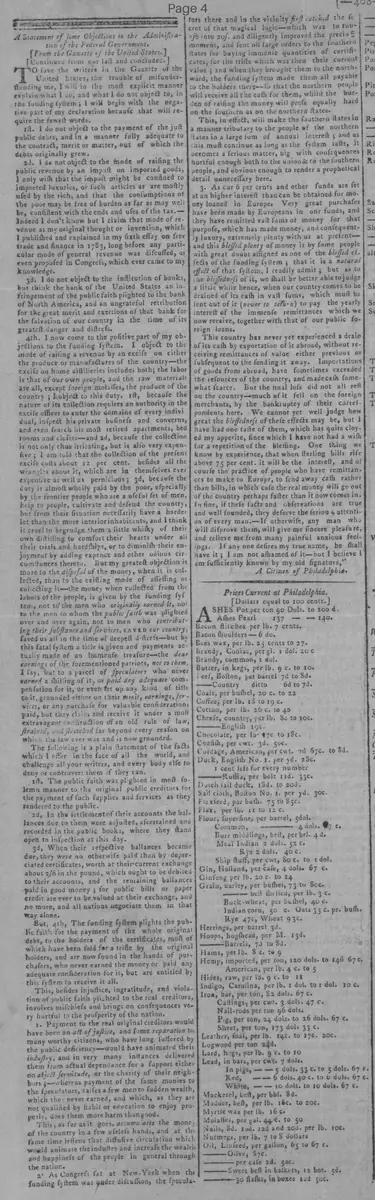
A Statement of some Objections to the Administration of the Federal Government.
[From the Gazette of the United States.]
[Continued from our last and concluded.]
O save the writers in the Gazette of the United States, the trouble of misunderstanding me, I will in the most explicit manner explain what I do, and what I do not object to, in the funding system; I will begin with the negative part of my declaration because that will require the fewest words.
1st. I do not object to the payment of the just public debts, and in a manner fully adequate to the contract, merit or matter, out of which the debts originally grew.
2d. I do not object to the mode of raising the public revenue by an impost on imported goods, I only wish that the impost might be confined to imported luxuries, or such articles as are mostly used by the rich, and that the consumptions of the poor may be free of burden as far as may well be, consistent with the ends and uses of the tax.—
Indeed I don't know but I claim that mode of revenue as my original thought or invention, which I published and explained in my sixth essay on free trade and finance in 1783, long before any particular mode of general revenue was discussed, or even proposed in Congress, which ever came to my knowledge.
3d. I do not object to the institution of banks, but think the bank of the United States an infringement of the public faith plighted to the bank of North America, and an ungrateful retribution for the great merit and exertions of that bank for the salvation of our country in the time of its greatest danger and distress.
4th. I now come to the positive part of my objections to the funding system. I object to the mode of raising a revenue by an excise on either the produce or manufactures of the country—the excise on home distilleries includes both; the labor is that of our own people, and the raw materials are all, except foreign molasses, the produce of the country; I object to this duty, 1st, because the nature of its collection requires an authority in the excise officer to enter the domains of every individual, inspect his private business and concerns, and even search his most retired apartments, bed rooms and closets—and 2d, because the collection is not only thus irritating, but is also very expensive; I am told that the collection of the present excise costs about 12 per cent. besides all the wrangles about it, which are in themselves ever expensive as well as pernicious; 3d, because the duty is almost wholly paid by the poor, especially by the frontier people who are a useful set of men, help to people, cultivate and defend the country, but from their situation necessarily have a harder lot than the more interior inhabitants, and I think it cruel to begrudge them a little whisky of their own distilling to comfort their hearts under all their trials and hardships, or to diminish their enjoyment by adding expense and other odious circumstances thereto. But my greatest objection is more to the disposal of the money, when it is collected, than to the existing mode of raising or collecting it—the money when collected from the labors of the people, is given by the funding system, not to the men who originally earned it, nor to the men to whom the public faith was plighted over and over again, not to men who contributing their substance and services, saved our country, saved us all in the time of deepest distress—but by this fatal system a title is given and payments actually made of an immense treasure—the dear earnings of the forementioned patriots, not to them, I say, but to a parcel of speculators who never earned a shilling of it, or paid any adequate compensation for it, or even set up any kind of title to it, grounded either on their merit, earnings, services, or any purchase for valuable considerations paid, but they claim and receive it under a most extravagant construction of an old rule of law, strained, and stretched far beyond every reason on which the law ever was and is now grounded.
The following is a plain Statement of the facts which I offer in the face of all the world, and challenge all your writers, and every body else to deny or controvert them if they can.
1st. The public faith was plighted in most solemn manner to the original public creditors for the payment of such supplies and services as they rendered to the public.
2d, In the settlement of their accounts the balances due to them were adjusted, ascertained and recorded in the public books, where they stand open to inspection at this day.
3d, When their respective balances became due, they were no otherwise paid than by depreciated certificates, worth at their current exchange about 2/6 in the pound, which ought to be debited to their accounts, and the remaining balances paid in good money; for public bills or paper credit are ever to be valued at their exchange, and no more, and all nations negotiate them in that way alone.
But, 4th, The funding system plights the public faith for the payment of the whole original debt, to the holders of the certificates, most of which have been sold for a trifle by the original holders, and are now found in the hands of purchasers, who never earned the money or paid any adequate consideration for it, but are entitled by this system to receive it all,
This, besides injustice, ingratitude, and violation of public faith plighted to the real creditors, involves mischiefs and brings on consequences very hurtful to the prosperity of the nation.
1. Payment to the real original creditors would have been an act of justice, and some reparation to many worthy citizens, who have long suffered by the public deficiency—would have animated their industry, and in very many instances delivered them from actual dependence for a support either on abject servitude, or the charity of their neighbors;—whereas payment of the same monies to the speculators, raises a few men to sudden wealth, which they never earned, and which, as they are not qualified by habit or education to enjoy properly, does them more harm than good.
This, as far as it goes, accumulates the money of the country in a few wealthy hands, and at the same time lessens that diffusive circulation which would animate the industry and increase the wealth and happiness of the people in general through the nation.
2° As Congress sat at New-York when the funding system was under discussion, the speculators there and in the vicinity first caught the secret of that magical logic—which was to turn 6 into 20. and diligently improved the precious moment, and sent off large orders to the southern States for buying immense quantities of certificates, for the trifle which was then their current value; and when they brought them to the northward, the funding System made them all payable to the holders there—so that the northern people will receive all the cash for them, whilst the burden of raising the money will press equally hard on the southern as on the northern states.
This, in effect, will make the southern states in a manner tributary to the people of the northern states in a large sum of annual interest; and as this must continue as long as the system lasts, it becomes a serious matter, big with consequences hurtful enough both to the union & to the southern people, and obvious enough to render a prophetical detail unnecessary here.
3. As our 6 per cents and other funds are set at an higher interest than can be obtained for money loaned in Europe. Very great purchases have been made by Europeans in our funds, and they have remitted vast sums of money for that purpose, which has made money, and consequently luxury, extremely plenty with us at present— and this blessed plenty of money is by some people with great doubt assigned as one of the blessed effects of the funding system; that it is a natural effect of that system, I readily admit; but as to the blessedness of it, we shall be better able to judge a little while hence, when our country comes to be drained of its cash in vast sums, which must be lent out of it (never to return) to pay the yearly interest of the immense remittances which we now receive, together with that of our public foreign loans.
This country has never yet experienced a drain of its cash by exportation of it abroad, without receiving remittances of value either previous or subsequent to the sending it away. Importations of goods from abroad, have sometimes exceeded the resources of the country, and made cash somewhat scarce. But the real loss did not all rest on the country much of it fell on the foreign merchants, by the bankruptcy of their correspondents here. We cannot yet well judge how great the blessedness of these effects may be, but I have had one taste of them, which has quite cloyed my appetite, since which I have not had a wish for a repetition of the blessing. One thing we know by experience, that when sterling bills rise above 75 per cent. it will be the interest, and of course the practice of people who have remittances to make to Europe, to send away cash rather than bills, in which case the real money will go out of the country perhaps faster than it now comes in.
In fine, if these facts and observations are true and well founded, they deserve the serious attention of every man.—If otherwise, any man who will disprove them, will give me sincere pleasure, and relieve me from many painful anxious feelings. If any one desires my true name, he shall have it; I am not ashamed of it—but I believe I am sufficiently known by my old signature, of Philadelphia.
[From the Gazette of the United States.]
[Continued from our last and concluded.]
O save the writers in the Gazette of the United States, the trouble of misunderstanding me, I will in the most explicit manner explain what I do, and what I do not object to, in the funding system; I will begin with the negative part of my declaration because that will require the fewest words.
1st. I do not object to the payment of the just public debts, and in a manner fully adequate to the contract, merit or matter, out of which the debts originally grew.
2d. I do not object to the mode of raising the public revenue by an impost on imported goods, I only wish that the impost might be confined to imported luxuries, or such articles as are mostly used by the rich, and that the consumptions of the poor may be free of burden as far as may well be, consistent with the ends and uses of the tax.—
Indeed I don't know but I claim that mode of revenue as my original thought or invention, which I published and explained in my sixth essay on free trade and finance in 1783, long before any particular mode of general revenue was discussed, or even proposed in Congress, which ever came to my knowledge.
3d. I do not object to the institution of banks, but think the bank of the United States an infringement of the public faith plighted to the bank of North America, and an ungrateful retribution for the great merit and exertions of that bank for the salvation of our country in the time of its greatest danger and distress.
4th. I now come to the positive part of my objections to the funding system. I object to the mode of raising a revenue by an excise on either the produce or manufactures of the country—the excise on home distilleries includes both; the labor is that of our own people, and the raw materials are all, except foreign molasses, the produce of the country; I object to this duty, 1st, because the nature of its collection requires an authority in the excise officer to enter the domains of every individual, inspect his private business and concerns, and even search his most retired apartments, bed rooms and closets—and 2d, because the collection is not only thus irritating, but is also very expensive; I am told that the collection of the present excise costs about 12 per cent. besides all the wrangles about it, which are in themselves ever expensive as well as pernicious; 3d, because the duty is almost wholly paid by the poor, especially by the frontier people who are a useful set of men, help to people, cultivate and defend the country, but from their situation necessarily have a harder lot than the more interior inhabitants, and I think it cruel to begrudge them a little whisky of their own distilling to comfort their hearts under all their trials and hardships, or to diminish their enjoyment by adding expense and other odious circumstances thereto. But my greatest objection is more to the disposal of the money, when it is collected, than to the existing mode of raising or collecting it—the money when collected from the labors of the people, is given by the funding system, not to the men who originally earned it, nor to the men to whom the public faith was plighted over and over again, not to men who contributing their substance and services, saved our country, saved us all in the time of deepest distress—but by this fatal system a title is given and payments actually made of an immense treasure—the dear earnings of the forementioned patriots, not to them, I say, but to a parcel of speculators who never earned a shilling of it, or paid any adequate compensation for it, or even set up any kind of title to it, grounded either on their merit, earnings, services, or any purchase for valuable considerations paid, but they claim and receive it under a most extravagant construction of an old rule of law, strained, and stretched far beyond every reason on which the law ever was and is now grounded.
The following is a plain Statement of the facts which I offer in the face of all the world, and challenge all your writers, and every body else to deny or controvert them if they can.
1st. The public faith was plighted in most solemn manner to the original public creditors for the payment of such supplies and services as they rendered to the public.
2d, In the settlement of their accounts the balances due to them were adjusted, ascertained and recorded in the public books, where they stand open to inspection at this day.
3d, When their respective balances became due, they were no otherwise paid than by depreciated certificates, worth at their current exchange about 2/6 in the pound, which ought to be debited to their accounts, and the remaining balances paid in good money; for public bills or paper credit are ever to be valued at their exchange, and no more, and all nations negotiate them in that way alone.
But, 4th, The funding system plights the public faith for the payment of the whole original debt, to the holders of the certificates, most of which have been sold for a trifle by the original holders, and are now found in the hands of purchasers, who never earned the money or paid any adequate consideration for it, but are entitled by this system to receive it all,
This, besides injustice, ingratitude, and violation of public faith plighted to the real creditors, involves mischiefs and brings on consequences very hurtful to the prosperity of the nation.
1. Payment to the real original creditors would have been an act of justice, and some reparation to many worthy citizens, who have long suffered by the public deficiency—would have animated their industry, and in very many instances delivered them from actual dependence for a support either on abject servitude, or the charity of their neighbors;—whereas payment of the same monies to the speculators, raises a few men to sudden wealth, which they never earned, and which, as they are not qualified by habit or education to enjoy properly, does them more harm than good.
This, as far as it goes, accumulates the money of the country in a few wealthy hands, and at the same time lessens that diffusive circulation which would animate the industry and increase the wealth and happiness of the people in general through the nation.
2° As Congress sat at New-York when the funding system was under discussion, the speculators there and in the vicinity first caught the secret of that magical logic—which was to turn 6 into 20. and diligently improved the precious moment, and sent off large orders to the southern States for buying immense quantities of certificates, for the trifle which was then their current value; and when they brought them to the northward, the funding System made them all payable to the holders there—so that the northern people will receive all the cash for them, whilst the burden of raising the money will press equally hard on the southern as on the northern states.
This, in effect, will make the southern states in a manner tributary to the people of the northern states in a large sum of annual interest; and as this must continue as long as the system lasts, it becomes a serious matter, big with consequences hurtful enough both to the union & to the southern people, and obvious enough to render a prophetical detail unnecessary here.
3. As our 6 per cents and other funds are set at an higher interest than can be obtained for money loaned in Europe. Very great purchases have been made by Europeans in our funds, and they have remitted vast sums of money for that purpose, which has made money, and consequently luxury, extremely plenty with us at present— and this blessed plenty of money is by some people with great doubt assigned as one of the blessed effects of the funding system; that it is a natural effect of that system, I readily admit; but as to the blessedness of it, we shall be better able to judge a little while hence, when our country comes to be drained of its cash in vast sums, which must be lent out of it (never to return) to pay the yearly interest of the immense remittances which we now receive, together with that of our public foreign loans.
This country has never yet experienced a drain of its cash by exportation of it abroad, without receiving remittances of value either previous or subsequent to the sending it away. Importations of goods from abroad, have sometimes exceeded the resources of the country, and made cash somewhat scarce. But the real loss did not all rest on the country much of it fell on the foreign merchants, by the bankruptcy of their correspondents here. We cannot yet well judge how great the blessedness of these effects may be, but I have had one taste of them, which has quite cloyed my appetite, since which I have not had a wish for a repetition of the blessing. One thing we know by experience, that when sterling bills rise above 75 per cent. it will be the interest, and of course the practice of people who have remittances to make to Europe, to send away cash rather than bills, in which case the real money will go out of the country perhaps faster than it now comes in.
In fine, if these facts and observations are true and well founded, they deserve the serious attention of every man.—If otherwise, any man who will disprove them, will give me sincere pleasure, and relieve me from many painful anxious feelings. If any one desires my true name, he shall have it; I am not ashamed of it—but I believe I am sufficiently known by my old signature, of Philadelphia.
What sub-type of article is it?
Economic Policy
Taxation
What keywords are associated?
Funding System
Public Debts
Excise Tax
Speculators
Original Creditors
Impost Duties
Bank Of North America
What entities or persons were involved?
Gazette Of The United States
Bank Of North America
Bank Of The United States
Speculators
Original Public Creditors
Congress
Editorial Details
Primary Topic
Objections To The Federal Funding System
Stance / Tone
Critical Of Funding System And Excise Taxes
Key Figures
Gazette Of The United States
Bank Of North America
Bank Of The United States
Speculators
Original Public Creditors
Congress
Key Arguments
Payment Of Public Debts Should Go To Original Creditors, Not Speculators Who Bought Certificates Cheaply.
Excise Taxes On Domestic Production Invade Privacy And Burden The Poor, Especially Frontier People.
Impost On Imported Luxuries Is Preferable To Excise.
Funding System Benefits Northern Speculators At Southern States' Expense.
High Interest On Funds Attracts European Investment, Leading To Future Cash Drain And Luxury.
Bank Of The United States Infringes On Public Faith To Bank Of North America.