Thank you for visiting SNEWPapers!
Sign up free
Editorial
December 12, 1827
The Massachusetts Spy, And Worcester County Advertiser
Worcester, Worcester County, Massachusetts
What is this article about?
A letter to the editor critiques superficial schoolmaster practices, emphasizing deep understanding over rote learning, individualized instruction, minimal corporal punishment, and parental cooperation to foster genuine knowledge and moral growth in pupils.
Clipping
OCR Quality
98%
Excellent
Full Text
From the Concord Gazette.
SCHOOL KEEPING.
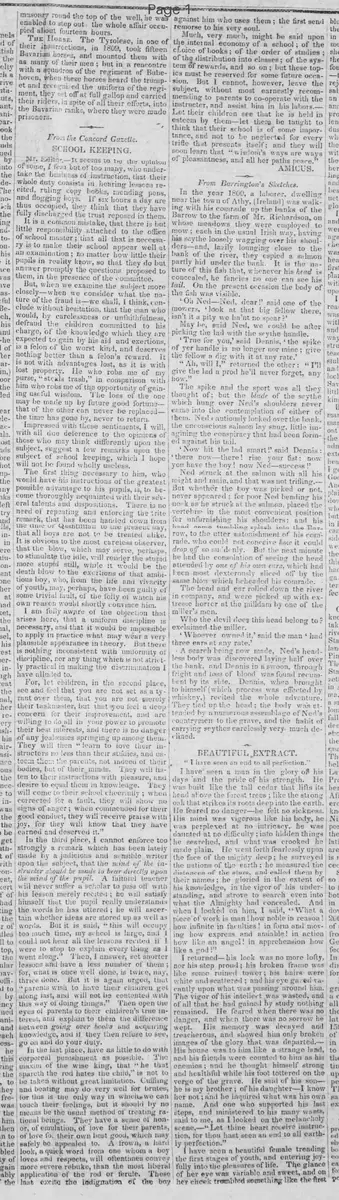
Mr. Editor,—It seems to be the opinion of some, I fear but of too many, who undertake the business of instruction, that their whole duty consists in hearing lessons recited, ruling copy books, mending pens, and flogging boys. If six hours a day are thus occupied, they think that they have fully discharged the trust reposed in them. It is a common mistake, that there is but little responsibility attached to the office of school master: that all that is necessary is to make their school appear well at an examination; no matter how little their pupils in reality know, so that they do but answer promptly the questions proposed to them, in the presence of the committee. But, when we examine the subject more closely—when we consider what the nature of the fraud is—we shall, I think, conclude without hesitation, that the man who would, by carelessness or unfaithfulness, defraud the children committed to his charge, of the knowledge which they are expected to gain by his aid and exertions, is a felon of the worst kind, and deserves nothing better than a felon's reward. It is not with advantages lost, as it is with lost property. He who robs me of my purse, "steals trash," in comparison with him who robs me of the opportunity of gaining useful wisdom. The loss of the one may be made up by future good fortune—that of the other can never be replaced—the time has gone by, never to return.
Impressed with these sentiments, I will, with all due deference to the opinions of those who may think differently upon the subject, suggest a few remarks upon the subject of school keeping, which I hope will not be found wholly useless.
The first thing necessary to him, who would have his instructions of the greatest possible advantage to his pupils, is, to become thoroughly acquainted with their several talents and dispositions. There is no need of repeating and enforcing the trite remark, that has been handed down from the time of Quintilian to the present day, that all boys are not to be treated alike. It is obvious to the most careless observer, that the blow, which may serve, perhaps, to stimulate the idle, will render the stupid more stupid still, while it would be the death blow to the exertions of that ambitious boy, who, from the life and vivacity of youth, may, perhaps, have been guilty of some trivial fault, of the folly of which his own reason would shortly convince him. I am fully aware of the objection that arises here, that a uniform discipline is necessary, and that it would be impossible to apply in practice what may wear a very plausible appearance in theory. But there is nothing inconsistent with uniformity of discipline, nor any thing which is not strictly practical in making the discrimination I have alluded to.
For, let children, in the second place, see and feel that you are not set as a tyrant over them, that you are not merely their taskmaster, but that you feel a deep concern for their improvement, and are willing to do all in your power to promote their best interests, and there is no danger of any jealousies springing up among them. They will then "learn to love their instructors no less than their studies, and esteem them the parents, not indeed of their bodies, but of their minds. They will listen to their instructions with pleasure, and desire to equal them in knowledge. They will come to their school cheerfully; when corrected for a fault, they will show no signs of anger; when commended for their good conduct, they will receive praise with joy, for they will know that they have earned and deserved it."
In the third place, I cannot enforce too strongly a remark which has been lately made by a judicious and sensible writer upon the subject, that the mind of the instructor should be made to bear directly upon the mind of the pupil. A faithful teacher will never suffer a scholar to pass off with his lesson merely recited; he will satisfy himself that the pupil really understands the words he has uttered: he will ascertain whether ideas are stored up as well as words. But it is said, "this will occupy too much time, my school is large, and I could not hear all the lessons recited if I were to stop to explain every thing as I went along." Then, I answer, set shorter lessons and have a less number of them; for, what is once well done, is twice, nay, thrice done. But it is again urged, that "parents wish to have their children get along fast, and will not be contented with this way of doing things." Then open the eyes of parents to their children's true interest, and explain to them the difference between going over books and acquiring knowledge, and if they then refuse to see, go on and do your duty.
In the last place, have as little to do with corporeal punishment as possible. The maxim of the wise king, that "he that spareth the rod hates the child," is not to be taken without great limitation. Cuffing and beating may do very well for brutes, for this is the only way in which we can touch their feelings, but it should by no means be the usual method of treating rational beings. They have a sense of honor, of emulation, of love for their parents, of love for their own best good, which may safely be appealed to. A frown, a hard look, a quick word from one whom a boy loves and respects, will oftentimes convey more severe rebuke, than the most liberal application of the rod or ferule. These last excite the indignation of the boy against him who uses them; the first send remorse to his very soul.
Much, very much, might be said upon the internal economy of a school; of the choice of books; of the order of studies; of the distribution into classes; of the system of rewards, and so on; but these topics must be reserved for some future occasion. But I cannot, however, leave the subject, without most earnestly recommending to parents to co-operate with the instructor, and assist him in his labors.—Let their children see that he is held in esteem by them—let them be taught to think that their school is of some importance, and not to be neglected for every trifle that presents itself; and they will soon learn that "wisdom's ways are ways of pleasantness, and all her paths peace."
AMICUS.
SCHOOL KEEPING.
Mr. Editor,—It seems to be the opinion of some, I fear but of too many, who undertake the business of instruction, that their whole duty consists in hearing lessons recited, ruling copy books, mending pens, and flogging boys. If six hours a day are thus occupied, they think that they have fully discharged the trust reposed in them. It is a common mistake, that there is but little responsibility attached to the office of school master: that all that is necessary is to make their school appear well at an examination; no matter how little their pupils in reality know, so that they do but answer promptly the questions proposed to them, in the presence of the committee. But, when we examine the subject more closely—when we consider what the nature of the fraud is—we shall, I think, conclude without hesitation, that the man who would, by carelessness or unfaithfulness, defraud the children committed to his charge, of the knowledge which they are expected to gain by his aid and exertions, is a felon of the worst kind, and deserves nothing better than a felon's reward. It is not with advantages lost, as it is with lost property. He who robs me of my purse, "steals trash," in comparison with him who robs me of the opportunity of gaining useful wisdom. The loss of the one may be made up by future good fortune—that of the other can never be replaced—the time has gone by, never to return.
Impressed with these sentiments, I will, with all due deference to the opinions of those who may think differently upon the subject, suggest a few remarks upon the subject of school keeping, which I hope will not be found wholly useless.
The first thing necessary to him, who would have his instructions of the greatest possible advantage to his pupils, is, to become thoroughly acquainted with their several talents and dispositions. There is no need of repeating and enforcing the trite remark, that has been handed down from the time of Quintilian to the present day, that all boys are not to be treated alike. It is obvious to the most careless observer, that the blow, which may serve, perhaps, to stimulate the idle, will render the stupid more stupid still, while it would be the death blow to the exertions of that ambitious boy, who, from the life and vivacity of youth, may, perhaps, have been guilty of some trivial fault, of the folly of which his own reason would shortly convince him. I am fully aware of the objection that arises here, that a uniform discipline is necessary, and that it would be impossible to apply in practice what may wear a very plausible appearance in theory. But there is nothing inconsistent with uniformity of discipline, nor any thing which is not strictly practical in making the discrimination I have alluded to.
For, let children, in the second place, see and feel that you are not set as a tyrant over them, that you are not merely their taskmaster, but that you feel a deep concern for their improvement, and are willing to do all in your power to promote their best interests, and there is no danger of any jealousies springing up among them. They will then "learn to love their instructors no less than their studies, and esteem them the parents, not indeed of their bodies, but of their minds. They will listen to their instructions with pleasure, and desire to equal them in knowledge. They will come to their school cheerfully; when corrected for a fault, they will show no signs of anger; when commended for their good conduct, they will receive praise with joy, for they will know that they have earned and deserved it."
In the third place, I cannot enforce too strongly a remark which has been lately made by a judicious and sensible writer upon the subject, that the mind of the instructor should be made to bear directly upon the mind of the pupil. A faithful teacher will never suffer a scholar to pass off with his lesson merely recited; he will satisfy himself that the pupil really understands the words he has uttered: he will ascertain whether ideas are stored up as well as words. But it is said, "this will occupy too much time, my school is large, and I could not hear all the lessons recited if I were to stop to explain every thing as I went along." Then, I answer, set shorter lessons and have a less number of them; for, what is once well done, is twice, nay, thrice done. But it is again urged, that "parents wish to have their children get along fast, and will not be contented with this way of doing things." Then open the eyes of parents to their children's true interest, and explain to them the difference between going over books and acquiring knowledge, and if they then refuse to see, go on and do your duty.
In the last place, have as little to do with corporeal punishment as possible. The maxim of the wise king, that "he that spareth the rod hates the child," is not to be taken without great limitation. Cuffing and beating may do very well for brutes, for this is the only way in which we can touch their feelings, but it should by no means be the usual method of treating rational beings. They have a sense of honor, of emulation, of love for their parents, of love for their own best good, which may safely be appealed to. A frown, a hard look, a quick word from one whom a boy loves and respects, will oftentimes convey more severe rebuke, than the most liberal application of the rod or ferule. These last excite the indignation of the boy against him who uses them; the first send remorse to his very soul.
Much, very much, might be said upon the internal economy of a school; of the choice of books; of the order of studies; of the distribution into classes; of the system of rewards, and so on; but these topics must be reserved for some future occasion. But I cannot, however, leave the subject, without most earnestly recommending to parents to co-operate with the instructor, and assist him in his labors.—Let their children see that he is held in esteem by them—let them be taught to think that their school is of some importance, and not to be neglected for every trifle that presents itself; and they will soon learn that "wisdom's ways are ways of pleasantness, and all her paths peace."
AMICUS.
What sub-type of article is it?
Education
Social Reform
What keywords are associated?
School Keeping
Teacher Responsibilities
Education Reform
Pupil Instruction
Corporal Punishment
Parental Cooperation
What entities or persons were involved?
Schoolmasters
Pupils
Parents
Editorial Details
Primary Topic
Responsibilities And Methods Of Schoolmasters
Stance / Tone
Advocacy For Thoughtful, Individualized Instruction Over Rote Learning And Corporal Punishment
Key Figures
Schoolmasters
Pupils
Parents
Key Arguments
Superficial Teaching Defrauds Children Of Irreplaceable Knowledge Opportunities.
Teachers Must Understand Pupils' Talents And Dispositions For Tailored Treatment.
Instructors Should Show Genuine Concern To Foster Love And Respect In Students.
Ensure Pupils Comprehend Ideas, Not Just Recite Words; Adjust Lessons Accordingly.
Minimize Corporal Punishment; Appeal To Honor And Remorse Instead.
Parents Should Cooperate With Teachers To Value Education.