Thank you for visiting SNEWPapers!
Sign up free
Editorial
October 1, 1828
Phenix Gazette
Alexandria, Virginia
What is this article about?
The editorial quotes the New York Statesman, which argues that printing and history make physical monuments unnecessary for commemorating Governor Clinton. The author counters, praising Clinton's legacy and asserting that tangible monuments inspire patriotism and virtue more effectively, drawing on ancient Greek, Egyptian, Roman, and modern European examples like Westminster Abbey and Nelson's cry.
Clipping
OCR Quality
95%
Excellent
Full Text
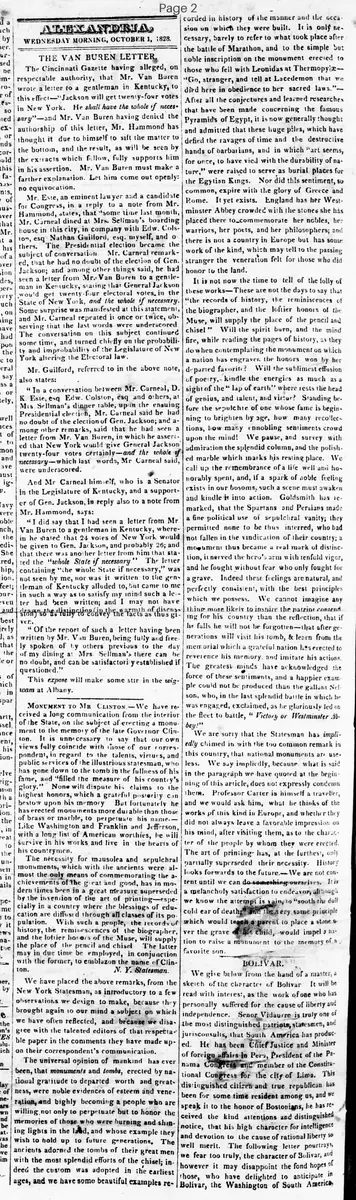
Monument To Mr Clinton.--We have received a long communication from the interior of the State, on the subject of erecting a monument to the memory of the late Governor Clinton. It is unnecessary to say that our own views fully coincide with those of our correspondent, in regard to the talents, virtues, and public services of the illustrious statesman, who has gone down to the tomb in the fullness of his fame, and filled the measure of his country's glory. None will dispute his claims to the highest honors, which a grateful posterity can bestow upon his memory But fortunately he has erected monuments more durable than those of brass or marble, to perpetuate his name.-- Like Washington and Franklin and Jefferson, with a long list of American worthies, he will survive in his works and live in the hearts of his countrymen.
The necessity for mausolea and sepulchral monuments, which with the ancients were almost the only means of commemorating the achievements of the great and good, has in modern times been in a great measure superseded by the invention of the art of printing--especially in a country where the blessings of education are diffused through all classes of its population. With such a people, the records of history, the reminiscences of the biographer, and the loftier honors of the Muse, will supply the place of the pencil and chisel The latter may in due time be employed, in conjunction with the former, to emblazon the name of Clinton.
N. Y. Statesman.
We have placed the above remarks, from the New York Statesman, as introductory to a few observations we design to make, because they brought again to our mind a subject on which we have often reflected, and because we disagree with the talented editors of that respectable paper in the comments they have made upon their correspondent's communication.
The universal opinion of mankind has ever been, that monuments and tombs, erected by national gratitude to departed worth and greatness, were noble evidences of esteem and veneration, and highly becoming a people who are willing, not only to perpetuate but to honor the memories of those who were burning and shining lights in the land, and whose example they wish to hold up to future generations. The ancients adorned the tombs of their great men with the most splendid efforts of the chisel; indeed the custom was adopted in the earliest ages, and we have some beautiful examples recorded in history of the manner and the occasion on which they were built. It is only necessary, barely to refer to what took place after the battle of Marathon, and to the simple but noble inscription on the monument erected to those who fell with Leonidas at Thermopylae--
"Go, stranger, and tell at Lacedemon that we died here in obedience to her sacred laws."
After all the conjectures and learned researches that have been made concerning the famous Pyramids of Egypt, it is now generally thought and admitted that these huge piles, which have defied the ravages of time and the destructive hands of barbarians, and in which "art seems, for once, to have vied with the durability of nature," were raised to serve as burial places for the Egyptian Kings. Nor did this sentiment, so common, expire with the glory of Greece and Rome. It yet exists. England has her Westminster Abbey crowded with the stones she has placed there to commemorate her nobles, her warriors, her poets, and her philosophers; and there is not a country in Europe but has some work of the kind, which may tell to the passing stranger the veneration felt for those who did honor to the land.
It is not now the time to tell of the folly of these works--These are not the days to say that "the records of history, the reminiscences of the biographer, and the loftier honors of the Muse, will supply the place of the pencil and chisel" Will the spirit burn, and the mind fire, while reading the pages of history, as they do when contemplating the monument on which a nation has engraved the honors won by her departed favorite? Will the sublimest effusion of poetry--kindle the energies as much as a sight of the "lap of earth" where rests the head of genius, and talent, and virtue? Standing before the sepulchre of one whose fame is beginning to brighten by age, how many recollections, how many ennobling sentiments crowd upon the mind! We pause, and survey with admiration the splendid column, and the polished marble which marks his resting place. We call up the remembrance of a life well and honorably spent, and, if a spark of noble feeling exists in our bosoms, such a scene must awaken and kindle it into action. Goldsmith has remarked, that the Spartans and Persians made a fine political use of sepulchral vanity; they permitted none to be thus interred, who had not fallen in the vindication of their country; a monument thus became a real mark of distinction, it nerved the hero's arm with tenfold vigor. and he fought without fear who only fought for a grave. Indeed these feelings are natural, and perfectly consistent, with the best principles which we possess. We cannot imagine any thing more likely to inspire the patriot contending for his country than the reflection, that if he falls he will not be forgotten--that after generations will visit his tomb, & learn from the memorial which a grateful nation has erected to reverence his memory, and imitate his actions,
The greatest minds have acknowledged the force of these sentiments, and a happier example could not be produced than the gallant Nelson, who, in the last splendid battle in which he was engaged, exclaimed, as he gloriously led on the fleet to battle, " Victory or Westminster Abbey!"
We are sorry that the Statesman has impliedly chimed in with the too common remark in this country, that national monuments are useless. We say impliedly, because what is said in the paragraph we have quoted at the beginning of this article, does not expressly condemn them. Professor Carter is himself a traveller, and we would ask him, what he thinks of the works of this kind in Europe, and whether they did not always leave a favorable impression on his mind, after visiting them, as to the character of the people by whom they were erected.
The art of printing- has, at the furthest, only partially superseded their necessity. History looks backwards to the past.- We are not content until we can do something ourselves. It is a melancholy satisfaction to endeavor, although we know the attempt is vain, to "sooth the dull cold ear of death" and the very same principle which would teach a parent to place a stone over the grave of his child, would impel a nation to raise a monument to the memory of a favorite son.
The necessity for mausolea and sepulchral monuments, which with the ancients were almost the only means of commemorating the achievements of the great and good, has in modern times been in a great measure superseded by the invention of the art of printing--especially in a country where the blessings of education are diffused through all classes of its population. With such a people, the records of history, the reminiscences of the biographer, and the loftier honors of the Muse, will supply the place of the pencil and chisel The latter may in due time be employed, in conjunction with the former, to emblazon the name of Clinton.
N. Y. Statesman.
We have placed the above remarks, from the New York Statesman, as introductory to a few observations we design to make, because they brought again to our mind a subject on which we have often reflected, and because we disagree with the talented editors of that respectable paper in the comments they have made upon their correspondent's communication.
The universal opinion of mankind has ever been, that monuments and tombs, erected by national gratitude to departed worth and greatness, were noble evidences of esteem and veneration, and highly becoming a people who are willing, not only to perpetuate but to honor the memories of those who were burning and shining lights in the land, and whose example they wish to hold up to future generations. The ancients adorned the tombs of their great men with the most splendid efforts of the chisel; indeed the custom was adopted in the earliest ages, and we have some beautiful examples recorded in history of the manner and the occasion on which they were built. It is only necessary, barely to refer to what took place after the battle of Marathon, and to the simple but noble inscription on the monument erected to those who fell with Leonidas at Thermopylae--
"Go, stranger, and tell at Lacedemon that we died here in obedience to her sacred laws."
After all the conjectures and learned researches that have been made concerning the famous Pyramids of Egypt, it is now generally thought and admitted that these huge piles, which have defied the ravages of time and the destructive hands of barbarians, and in which "art seems, for once, to have vied with the durability of nature," were raised to serve as burial places for the Egyptian Kings. Nor did this sentiment, so common, expire with the glory of Greece and Rome. It yet exists. England has her Westminster Abbey crowded with the stones she has placed there to commemorate her nobles, her warriors, her poets, and her philosophers; and there is not a country in Europe but has some work of the kind, which may tell to the passing stranger the veneration felt for those who did honor to the land.
It is not now the time to tell of the folly of these works--These are not the days to say that "the records of history, the reminiscences of the biographer, and the loftier honors of the Muse, will supply the place of the pencil and chisel" Will the spirit burn, and the mind fire, while reading the pages of history, as they do when contemplating the monument on which a nation has engraved the honors won by her departed favorite? Will the sublimest effusion of poetry--kindle the energies as much as a sight of the "lap of earth" where rests the head of genius, and talent, and virtue? Standing before the sepulchre of one whose fame is beginning to brighten by age, how many recollections, how many ennobling sentiments crowd upon the mind! We pause, and survey with admiration the splendid column, and the polished marble which marks his resting place. We call up the remembrance of a life well and honorably spent, and, if a spark of noble feeling exists in our bosoms, such a scene must awaken and kindle it into action. Goldsmith has remarked, that the Spartans and Persians made a fine political use of sepulchral vanity; they permitted none to be thus interred, who had not fallen in the vindication of their country; a monument thus became a real mark of distinction, it nerved the hero's arm with tenfold vigor. and he fought without fear who only fought for a grave. Indeed these feelings are natural, and perfectly consistent, with the best principles which we possess. We cannot imagine any thing more likely to inspire the patriot contending for his country than the reflection, that if he falls he will not be forgotten--that after generations will visit his tomb, & learn from the memorial which a grateful nation has erected to reverence his memory, and imitate his actions,
The greatest minds have acknowledged the force of these sentiments, and a happier example could not be produced than the gallant Nelson, who, in the last splendid battle in which he was engaged, exclaimed, as he gloriously led on the fleet to battle, " Victory or Westminster Abbey!"
We are sorry that the Statesman has impliedly chimed in with the too common remark in this country, that national monuments are useless. We say impliedly, because what is said in the paragraph we have quoted at the beginning of this article, does not expressly condemn them. Professor Carter is himself a traveller, and we would ask him, what he thinks of the works of this kind in Europe, and whether they did not always leave a favorable impression on his mind, after visiting them, as to the character of the people by whom they were erected.
The art of printing- has, at the furthest, only partially superseded their necessity. History looks backwards to the past.- We are not content until we can do something ourselves. It is a melancholy satisfaction to endeavor, although we know the attempt is vain, to "sooth the dull cold ear of death" and the very same principle which would teach a parent to place a stone over the grave of his child, would impel a nation to raise a monument to the memory of a favorite son.
What sub-type of article is it?
Social Reform
Moral Or Religious
What keywords are associated?
Monument To Clinton
National Commemoration
Value Of Monuments
Historical Examples
Patriotism Inspiration
Printing Vs Chisel
What entities or persons were involved?
Governor Clinton
New York Statesman
Washington
Franklin
Jefferson
Leonidas
Nelson
Professor Carter
Editorial Details
Primary Topic
Advocacy For Physical Monuments To Honor Governor Clinton
Stance / Tone
Supportive Of National Monuments As Inspirers Of Virtue And Patriotism
Key Figures
Governor Clinton
New York Statesman
Washington
Franklin
Jefferson
Leonidas
Nelson
Professor Carter
Key Arguments
Physical Monuments Provide A More Powerful Emotional And Inspirational Impact Than Written Records
Historical Examples From Ancient Greece, Egypt, And Rome Demonstrate The Enduring Value Of Monuments
Modern Europe, Including Westminster Abbey, Continues The Tradition Of Commemorating Great Figures
Monuments Kindle Noble Feelings And Motivate Patriots By Promising Lasting Remembrance
Printing Has Only Partially Replaced The Need For Tangible Memorials
Erecting Monuments Honors The Dead And Benefits The Living By Upholding Examples Of Virtue