Thank you for visiting SNEWPapers!
Sign up free
Norfolk Gazette And Publick Ledger
Norfolk, Virginia
What is this article about?
A mechanic critiques General Samuel Smith's speech at an electioneering meeting, defending federal laws on aliens and sedition, questioning economic claims about debt and Louisiana, detailing the Sophia brig incident, and lamenting the embargo's devastating local effects on commerce and life in the town. Includes a note on the district court's ruling upholding the embargo's constitutionality.
Clipping
OCR Quality
Full Text
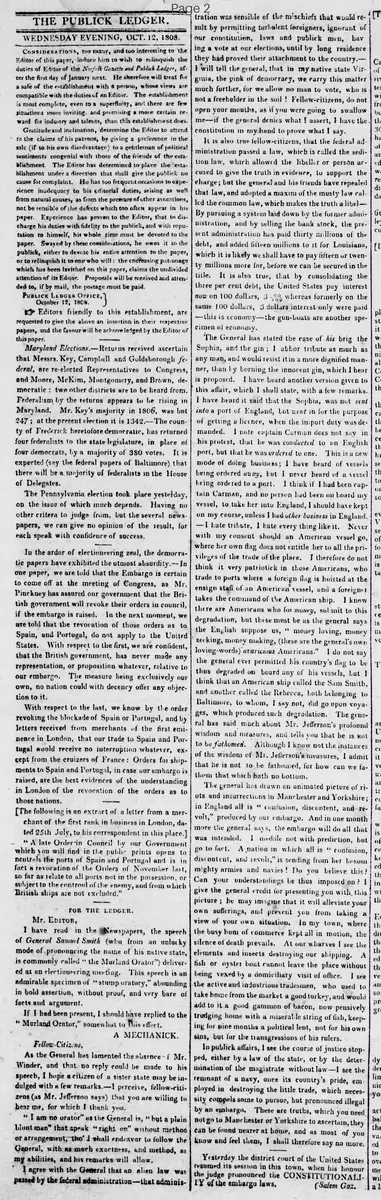
Mr. EDITOR,
I have read in the Newspapers, the speech of General Samuel Smith (who from an unlucky mode of pronouncing the name of his native state, is commonly called "the Murland Orator") delivered at an electioneering meeting. This speech is an admirable specimen of "stump oratory," abounding in bold assertion, without proof, and very bare of facts and argument.
If I had been present, I should have replied to the "Murland Orator," somewhat to this effect.
A MECHANICK.
Fellow-Citizens,
As the General has lamented the absence of Mr. Winder, and that no reply could be made to his speech, I hope a citizen of a sister state may be indulged with a few remarks.--I perceive, fellow-citizens (as Mr. Jefferson says) that you are willing to bear me, for which I thank you.
"I am no orator" as the General is, "but a plain blunt man" that speak "right on" without method or arrangement, tho' I shall endeavor to follow the General, with as much exactness, and method, as my abilities, and his remarks will allow.
I agree with the General that an alien law was passed by the federal administration--that administration was sensible of the mischiefs that would result by permitting turbulent foreigners, ignorant of our constitution, laws and publick men, having a vote at our elections, until by long residence they had proved their attachment to the country.---
I will tell the general, that in my native state Virginia, the pink of democracy, we carry this matter much further, for we allow no man to vote, who is not a freeholder in the soil! Fellow-citizens, do not open your mouths, as if you were going to swallow me--if the general denies what I assert, I have the constitution in my hand to prove what I say.
It is also true fellow-citizens, that the federal administration passed a law, which is called the sedition law, which allowed the libeller or person accused to give the truth in evidence, to support the charge; but the general and his friends have repealed that law, and adopted a maxim of the musty law called the common law, which makes the truth a libel--
By pursuing a system laid down by the former administration, and by selling the bank stock, the present administration has paid thirty millions of the debt, and added fifteen millions to it for Louisiana, which it is likely we shall have to pay fifteen or twenty millions more for, before we can be secured in the title. It is also true, that by consolidating the three per cent debt, the United States pay interest now on 100 dollars, 3 % whereas formerly on the same 100 dollars, 3 dollars interest only were paid --this is economy--the gun-boats are another specimen of economy.
The General has stated the case of his brig the Sophia, and the gin; I abhor tribute as much as any man, and would resist it in a more dignified manner, than by burning the innocent gin, which I hear is proposed. I have heard another version given to this affair, which I shall state, with a few remarks.
I have heard it said that the Sophia, was not sent into a port of England, but sent in for the purpose of getting a licence, when the import duty was demanded. I note captain Carman does not say in his protest, that he was conducted to an English port, but that he was ordered to one. This is a new mode of doing business; I have heard of vessels being ordered away, but I never heard of a vessel being ordered to a port. I think if I had been captain Carman, and no person had been on board my vessel, to take her into England, I should have kept on my course, unless I had other business in England.
--I hate tribute, I hate every thing like it. Never with my consent should an American vessel go, where her own flag does not entitle her to all the privileges of the trade of the place. I therefore do not think it very patriotick in those Americans, who trade to ports where a foreign flag is hoisted at the ensign staff of an American vessel, and a foreigner takes the command of the American ship. I know there are Americans who for money, submit to this degradation, but these must be as the general says the English suppose us, "money loving, money seeking, money making, (these are the general's own words) avaricious Americans." I do not say the general ever permitted his country's flag to be thus degraded on board any of his vessels, but I think that an American ship called the Sam Smith, and another called the Rebecca, both belonging to Baltimore, to whom, I say not, did go upon voyages, which produced such degradation. The general has said much about Mr. Jefferson's profound wisdom and measures, and tells you that he is not to be fathomed. Although I know not the instances of the wisdom of Mr. Jefferson's measures, I admit that he is not to be fathomed, or how can we fathom that which hath no bottom.
The general has drawn an animated picture of riots and insurrections in Manchester and Yorkshire; in England all is "confusion, discontent, and revolt," produced by our embargo. And in one month more the general says, the embargo will do all that was intended. I meddle not with prediction, but go to fact. A nation in which all is "confusion, discontent, and revolt," is sending from her bosom mighty armies and navies! Do you believe this? Can your understandings be thus imposed on? I give the general credit for presenting you with, this picture; he may imagine that it will alleviate your own sufferings, and prevent you from taking a view of your own situation. In my town, where the busy hum of commerce kept all in motion, the silence of death prevails. At our wharves I see the elements and insects destroying our shipping. A fish or oyster boat cannot leave the place without being vexed by a domiciliary visit of office. I see the active and industrious tradesmen, who used to take home from the market a good turkey, and would add to it a good gammon of bacon, now pensively trudging home with a miserable string of fish, keeping for nine months a political lent, not for his own sins, but for the transgressions of his rulers.
In publick affairs, I see the course of justice stopped, either by a law of the state, or by the determination of the magistrate without law--I see the remnant of a navy, once its country's pride, employed in destroying the little trade, which necessity compels some to pursue, but pronounced illegal by an embargo. These are truths, which you need not go to Manchester or Yorkshire to ascertain, they can be found nearer at home, and as most of you know and feel them, I shall therefore say no more.
Yesterday the district court of the United States resumed its session in this town, when his honour the judge pronounced the CONSTITUTIONALITY of the embargo laws.
CSalem Ga:
What sub-type of article is it?
What themes does it cover?
What keywords are associated?
What entities or persons were involved?
Letter to Editor Details
Author
A Mechanick.
Recipient
Mr. Editor
Main Argument
the writer critiques general samuel smith's electioneering speech for lacking facts and argument, defends aspects of federal alien and sedition laws, highlights economic issues like debt management and louisiana purchase costs, questions the sophia brig incident, and describes the embargo's harmful effects on local commerce and daily life.
Notable Details
- references virginia freeholder voting requirement
- cites constitution to support claims
- discusses repeal of sedition law allowing truth as defense
- mentions payment of thirty millions debt and addition for louisiana
- details sophia brig ordered to english port for license and duty
- criticizes americans trading under foreign flags
- mocks jefferson as unfathomable
- depicts english riots from embargo but contrasts with military buildup
- describes local embargo impacts on shipping, tradesmen, justice, and navy
- notes district court ruling on constitutionality of embargo laws