Thank you for visiting SNEWPapers!
Sign up free
Alexandria Advertiser And Commercial Intelligencer
Alexandria, Virginia
What is this article about?
In the House of Commons on April 9, the Chancellor of the Exchequer proposed continuing restrictions on Bank of England cash payments due to poor exchange rates, export challenges, and to aid merchants, emphasizing the bank's stability; the motion passed.
Clipping
OCR Quality
Full Text
HOUSE OF COMMONS,
Friday, April 9.
BANK OF ENGLAND.
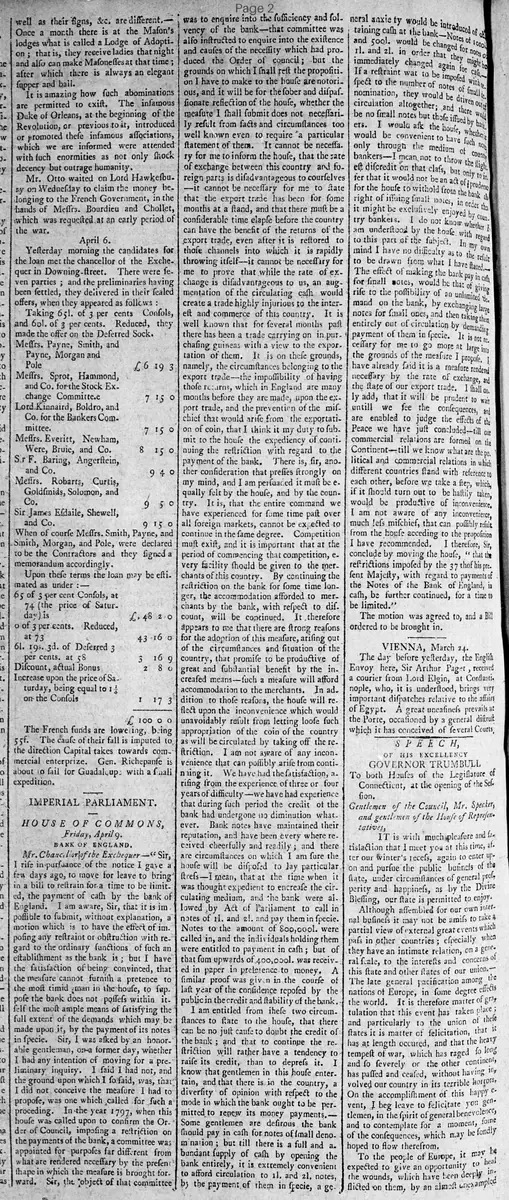
Mr. Chancellor of the Exchequer—Sir, I rise in pursuance of the notice I gave a few days ago, to move for leave to bring in a bill to restrain for a time to be limited, the payment of cash by the bank of England. I am aware, Sir, that it is impossible to submit, without explanation, a motion which is to have the effect of imposing any restraint or obstruction with regard to the ordinary functions of such an establishment as the bank is; but I have the satisfaction of being convinced, that the measure cannot furnish a pretence to the most timid man in the house, to suppose the bank does not possess within itself the most ample means of satisfying the full extent of the demands which may be made upon it, by the payment of its notes in specie. Sir, I was asked by an honorable gentleman, on a former day, whether I had any intention of moving for a preliminary inquiry. I said I had not, and the ground upon which I said, was, that I did not conceive the measure I had to propose, was one which called for such a proceeding. In the year 1797, when this house was called upon to confirm the Order of Council, imposing a restriction on the payments of the bank, a committee was appointed for purposes far different from what are rendered necessary by the present shape in which the measure is brought forward. Sir, the object of that committee was to enquire into the sufficiency and solvency of the bank—that committee was also instructed to enquire into the existence and causes of the necessity which had produced the Order of council; but the grounds on which I shall rest the proposition I have to make to the house are notorious, and it will be for the sober and dispassionate reflection of the house, whether the measure I shall submit does not necessarily result from facts and circumstances too well known even to require a particular statement of them. It cannot be necessary for me to inform the house, that the state of exchange between this country and foreign parts is disadvantageous to ourselves: it cannot be necessary for me to state that the export trade has been for some months at a stand, and that there must be a considerable time elapse before the country can have the benefit of the returns of the export trade, even after it is restored to those channels into which it is rapidly throwing itself—it cannot be necessary for me to prove that while the rate of exchange is disadvantageous to us, an augmentation of the circulating cash would create a trade highly injurious to the interest and commerce of this country. It is well known that for several months past there has been a trade carrying on in purchasing guineas with a view to the exportation of them. It is on these grounds, namely, the circumstances belonging to the export trade—the impossibility of having those returns, which in England are many months before they are made, upon the export trade, and the prevention of the mischief that would arise from the exportation of coin, that I think it my duty to submit to the house the expediency of continuing the restriction with regard to the payment of the bank. There is, Sir, another consideration that presses strongly on my mind, and I am persuaded it must be equally felt by the house, and by the country. It is, that the entire command we have experienced for some time past over all foreign markets, cannot be expected to continue in the same degree. Competition must exist, and it is important that at the period of commencing that competition, every facility should be given to the merchants of this country. By continuing the restriction on the bank for some time longer, the accommodation afforded to merchants by the bank, with respect to discount, will be continued. It therefore appears to me that there are strong reasons for the adoption of this measure, arising out of the circumstances and situation of the country, that promise to be productive of great and substantial benefit by the increased means—such a measure will afford accommodation to the merchants. In addition to those reasons, the house will reflect upon the inconvenience which would unavoidably result from letting loose such appropriation of the coin of the country as will be circulated by taking off the restriction. I am not aware of any inconvenience that can possibly arise from continuing it. We have had the satisfaction, arising from the experience of three or four years of difficulty—we have had experience that during such period the credit of the bank had undergone no diminution whatever. Bank notes have maintained their reputation, and have been every where received cheerfully and readily; and there are circumstances on which I am sure the house will be disposed to lay particular stress—I mean, that at the time when it was thought expedient to increase the circulating medium, and the bank were allowed by Act of Parliament to call in notes of £1 and £2 and pay them in specie. Notes to the amount of £500,000 were called in, and the individuals holding them were entitled to payment in cash; but of that sum upwards of £400,000 was received in paper in preference to money. A similar proof was given in the course of last year of the confidence reposed by the public in the credit and stability of the bank. I am entitled from these two circumstances to state to the house, that there can be no just cause to doubt the credit of the bank: and that to continue the restriction will rather have a tendency to raise its credit, than to depress it. I know that gentlemen in this house entertain, and that there is in the country, a diversity of opinion with respect to the mode in which the bank ought to be permitted to renew its money payments. Some gentlemen are desirous the bank should pay in cash for notes of small denomination; but till there is a full and abundant supply of cash by opening the bank entirely, it is extremely convenient to afford circulation to £1 and £2 notes, as the payment of them in specie would be general anxiety would be created by obtaining cash at the bank—notes of 1l. and 2l. in order that they might be immediately changed again for cash. If a restraint was to be imposed with respect to the number of notes nomination, they would be driven out of small denomination circulation altogether; and there would be no 1l. or 2l. notes. I would ask the house, whether it would be convenient to have such notes only through the medium of bankers—I mean not to throw off the light count it that cut for that it would not be an act for the house to withhold from the bank the right of issuing small notes, in order that it might be exclusively enjoyed by country bankers. I do not know whether I am understood by the house. with regard to this part of the subject. In my own mind I have no difficulty as to the result to be drawn from what I have stated.- The effect of making the bank pay in cash for small notes, would be that of giving rise to the possibility of an unlimited demand on the bank, by exchanging large notes for small ones, and then taking them entirely out of circulation by demanding payment of them in specie. It is not necessary for me to go more at large into the grounds of the measure I propose. I have already said it is a measure rendered necessary by the rate of exchange, and the state of our export trade. I shall only add, that it will be prudent to wait until we see the consequences, and are enabled to judge the effects of the Peace we have just concluded—till our commercial relations are formed on the Continent—till we know what are the political and commercial relations in which different countries stand with reference to each other, before we take a step, which, if it should turn out to be hastily taken, would be productive of inconvenience. I am not aware of any inconvenience, much less mischief, that can possibly result from the house acceding to the proposition I have recommended. I therefore, Sir, conclude by moving the house, "that the restrictions imposed by the 37th of his present Majesty, with regard to payments of the Notes of the Bank of England, in cash, be further continued, for a time to be limited."
The motion was agreed to, and a Bill ordered to be brought in.
What sub-type of article is it?
What keywords are associated?
What entities or persons were involved?
Where did it happen?
Foreign News Details
Primary Location
England
Event Date
Friday, April 9
Key Persons
Outcome
the motion was agreed to, and a bill ordered to be brought in.
Event Details
The Chancellor of the Exchequer moved for leave to bring in a bill to continue restrictions on the Bank of England paying cash for its notes, citing disadvantageous exchange rates, stalled export trade, exportation of guineas, and the need to support merchants amid potential foreign competition. He argued the bank's solvency and public confidence in its notes, referencing past experiences where notes were preferred over specie. He opposed immediate resumption of cash payments for small notes to avoid unlimited demands and circulation issues. The measure was presented as temporary until effects of recent peace and commercial relations are known.