Thank you for visiting SNEWPapers!
Sign up free
Honolulu Star Bulletin
Honolulu, Honolulu County, Hawaii
What is this article about?
In Honolulu, the Sugar Protection Committee meets with businessmen representatives to discuss campaign strategies against threats to the sugar industry, sharing statistics on commerce, irrigation costs, and eastern misconceptions, while planning outreach and headquarters.
Merged-components note: Continuation of the businessmen conference on sugar from page 1 to page 2.
Clippings
1 of 2
OCR Quality
Full Text
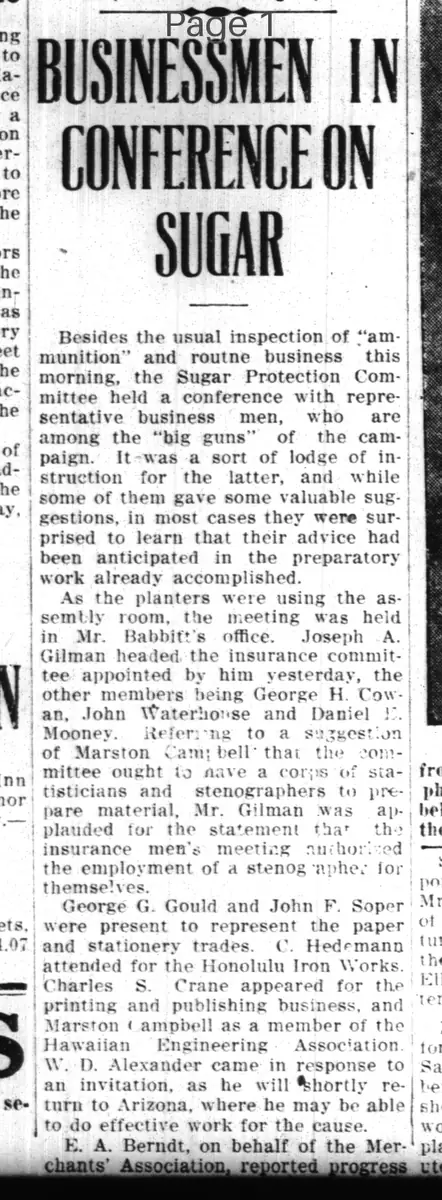
Besides the usual inspection of "ammunition" and routine business this morning, the Sugar Protection Committee held a conference with representative business men, who are among the "big guns" of the campaign. It was a sort of lodge of instruction for the latter, and while some of them gave some valuable suggestions, in most cases they were surprised to learn that their advice had been anticipated in the preparatory work already accomplished.
As the planters were using the assembly room, the meeting was held in Mr. Babbitt's office. Joseph A. Gilman headed the insurance committee appointed by him yesterday, the other members being George H. Cowan, John Waterhouse and Daniel J. Mooney. Referring to a suggestion of Marston Campbell that the committee ought to have a corps of statisticians and stenographers to prepare material, Mr. Gilman was applauded for the statement that the insurance men's meeting authorized the employment of a stenographer for themselves.
George G. Gould and John F. Soper were present to represent the paper and stationery trades. C. Hedemann attended for the Honolulu Iron Works. Charles S. Crane appeared for the printing and publishing business, and Marston Campbell as a member of the Hawaiian Engineering Association. W. D. Alexander came in response to an invitation, as he will shortly return to Arizona, where he may be able to do effective work for the cause.
E. A. Berndt, on behalf of the Merchants.
BUSINESSMEN MEET FOR SUGAR PROTECTION
(Continued from Page 1.)
...for the finance sub-committee. Further time was granted to the sub-committee to prepare resolutions for Mr. Dohrmann to submit to the San Francisco commercial bodies.
Chairman George R. Carter submitted a diagram to illustrate the progress of the campaign, which was referred to the organization committee. It will show from day to day what has been done by the workers reporting on letters sent.
Secretary W. H. Babbitt reported lists of senators and representatives, which were ordered published according to arrangements he had made with copies furnished on separate sheets after appearance in the daily papers.
Mr. Carter said he appreciated very much the action taken by the insurance men. "We must realize," he said, addressing the meeting, "that if the sugar industry is crippled we will all have to go to the mainland to hunt a job. We must carry the sugar ship on our shoulder like the proverbial Irishman."
He went on to say that different methods would have to be used to influence different kinds of people, and suggested a line of information to be sent out by insurance men. Correspondents were not supposed to enclose the printed material furnished, but to study the contents and make them their own. In other words, he urged the personal touch.
He read a synopsis of Judge Baldwin's brief which had been prepared by the planters and commended it as suitable for printing. There was some discussion of certain expressions in the paper and it was laid aside for further consideration. The chairman also submitted statistics of Hawaiian commerce for 1912, partly obtained by himself from the custom house and partly furnished by the commercial editor of The Star-Bulletin. They showed that California had enjoyed the lion's share of the trade, also that the commerce had greatly increased last year.
Mr. Carter expressed surprise at the growth of the campaign, which exceeded anything he anticipated when he suggested, in answer to the request for him to go to Washington, that it was more important to do something at home.
Mr. Campbell told of the seeming incredulity with which a gathering of engineers that entertained him in New York received his statement that the plantations here had to pump twice as much water as the entire supply of the city of San Francisco.
In answer to a question by Mr. Campbell, the chairman said that the beet sugar men had done more than was generally known, but they did not pull with the Louisiana cane sugar men and had no organized campaign.
He then addressed the visitors in explanation of the plan of campaign.
Mr. Hedemann spoke of the dense ignorance of the people in the east regarding the conditions of the sugar industry in Hawaii. They knew nothing of the cost of irrigation. It was thought by them that all that had to be done here was just to stick a piece of cane in the ground and it would grow beautifully the same as in Cuba. What we pay for water and fertilizers which they do not use in Cuba, was utterly unknown to them. As a matter of fact, it was almost ridiculous to consider cane-growing here in comparison with the practices in Cuba.
Mr. Gilpin said it would not be a bad idea to let people know where Hawaii is and its relation to the United States. The other day he received a letter addressed to Honolulu, Philippine Islands.
Mr. Carter gave an instance of the trouble a family friend had about sending a gift to his son, as he could not obtain the blank required to make out a foreign manifest.
Mr. Hedemann stated that four times as much water was used here to irrigate cane than the water supply of the city of New York. He gave rough figures to show that it cost approximately twenty dollars more to produce a ton of sugar in Hawaii than in Cuba. On the question of labor also there was much misapprehension, the speaker continued. In some of the sugar districts of Cuba there were twenty-six men for every square mile, and in those districts there was never any trouble in procuring all the labor wanted at lower wages than paid in Hawaii. In other districts the number of men to the square mile was eight, and there it was less easy to obtain labor.
Mr. Carter said these facts suggested another line of argument. In referring to the boast of Hawaii that it was the most advanced sugar country in the world, sugar men elsewhere gave the large profits of sugar raising here as the reason. Instead of that, the fact was that the Hawaiian planter had to put science into the business to make it yield any profit.
He related a conversation with a Cuban planter, who told him the degree of extraction from the cane on his plantation. It showed that Cuba burned up enough sucrose to make a profit in Hawaii.
In reply to a suggestion by Mr. Mooney for widening the scope of the campaign, Mr. Towse displayed and quoted from a long list of firms and organizations actively enlisted in the work. Messrs. Guild and Soper told what they were prepared to do, upon which the chairman at once entered Mr. Guild's name on the list of sharp shooters. Mr. Carter also gave mention of two valuable discoveries, one being the brother-in-law of a new senator and the other a sister of the manager of the Porto Rico campaign. The latter had asked for information on the local campaign to send to her brother.
Mr. Carter announced that the committee would probably accept the offer of Mr. Tenney of the hall above Castle & Cooke's for headquarters.
The meeting adjourned till 4 o'clock this afternoon, when the automobile, lumber and dry goods representatives will meet the committee.
What sub-type of article is it?
What themes does it cover?
What keywords are associated?
What entities or persons were involved?
Where did it happen?
Story Details
Key Persons
Location
Mr. Babbitt's Office, Honolulu, Hawaii
Story Details
The Sugar Protection Committee confers with businessmen representatives on campaign strategies to protect Hawaii's sugar industry, discussing progress diagrams, senator lists, irrigation and labor costs compared to Cuba, eastern ignorance, and personal outreach methods; meeting adjourns for further sessions.