Thank you for visiting SNEWPapers!
Sign up free
Gazette Of The United States
New York, New York County, New York
What is this article about?
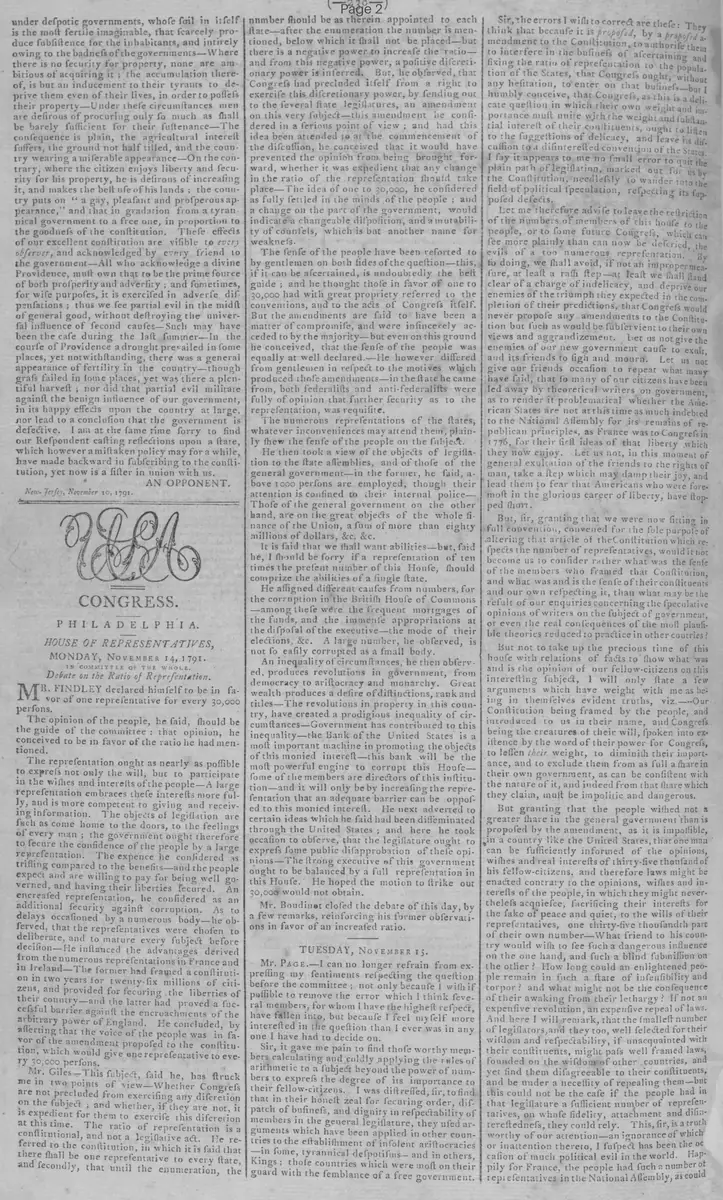
U.S. House of Representatives proceedings in Philadelphia, November 14-22, 1791: Primary debate on constitutional amendment for representation ratio of 1 per 30,000 persons, with speeches by Findley, Giles, Page, and Boudinot favoring larger representation for better governance and against corruption. Includes petitions, bills on militia and appropriations, and discussions on elections and certificates.
Merged-components note: This is a single continuous story reporting on congressional proceedings in the House of Representatives, covering debates and sessions from November 14 to November 22, 1791; text flows sequentially across pages 2 and 3.
Clippings
1 of 2
OCR Quality
Full Text
PHILADELPHIA.
HOUSE OF REPRESENTATIVES,
MONDAY, NOVEMBER 14, 1791.
IN COMMITTEE OF THE WHOLE.
Debate on the Ratio of Representation.
MR. FINDLEY declared himself to be in favor of one representative for every 30,000 persons.
The opinion of the people, he said, should be the guide of the committee: that opinion, he conceived to be in favor of the ratio he had mentioned.
The representation ought as nearly as possible to express not only the will, but to participate in the wishes and interests of the people—A large representation embraces these interests more fully, and is more competent to giving and receiving information. The objects of legislation are such as come home to the doors, to the feelings of every man; the government ought therefore to secure the confidence of the people by a large representation. The expense he considered as trifling compared to the benefits—and the people expect and are willing to pay for being well governed, and having their liberties secured. An increased representation, he considered as an additional security against corruption. As to delays occasioned by a numerous body—he observed, that the representatives were chosen to deliberate, and to mature every subject before decision—He instanced the advantages derived from the numerous representations in France and in Ireland—The former had framed a constitution in two years for twenty-six millions of citizens, and provided for securing the liberties of their country—and the latter had proved a successful barrier against the encroachments of the arbitrary power of England. He concluded, by asserting that the voice of the people was in favor of the amendment proposed to the constitution, which would give one representative to every 30,000 persons.
Mr. Giles—This subject, said he, has struck me in two points of view—Whether Congress are not precluded from exercising any discretion on the subject; and whether, if they are not, it is expedient for them to exercise this discretion at this time. The ratio of representation is a constitutional, and not a legislative act. He referred to the constitution, in which it is said that there shall be one representative to every state, and secondly, that until the enumeration, the number should be as therein appointed to each state—after the enumeration the number is mentioned, below which it shall not be placed—but there is a negative power to increase the ratio—and from this negative power, a positive discretionary power is inferred. But, he observed, that Congress had precluded itself from a right to exercise this discretionary power, by sending out to the several state legislatures, an amendment on this very subject—this amendment he considered in a serious point of view: and had this idea been attended to at the commencement of the discussion, he conceived that it would have prevented the opinion from being brought forward, whether it was expedient that any change in the ratio of the representation should take place—The idea of one to 30,000, he considered as fully settled in the minds of the people; and a change on the part of the government, would indicate a changeable disposition, and a mutability of counsels, which is but another name for weakness.
The sense of the people have been resorted to by gentlemen on both sides of the question—this, if it can be ascertained, is undoubtedly the best guide; and he thought those in favor of one to 30,000 had with great propriety referred to the conventions, and to the acts of Congress itself.
But the amendments are said to have been a matter of compromise, and were sincerely acceded to by the majority—but even on this ground he conceived, that the sense of the people was equally as well declared.—He however differed from gentlemen in respect to the motives which produced those amendments—in the state he came from, both federalists and anti-federalists were fully of opinion that further security as to the representation, was requisite.
The numerous representations of the states, whatever inconveniences may attend them, plainly shew the sense of the people on the subject.
He then took a view of the objects of legislation to the state assemblies, and of those of the general government—in the former, he said, above 1000 persons are employed, though their attention is confined to their internal police—Those of the general government on the other hand, are on the great objects of the whole, finance of the Union, a sum of more than eighty millions of dollars. &c. &c.
It is said that we shall want abilities—but, said he, I should be sorry if a representation of ten times the present number of this House, should comprise the abilities of a single state.
He assigned different causes from numbers, for the corruption in the British House of Commons—among these were the frequent mortgages of the funds, and the immense appropriations at the disposal of the executive—the mode of their elections, &c. A large number, he observed, is not so easily corrupted as a small body.
An inequality of circumstances, he then observed, produces revolutions in government, from democracy to aristocracy and monarchy. Great wealth produces a desire of distinctions, rank and titles—The revolutions in property in this country, have created a prodigious inequality of circumstances—Government has contributed to this inequality—the Bank of the United States is a most important machine in promoting the objects of this monied interest—this bank will be the most powerful engine to corrupt this House—some of the members are directors of this institution—and it will only be by increasing the representation that an adequate barrier can be opposed to this monied interest. He next adverted to certain ideas which he said had been disseminated through the United States; and here he took occasion to observe, that the legislature ought to express some public disapprobation of these opinions—The strong executive of this government ought to be balanced by a full representation in this House. He hoped the motion to strike out 30,000 would not obtain.
Mr. Boudinot closed the debate of this day, by a few remarks, reinforcing his former observations in favor of an increased ratio.
TUESDAY, NOVEMBER 15.
Mr. PAGE. I can no longer refrain from expressing my sentiments respecting the question before the committee; not only because I wish if possible to remove the error which I think several members, for whom I have the highest respect, have fallen into, but because I feel myself more interested in the question than I ever was in any one I have had to decide on.
Sir, it gave me pain to find those worthy members calculating and coldly applying the rules of arithmetic to a subject beyond the power of numbers to express the degree of its importance to their fellow-citizens. I was distressed, sir, to find that in their honest zeal for securing order, dispatch of business, and dignity in respectability of members in the general legislature, they used arguments which have been applied in other countries to the establishment of insolent aristocracies—in some, tyrannical despotisms—and in others, Kings; those countries which were most on their guard with the semblance of a free government.
Sir, the errors I wish to correct are these: They think that because it is proposed, by a proposed amendment to the Constitution, to authorize them to interfere in the business of ascertaining and fixing the ratio of representation to the population of the States, that Congress ought, without any hesitation, to enter on that business—but I humbly conceive, that Congress, as this is a delicate question in which their own weight and importance must unite with the weight and substantial interest of their constituents, ought to listen to the suggestions of delicacy, and leave its discussion to a disinterested convention of the States.
I say it appears to me no small error to quit the plain path of legislation, marked out for us by the Constitution, needlessly to wander into the field of political speculation, respecting its supposed defects.
Let me therefore advise to leave the restriction of the numbers of members of this house to the people, or to some future Congress, which can see more plainly than can now be descried, the evils of a too numerous representation.
By so doing, we shall avoid, if not an improper measure, at least a rash step—at least we shall stand clear of a charge of indelicacy, and deprive our enemies of the triumph they expected in the completion of their predictions, that Congress would never propose any amendments to the Constitution but such as would be subservient to their own views and aggrandizement. Let us not give the enemies of our new government cause to exult, and its friends to sigh and mourn. Let us not give our friends occasion to repeat what many have said, that so many of our citizens have been led away by theoretical writers on government, as to render it problematical whether the American States are not at this time as much indebted to the National Assembly for its remains of republican principles, as France was to Congress in 1776, for their first ideas of that liberty which they now enjoy. Let us not, in this moment of general exultation of the friends to the rights of man, take a step which may damp their joy, and lead them to fear that Americans who were foremost in the glorious career of liberty, have stopped short.
But, sir, granting that we were now sitting in full convention, convened for the sole purpose of altering that article of the Constitution which respects the number of representatives, would it not become us to consider rather what was the sense of the members who framed that Constitution, and what was and is the sense of their constituents and our own respecting it, than what may be the result of our enquiries concerning the speculative opinions of writers on the subject of government, or even the real consequences of the most plausible theories reduced to practice in other countries?
But not to take up the precious time of this house with relations of facts to show what was and is the opinion of our fellow-citizens on this interesting subject, I will only state a few arguments which have weight with me as being in themselves evident truths, viz.—Our Constitution being framed by the people, and introduced to us in their name, and Congress being the creatures of their will, spoken into existence by the word of their power for Congress, to lessen their weight, to diminish their importance, and to exclude them from as full a share in their own government, as can be consistent with the nature of it, and indeed from that share which they claim, must be impolitic and dangerous.
But granting that the people wished not a greater share in the general government than is proposed by the amendment, as it is impossible, in a country like the United States, that one man can be sufficiently informed of the opinions, wishes and real interests of thirty-five thousand of his fellow-citizens, and therefore laws might be enacted contrary to the opinions, wishes and interests of the people, in which they might nevertheless acquiesce, sacrificing their interests for the sake of peace and quiet. to the wills of their representatives, one thirty-five thousandth part of their own number—What friend to his country would wish to see such a dangerous influence on the one hand, and such a blind submission on the other? How long could an enlightened people remain in such a state of insensibility and torpor? and what might not be the consequence of their awaking from their lethargy? If not an expensive revolution, an expensive repeal of laws.
And here I will remark, that the smallest number of legislators, and they too, well selected for their wisdom and respectability, if unacquainted with their constituents, might pass well framed laws, founded on the wisdom of other countries, and yet find them disagreeable to their constituents, and be under a necessity of repealing them—but this could not be the case if the people had in that legislature a sufficient number of representatives, on whose fidelity, attachment and disinterestedness, they could rely.
This, sir, is a truth worthy of our attention—an ignorance of which or inattention thereto, I suspect has been the occasion of much political evil in the world. Happily for France, the people had such a number of representatives in the National Assembly, as could
in their fidelity and disinterestedness—had that attach their interest, and establish their confidence engage their feeling, inform their judgment, at- number been much smaller, it is probable France would never have been delivered from oppression by their exertions.
I believe the National Assembly have judged about 750 members sufficient to represent their people, which on a supposition that they amount even to 26 millions, will be 1 representative for every 34,000; a larger representation than is proposed by the amendment before us; but, sir, it is not and cannot be the interest or wish of the people at large to have a small representation in Congress under the present government. We are told however that to avoid expense the peo- ple wish it—and that to avoid confusion in this house we should comply with that wish. With respect to the article of expense, I think we may with propriety make use of arithmetical calcula- tions, and to find how much at 6 dollars per day paid to 1 representative it would cost the 30,000 divide 600 cents by 30,000, the number of citi- zens—and we have 1-50 of a cent per diem, the expense of each citizen, if to be equally divided amongst them—that is 1 cent for every 50 citi- zens pr. diem, or which must be the same thing 1 cent must be paid by each citizen for every 50 days session of their representative in Congress; Sir, I have the consolation to find that if our con- stitution had 1 representative for every 15, in- stead of 30,000 they could well afford to pay them, and that if it were even more expensive as to the payment of members, yet the people would most certainly be better satisfied with the laws which they would then have so great a share in framing. The people see that if their interests are not well guarded by a sufficient number of their fellow-citizens, who have a fellow-feeling. a common interest, they may be sacrificed to the ambition of some, or the vanity of others; I trust sir, that they know too well the high price they have paid for the purchase of their liberties, to be unwilling to pay a few farthings for the only possible means of preserving them. They see now that the monarchical and aristocratical part of government is to be restrained—the former from absolute tyranny, and the latter from an insufferable insolence, by a very numerous body of the representatives of the people alone. Ame- ricans know, sir, that monarchical governments were necessary for the protection of weak ig- norant people, against the encroachments of am- bitious and ferocious neighbors; and for the preservation of order amongst themselves: that an aristocratical form became convenient to pro- tect them against the oppression of tyranny spring- ing up out of monarchy—that this form was adapted to a small progress in the science of go- vernment, and that these two forms properly checked and controlled by the democratical form, is still better suited to a general know- ledge of that science; that a representative go- vernment such as their own is, every part of which is more or less pervaded by the spirit of representation, cannot by any other means be so perfectly secured, as by their having at least as full a share as they have claimed in the demo- cratical branch of their government.
I know Sir, that many friends of our constitu- tion, thought that the Convention did not pay a sufficient attention to the interests of their con- stituents, when they restrained them from hav- ing more than one representative for every 30,000 citizens.—I know that there is a report that the people are indebted to their President, even for this share in their government; and I believe, Sir, if this report be true, that whatever has been so justly said of him, as compared to Fabius, to Hannibal, to Alexander, may be forgotten, when this instance of his wisdom, disinterestedness, and attachment to the interests of his fellow citizens, will be more and more known and applauded, and be forever engraved on the hearts of their posterity —Shall we then, Mr. Chairman, the direct repre- sentatives of the people, be less attentive to their interest, and that too respecting their share in the deliberations of their own House of Repre- sentatives, than the President of their Conven- tion was? I trust not.
I will not pretend to say, however, whether in an assembly where attempts are frequently made, to carry into effect the projects of monar- chical or aristocratical juntos, the virtuous strug- gles of patriotic members, may not produce mob- like disorders; but in an assembly like Congress, where I should suppose no such question can be agitated; none which may not be discussed with temper and decency, such disorder need not be apprehended. I should suppose there would be less danger of animosities and disorderly debates in Congress, amongst 1200 members, than in the British Parliament, if it consisted but of 100.- Where we have all but one and the same great object in view, the happiness of our country, (not the interests of a particular body of men, born with privileges insulting the feelings and the rights of freemen nor the whims of any individual, born to trample on his fellow creatures) we can have no cause to be dissatisfied with one another.
MONDAY, NOVEMBER 21.
The address from the General Assembly of St. Domingo, to the Congress of the United States, was read.
Mr. Williamson presented an affidavit respecting the loss or de- struction of sundry certificates, the property of a citizen of North- Carolina, which being read, it was moved that it should be refer- red to the Secretary of the Treasury. The motion being objected to, as informal, the affidavit not being accompanied with a petition, was negatived.
Mr. Wadsworth, of the committee appointed for that purpose, reported a bill more effectually to provide for the national defence, by establishing a uniform militia throughout the United States— read the first and second time, and referred to a committee of the whole house, and made the order of the day for Monday next— to be printed in the interim.
The report of the committee on the petition of James Jackson, was referred to the committee of the whole, and made the order of the day for Thursday next—Report to be printed in the interim.
The report of the committee on the election of John Francis Mercer, was again read.
Mr. Giles observed that the case involved two principles, which he conceived to be of some importance to be fully discussed and decided, previous to an unqualified acceptance of the report—the first was, whether a member had a right to vacate his own seat— and the other was, how far it is in the power of the executive of a particular State, to fill the vacancies which may take place in this house. These considerations, he thought, had essential reference to the privileges of members.
Mr. Seney observed, that he conceived the report was strictly conformable to the rules and precedents of the house, in similar cases—several of which had occurred. With respect to the right of a member to resign, he thought the reverse idea involved an at- tack on the privileges of the citizens of the United States.
The motion was, after some further debate, referred to committee of the whole house to-morrow.
Mr. Smith (N. H.) presented the petition of Jason Waite—read and referred to the Secretary of War.
Mr. Boudinot moved that the petition of James Weeks should be referred to the Secretary of War. The petition was again read the motion for a particular reference to the Secretary of War, was objected to.
Mr. Williamson said the motion ought to be for a general re- ference. This motion being put, was negatived; and a motion to reject the petition was put and carried.
The petition of J. E. Moore, respecting a number of certificates of public debt, which were destroyed, praying they may be re- newed. was read—and with some others of a similar nature, refer- red to the Secretary of the Treasury.
The resolution for extending the time limited for settling the accounts between the United States and individual States, was agreed to; and a committee, consisting of Messrs. Dayton, Griffin and Hartley, appointed to report a bill accordingly.
The order of the day—on the bill apportioning the represen- tation of the inhabitants of the United States, according to the first enumeration—Mr. Muhlenberg in the chair.
The bill was read by the Clerk.
Mr. Macon moved that the first section be amended, by insert- ing the word five after the word thousand.
This motion, after some debate, was negatived—as were also motions to insert four and three.
Mr. Benson then moved to strike out the whole of the first sec- tion, in order to substitute another which he had prepared.
This motion respected a different modification of the section. still retaining the ratio of one representative to thirty thousand.
Further debate ensued, and the committee rose and reported pro- gress.—The house then adjourned.
TUESDAY, NOVEMBER 22.
A letter from the Secretary of State, enclosing a report on the petition of Jacob Isaacs, of Newport, (R.I.) who had prayed for a reward from government, for discovering the art of converting salt water into fresh, by an easy process—This report stated an ac- count of certain processes made by the petitioner in presence of the Secretary of State, to ascertain his pretensions—the result was that simple distillation, without Mr. Isaacs' discovered mixture produced as great a quantity of fresh water, as with it.
Mr. Sylvester presented the petition of Reuben Murray and Daniel Schermerhorn—read, and referred to the Secretary of the Treasury—
Sundry other petitions were read and referred.
Mr. Findley presented a petition of certain inhabitants of the counties of Washington, Alleghany, and Westmoreland, respecting the excise law—read, and referred to the Secretary of the Trea- sury.
Mr. Lawrence reported a bill making appropriations for the support of government for the year 1792—read the first and second time, and referred to a committee of the whole house, to be made the order of the day on Wednesday next.
Mr. Williamson presented the remonstrance and petition of a yearly meeting of the people called Quakers in the State of North- Carolina, against the duties and penalties of the militia law—read and referred to the committee of the whole House to whom the militia law was referred.
Mr. Lee presented the petition of John Crane, praying the renewal of a lost certificate, read and referred to the Secretary of the Treasury.
The petition of sundry surgeons of the late army praying a fair and equitable settlement of their accounts, was read.
In committee of the whole, on the report of the select commit- tee on the election of John Francis Mercer.
It was moved that the report should be accepted—Mr. Giles stated the reasons of his dissent from it—He was replied to by Mr. Smith, (S.C.) Mr. Murray, Mr. Gerry, and Mr. Seney. Mr. Sedgwick suggested some difficulties in the case—The question being called for, Mr. Lee moved that the committee should rise and report progress—this motion obtained, and the committee rose, and asked leave to sit again.
In committee of the whole on the bill apportioning the represen- tation of the inhabitants of the United States.
The committee agreed to sundry amendments to the bill— then rose, and the house adjourned.
What sub-type of article is it?
What themes does it cover?
What keywords are associated?
What entities or persons were involved?
Where did it happen?
Story Details
Key Persons
Location
Philadelphia
Event Date
November 14, 1791 To November 22, 1791
Story Details
Debate in the House of Representatives on amending the Constitution to set representation ratio at one per 30,000 persons, with arguments emphasizing public opinion, security against corruption, benefits of larger bodies as in France and Ireland, and risks of smaller representation leading to inequality and monied influence; interspersed with routine business including petitions on certificates, militia bill, election of John Francis Mercer, and appropriations.