Thank you for visiting SNEWPapers!
Sign up free
American Watchman And Delaware Advertiser
Wilmington, New Castle County, Delaware
What is this article about?
A personal reflection on the sublime qualities of sacred music, particularly Handel's Messiah, Judas Maccabeus, and Haydn's Creation. The author recounts emotional experiences hearing these oratorios in Europe, sung by Madame Mara and Mrs. Billington, and extols how sacred music fosters virtue, devotion, and enduring emotional resonance across ages.
Clipping
OCR Quality
Full Text
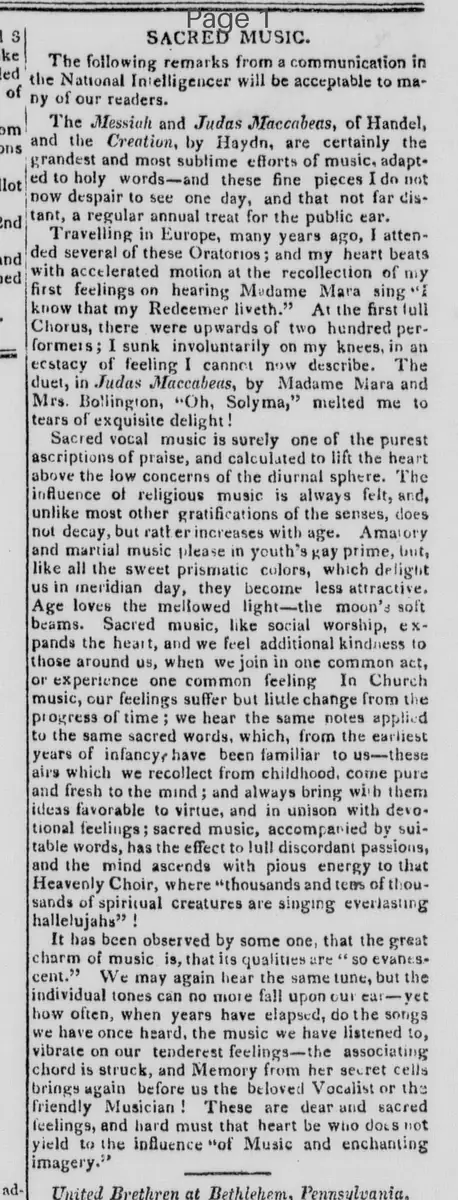
The following remarks from a communication in the National Intelligencer will be acceptable to many of our readers.
The Messiah and Judas Maccabeus, of Handel, and the Creation, by Haydn, are certainly the grandest and most sublime efforts of music, adapted to holy words—and these fine pieces I do not now despair to see one day, and that not far distant, a regular annual treat for the public ear.
Travelling in Europe, many years ago, I attended several of these Oratorios; and my heart beats with accelerated motion at the recollection of my first feelings on hearing Madame Mara sing "I know that my Redeemer liveth." At the first full Chorus, there were upwards of two hundred performers; I sunk involuntarily on my knees, in an ecstacy of feeling I cannot now describe. The duet, in Judas Maccabeus, by Madame Mara and Mrs. Billington, "Oh, Solyma," melted me to tears of exquisite delight!
Sacred vocal music is surely one of the purest ascriptions of praise, and calculated to lift the heart above the low concerns of the diurnal sphere. The influence of religious music is always felt, and, unlike most other gratifications of the senses, does not decay, but rather increases with age. Amatory and martial music please in youth's gay prime, but, like all the sweet prismatic colors, which delight us in meridian day, they become less attractive.
Age loves the mellowed light—the moon's soft beams. Sacred music, like social worship, expands the heart, and we feel additional kindness to those around us, when we join in one common act, or experience one common feeling In Church music, our feelings suffer but little change from the progress of time; we hear the same notes applied to the same sacred words, which, from the earliest years of infancy—have been familiar to us—these airs which we recollect from childhood, come pure and fresh to the mind; and always bring with them ideas favorable to virtue, and in unison with devotional feelings; sacred music, accompanied by suitable words, has the effect to lull discordant passions, and the mind ascends with pious energy to that Heavenly Choir, where "thousands and tens of thousands of spiritual creatures are singing everlasting hallelujahs"!
It has been observed by some one, that the great charm of music is, that its qualities are "so evanescent." We may again hear the same tune, but the individual tones can no more fall upon our ear—yet how often, when years have elapsed, do the songs we have once heard, the music we have listened to, vibrate on our tenderest feelings—the associating chord is struck, and Memory from her secret cells brings again before us the beloved Vocalist or the friendly Musician! These are dear and sacred feelings, and hard must that heart be who does not yield to the influence "of Music and enchanting imagery."
What sub-type of article is it?
What themes does it cover?
What keywords are associated?
What entities or persons were involved?
Where did it happen?
Story Details
Key Persons
Location
Europe
Event Date
Many Years Ago
Story Details
The author shares a personal recollection of attending oratorios in Europe, being deeply moved by performances of Handel's works sung by Madame Mara and Mrs. Billington, and reflects on the enduring, elevating power of sacred music to inspire virtue and devotion.