Thank you for visiting SNEWPapers!
Sign up free
Gazette Of The United States
New York, New York County, New York
What is this article about?
Secretary of State Thomas Jefferson reports to the U.S. House on Jacob Isaacks' petition for a reward for distilling fresh water from seawater using ship equipment. Historical methods are reviewed, experiments confirm simple distillation suffices without Isaacks' mixture, and dissemination of the knowledge to sailors is recommended. Philadelphia, November 21, 1791.
Merged-components note: Continuation of the Secretary of State's report on converting salt-water to fresh water.
Clipping
OCR Quality
Full Text
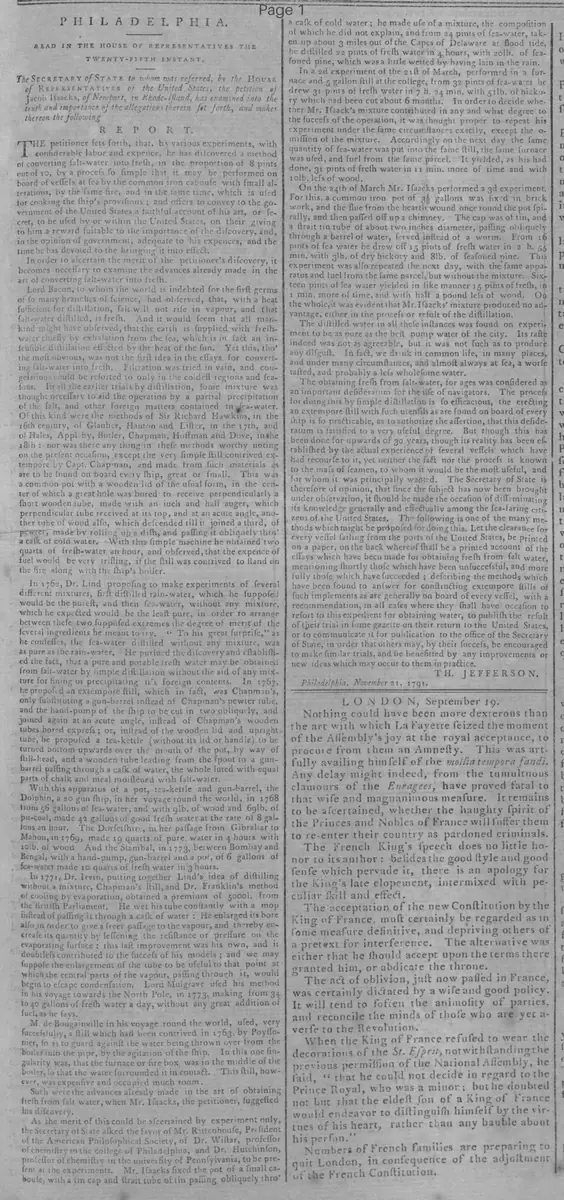
READ IN THE HOUSE OF REPRESENTATIVES THE TWENTY-FIFTH INSTANT.
The SECRETARY of STATE to whom was referred, by the House of REPRESENTATIVES of the United States, the petition of Jacob Isaacks, of Newport, in Rhode-Island, has examined into the truth and importance of the allegations therein set forth, and makes thereon the following
REPORT.
The petitioner sets forth, that by various experiments, with considerable labor and expense, he has discovered a method of converting salt-water into fresh, in the proportion of 8 pints out of 10, by a process simple that it may be performed on board of vessels at sea by the common iron caboose with small alterations, by the same fire, and in the same time, which is used for cooking the ship's provisions; and offers to convey to the government of the United States a faithful account of his art, or secret, to be used by or within the United States, on their giving to him a reward suitable to the importance of the discovery, and, in the opinion of government, adequate to his expenses, and the time he has devoted to the bringing it into effect.
In order to ascertain the merit of the petitioner's discovery, it becomes necessary to examine the advances already made in the art of converting salt-water into fresh.
Lord Bacon, to whom the world is indebted for the first germs of so many branches of science, had observed, that, with a heat sufficient for distillation, salt will not rise in vapour, and that salt-water distilled, is fresh. And it would seem that all mankind might have observed, that the earth is supplied with fresh-water chiefly by exhalation from the sea, which is in fact an insensible distillation effected by the heat of the sun. Yet this, though the most obvious, was not the first idea in the essays for converting salt-water into fresh. Filtration was tried in vain, and congelations could be resorted to only in the coldest regions and seasons. In all the earlier trials by distillation, some mixture was thought necessary to aid the operation by a partial precipitation of the salt, and other foreign matters contained in sea-water.
Of this kind were the methods of Sir Richard Hawkins, in the 16th century, of Glauber, Hauton and Lister, in the 17th, and of Hales, Appleby, Butler, Chapman, Hoffman and Dove, in the 18th: nor was there any thing in these methods worthy noting on the present occasion, except the very simple still contrived extempore by Capt. Chapman, and made from such materials as are to be found on board every ship, great or small. This was a common pot with a wooden lid of the usual form, in the center of which a great hole was bored to receive perpendicularly a short wooden tube, made with an inch and half auger, which perpendicular tube received at its top, and at an acute angle, another tube of wood also, which descended till it joined a third, of pewter, made by rolling up a dish, and passing it obliquely thro' a cask of cold water. With this simple machine he obtained two quarts of fresh-water an hour, and observed, that the expense of fuel would be very trifling, if the still was contrived to stand on the fire along with the ship's boiler.
In 1762, Dr. Lind proposed to make experiments of several different mixtures, first distilled rain-water, which he supposed would be the purest, and then sea-water, without any mixture, which he expected would be the least pure, in order to arrange between these two supposed extremes the degree of merit of the several ingredients he meant to try. To his great surprise, as he confesses, the sea-water distilled without any mixture, was as pure as the rain-water. He pursued the discovery and established the fact, that a pure and potable fresh water may be obtained from salt-water by simple distillation without the aid of any mixture for fining or precipitating its foreign contents. In 1767, he proposed an extempore still, which in fact, was Chapman's, only substituting a gun-barrel instead of Chapman's pewter tube, and the hand-pump of the ship to be cut in two obliquely, and joined again at an acute angle, instead of Chapman's wooden tubes bored express; or, instead of the wooden lid and upright tube, he proposed a tea-kettle (without its lid or handle) to be turned bottom upwards over the mouth of the pot, by way of still-head, and a wooden tube leading from the spout to a gun-barrel passing through a cask of water, the whole luted with equal parts of chalk and meal moistened with salt-water.
With this apparatus of a pot, tea-kettle and gun-barrel, the Dolphin, a 20 gun ship, in her voyage round the world, in 1768 from 56 gallons of sea-water, and with 6 lb. of wood and 6 lb. of pit-coal, made 42 gallons of good fresh water at the rate of 8 gallons an hour. The Dorsetshire, in her passage from Gibraltar to Mahon, in 1769, made 19 quarts of pure water in 4 hours with 10 lb. of wood And the Stampbal, in 1773, between Bombay and Bengal, with a hand-pump, gun-barrel and a pot, of 6 gallons of sea-water made 10 quarts of fresh water in 3 hours.
In 1771, Dr. Irvin, putting together Lind's idea of distilling without a mixture, Chapman's still, and Dr. Franklin's method of cooling by evaporation, obtained a premium of 5000 l. from the British Parliament. He wet his tube constantly with a mop instead of passing it through a cask of water : He enlarged its bore also in order to give a freer passage to the vapour, and thereby increase its quantity by lessening the resistance or pressure on the evaporating surface : this last improvement was his own, and it doubtless contributed to the success of his models ; and we may suppose the enlargement of the tube to be useful to that point at which the central parts of the vapour, passing through it, would begin to escape condensation. Lord Mulgrave used his method in his voyage towards the North Pole, in 1773, making from 34 to 40 gallons of fresh water a day, without any great addition of fuel, as he says.
M. de Bougainville in his voyage round the world, used, very successfully, a still which had been contrived in 1763, by Poylonier, so as to guard against the water being thrown over from the boiler into the pipe, by the agitation of the ship. In this one irregularity was, that the furnace or fire box was in the middle of the boiler, so that the water surrounded it in contact. This still, however, was expensive and occupied much room.
Such were the advances already made in the art of obtaining fresh from salt water, when Mr. Isaacks, the petitioner, suggested his discovery.
As the merit of this could be ascertained by experiment only, the Secretary of State asked the favor of Mr. Rittenhouse, President of the American Philosophical Society, of Dr. Wistar, professor of chemistry in the college of Philadelphia, and Dr. Hutchinson, professor of chemistry in the university of Pennsylvania, to be present at the experiments. Mr. Isaacks fixed the pot of a small caboose, with a tin cap and strait tube of tin passing obliquely thro' a cask of cold water: he made use of a mixture, the composition of which he did not explain, and from 24 pints of sea-water, taken up about 3 miles out of the Capes of Delaware at flood tide. he distilled 22 pints of fresh water in 4 hours, with 20 lb. of seasoned pine, which was a little wetted by having lain in the rain.
In a 2d experiment of the 21st of March, performed in a furnace and 5 gallon still at the college, from 32 pints of sea-water he drew 31 pints of fresh water in 7 h. 24 min. with 5 1/2 lb. of hickory which had been cut about 6 months. In order to decide whether Mr. Isaack's mixture contributed in any and what degree to the success of the operation, it was thought proper to repeat his experiment under the same circumstances exactly, except the omission of the mixture. Accordingly on the next day the same quantity of sea-water was put into the same still, the same furnace was used, and fuel from the same parcel. It yielded, as his had done, 31 pints of fresh water in 1 min. more of time and with 10 lb. less of wood.
On the 24th of March Mr. Isaacks performed a 3d experiment. For this, a common iron pot of 2 gallons was fixed in brick work, and the flue from the hearth wound once round the pot spirally, and then passed off up a chimney. The cap was of tin, and a strait tin tube of about two inches diameter, passing obliquely through a barrel of water, served instead of a worm. From 16 pints of sea water he drew off 15 pints of fresh water in 2 h. 55 min. with 3 lb. of dry hickory and 8 lb. of seasoned pine. This experiment was also repeated the next day, with the same apparatus and fuel from the same parcel, but without the mixture. Sixteen pints of sea water yielded in like manner 15 pints of fresh, in 1 min. more of time, and with half a pound less of wood. On the whole, it was evident that Mr. Isaacks' mixture produced no advantage, either in the process or result of the distillation.
The distilled water in all these instances was found on experiment to be as pure as the best pump water of the city. Its taste indeed was not as agreeable, but it was not such as to produce any disgust. In fact, we drink in common life, in many places, and under many circumstances, and almost always at sea, a worse tasted, and probably a less wholesome water.
The obtaining fresh from salt-water, for ages was considered as an important desideratum for the use of navigators. The process for doing this by simple distillation is so efficacious, the erecting an extempore still with such utensils as are found on board of every ship is so practicable, as to authorize the assertion, that this desideratum is satisfied to a very useful degree. But though this has been done for upwards of 30 years, though its reality has been established by the actual experience of several vessels which have had recourse to it, yet neither the fact nor the process is known to the mass of seamen, to whom it would be the most useful, and for whom it was principally wanted. The Secretary of State is therefore of opinion, that since the subject has now been brought under observation, it should be made the occasion of disseminating its knowledge generally and effectually among the sea-faring citizens of the United States. The following is one of the many methods which might be proposed for doing this. Let the clearance for every vessel sailing from the ports of the United States, be printed on a paper, on the back whereof shall be a printed account of the essays which have been made for obtaining fresh from salt water, mentioning shortly those which have been unsuccessful, and more fully those which have succeeded; describing the methods which have been found to answer for constructing extempore stills of such implements as are generally on board of every vessel, with a recommendation, in all cases where they shall have occasion to resort to this expedient for obtaining water, to publish the result of their trial in some gazette on their return to the United States, or to communicate it for publication to the office of the Secretary of State, in order that others may, by their success, be encouraged to make similar trials, and be benefited by any improvements or new ideas which may occur to them in practice.
TH. JEFFERSON.
Philadelphia, November 21, 1791.
What sub-type of article is it?
What keywords are associated?
What entities or persons were involved?
Where did it happen?
Domestic News Details
Primary Location
Philadelphia
Event Date
November 21, 1791
Key Persons
Outcome
isaacks' mixture provided no advantage; simple distillation proven effective; recommendation to disseminate knowledge via ship clearances without reward to petitioner.
Event Details
Secretary of State Jefferson examines Isaacks' petition for reward for seawater distillation method usable on ships. Reviews historical distillation techniques by figures like Bacon, Lind, Irvin. Details three experiments in March 1791 showing 80-97% yield of fresh water, with and without Isaacks' undisclosed mixture, confirming no benefit from mixture. Water purity comparable to city pump water. Concludes process already known and practicable, suggests public education for sailors.