Thank you for visiting SNEWPapers!
Sign up free
The New Hampshire Gazette And General Advertiser
Portsmouth, Rockingham County, New Hampshire
What is this article about?
An excerpt from the General History of Connecticut describes the manners, hospitality, religious observance, social customs, and physical characteristics of its inhabitants, highlighting their seriousness, inquisitiveness, and exemplary treatment of strangers.
Clipping
OCR Quality
Full Text
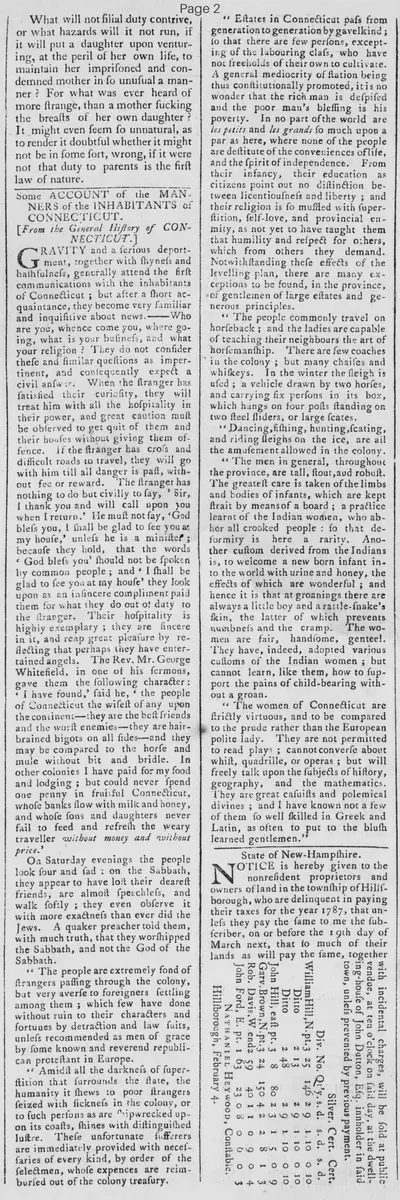
[From the General History of CONNECTICUT.]
GRAVITY and a serious deportment, together with shyness and bashfulness, generally attend the first communications with the inhabitants of Connecticut; but after a short acquaintance, they become very familiar and inquisitive about news.--Who are you, whence come you, where going, what is your business, and what your religion? They do not consider these and similar questions as impertinent, and consequently expect a civil answer. When the stranger has satisfied their curiosity, they will treat him with all the hospitality in their power, and great caution must be observed to get quit of them and their houses without giving them offence. If the stranger has cross and difficult roads to travel, they will go with him till all danger is past, without fee or reward. The stranger has nothing to do but civilly to say, 'Sir, I thank you and will call upon you when I return.' He must not say, 'God bless you, I shall be glad to see you at my house,' unless he is a minister; because they hold, that the words 'God bless you' should not be spoken by common people; and 'I shall be glad to see you at my house' they look upon as an insincere compliment paid them for what they do out of duty to the stranger. Their hospitality is highly exemplary; they are sincere in it, and reap great pleasure by reflecting that perhaps they have entertained angels. The Rev. Mr. George Whitefield, in one of his Sermons, gave them the following character: 'I have found,' said he, 'the people of Connecticut the wisest of any upon the continent--they are the best friends and the worst enemies--they are hair-brained bigots on all sides--and they may be compared to the horse and mule without bit and bridle. In other colonies I have paid for my food and lodging; but could never spend one penny in fruitful Connecticut, whose banks flow with milk and honey, and whose sons and daughters never fail to feed and refresh the weary traveller without money and without price.'
On Saturday evenings the people look out and sad: on the Sabbath. they appear to have lost their dearest friends, are almost speechless, and walk softly; they even observe it with more exactness than ever did the Jews. A quaker preacher told them, with much truth, that they worshipped the Sabbath, and not the God of the Sabbath.
The people are extremely fond of strangers passing through the colony, but very averse to foreigners settling among them; which few have done without ruin to their characters and fortunes by detraction and law suits, unless recommended as men of grace by some known and reverend republican protestant in Europe.
Amidst all the darkness of superstition that surrounds the state, the humanity it shows to poor strangers seized with sickness in the colony, or to such persons as are shipwrecked upon its coasts, shines with distinguished lustre. These unfortunate sufferers are immediately provided with necessaries of every kind, by order of the electmen, whose expenses are reimbursed out of the colony treasury.
Estates in Connecticut pass from generation to generation by gavelkind; so that there are few persons, excepting of the labouring class, who have not freeholds of their own to cultivate. A general mediocrity of station being thus constitutionally promoted, it is no wonder that the rich man is despised and the poor man's blessing is his poverty. In no part of the world are les petits and les grands so much upon a par as here, where none of the people are destitute of the conveniences of life, and the spirit of independence. From their infancy, their education as citizens point out no distinction between licentiousness and liberty: and their religion is so muffled with superstition, self-love, and provincial enmity, as not yet to have taught them that humility and respect for others, which from others they demand.
Notwithstanding these effects of the levelling plan, there are many exceptions to be found, in the province, of gentlemen of large estates and generous principles.
The people commonly travel on horseback: and the ladies are capable of teaching their neighbours the art of horsemanship. There are few coaches in the colony; but many chaises and whiskeys. In the winter the sleigh is used; a vehicle drawn by two horses, and carrying six persons in its box, which hangs on four posts standing on two steel sliders, or large skates.
Dancing, fishing, hunting, skating, and riding sleighs on the ice, are all the amusement allowed in the colony.
The men in general, throughout the province, are tall, stout, and robust. The greatest care is taken of the limbs and bodies of infants, which are kept strait by means of a board; a practice learnt of the Indian women, who abhor all crooked people: so that deformity is here a rarity. Another custom derived from the Indians is, to welcome a new born infant into the world with urine and honey, the effects of which are wonderful: and hence it is that at groanings there are always a little boy and a rattle-snake's skin, the latter of which prevents numbness and the cramp. The women are fair, handsome, genteel. They have, indeed, adopted various customs of the Indian women; but cannot learn, like them, how to support the pains of child-bearing without a groan.
The women of Connecticut are strictly virtuous, and to be compared to the prude rather than the European polite lady. They are not permitted to read plays; cannot converse about whist, quadrille, or operas; but will freely talk upon the subjects of history, geography, and the mathematics. They are great casuists and polemical divines; and I have known not a few of them so well skilled in Greek and Latin, as often to put to the blush learned gentlemen.
What sub-type of article is it?
What keywords are associated?
What entities or persons were involved?
Where did it happen?
Domestic News Details
Primary Location
Connecticut
Key Persons
Event Details
Description of the inhabitants' gravity, hospitality towards strangers, strict Sabbath observance, aversion to foreign settlers, aid to the sick and shipwrecked, inheritance practices promoting mediocrity, travel methods, allowed amusements, physical characteristics, infant care customs borrowed from Indians, and women's virtues and education.