Thank you for visiting SNEWPapers!
Sign up free
Editorial
July 13, 1820
Kentucky Gazette
Lexington, Fayette County, Kentucky
What is this article about?
The editorial defends the paper's right to describe insolent strangers and villains without naming them, responding to Mr. Hunt of the Monitor who believes himself targeted and reacts passionately, implying his guilt through his response.
Clipping
OCR Quality
95%
Excellent
Full Text
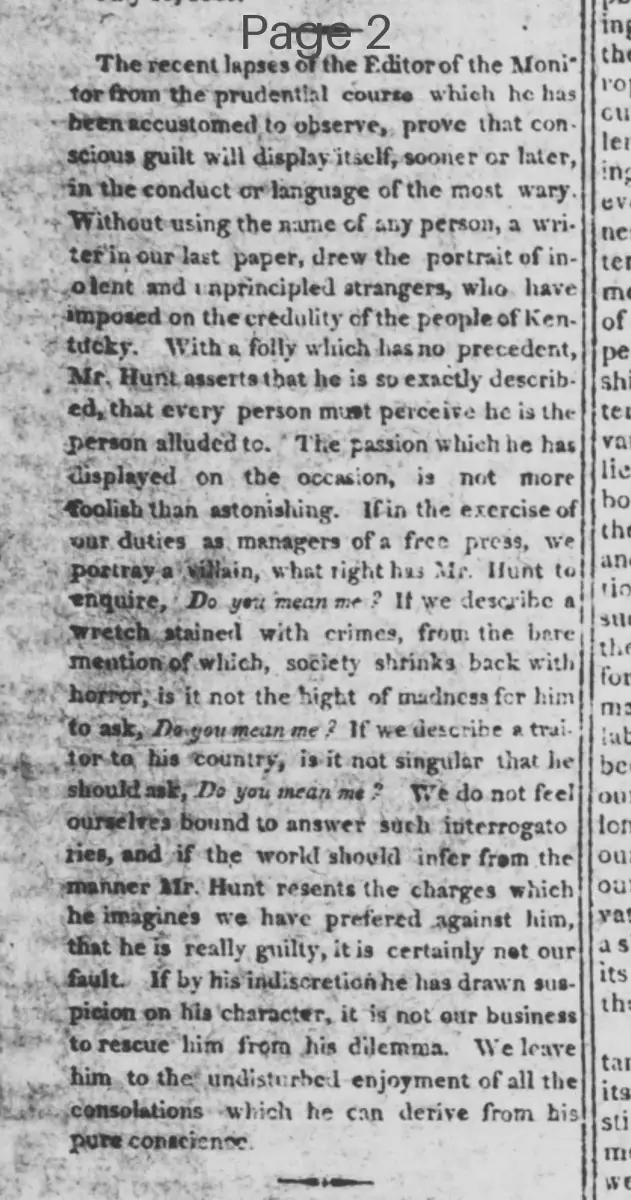
The recent lapses of the Editor of the Monitor from the prudential course which he has been accustomed to observe, prove that conscious guilt will display itself, sooner or later, in the conduct or language of the most wary.
Without using the name of any person, a writer in our last paper, drew the portrait of insolent and unprincipled strangers, who have imposed on the credulity of the people of Kentucky. With a folly which has no precedent, Mr. Hunt asserts that he is so exactly described, that every person must perceive he is the person alluded to. The passion which he has displayed on the occasion, is not more foolish than astonishing. If in the exercise of our duties as managers of a free press, we portray a villain, what right has Mr. Hunt to enquire, Do you mean me? If we describe a wretch attainted with crimes, from the bare mention of which, society shrinks back with horror; is it not the height of madness for him to ask, Do you mean me? If we describe a traitor to his country, is it not singular that he should ask, Do you mean me? We do not feel ourselves bound to answer such interrogatories, and if the world should infer from the manner Mr. Hunt resents the charges which he imagines we have preferred against him, that he is really guilty, it is certainly not our fault. If by his indiscretion he has drawn suspicion on his character, it is not our business to rescue him from his dilemma. We leave him to the undisturbed enjoyment of all the consolations which he can derive from his pure conscience.
Without using the name of any person, a writer in our last paper, drew the portrait of insolent and unprincipled strangers, who have imposed on the credulity of the people of Kentucky. With a folly which has no precedent, Mr. Hunt asserts that he is so exactly described, that every person must perceive he is the person alluded to. The passion which he has displayed on the occasion, is not more foolish than astonishing. If in the exercise of our duties as managers of a free press, we portray a villain, what right has Mr. Hunt to enquire, Do you mean me? If we describe a wretch attainted with crimes, from the bare mention of which, society shrinks back with horror; is it not the height of madness for him to ask, Do you mean me? If we describe a traitor to his country, is it not singular that he should ask, Do you mean me? We do not feel ourselves bound to answer such interrogatories, and if the world should infer from the manner Mr. Hunt resents the charges which he imagines we have preferred against him, that he is really guilty, it is certainly not our fault. If by his indiscretion he has drawn suspicion on his character, it is not our business to rescue him from his dilemma. We leave him to the undisturbed enjoyment of all the consolations which he can derive from his pure conscience.
What sub-type of article is it?
Press Freedom
Partisan Politics
What keywords are associated?
Press Freedom
Libel Accusation
Mr. Hunt
Guilt Inference
Newspaper Dispute
What entities or persons were involved?
Mr. Hunt
Editor Of The Monitor
Editorial Details
Primary Topic
Defense Of Press Rights Against Mr. Hunt's Accusations
Stance / Tone
Defensive And Accusatory
Key Figures
Mr. Hunt
Editor Of The Monitor
Key Arguments
Conscious Guilt Displays Itself In Conduct
Right To Portray Villains Without Naming Individuals
Mr. Hunt's Reaction Suggests His Own Guilt
Not Bound To Answer Interrogatories About Descriptions