Thank you for visiting SNEWPapers!
Sign up free
Literary
July 25, 1890
Weekly Expositor
Yale, Saint Clair County, Michigan
What is this article about?
An article listing and describing various historical eras from around the world, including their starting dates and key details, such as the eras of Abraham, Augustus, Tyre, Hegira, and others up to the era of Constantinople.
Clipping
OCR Quality
98%
Excellent
Full Text
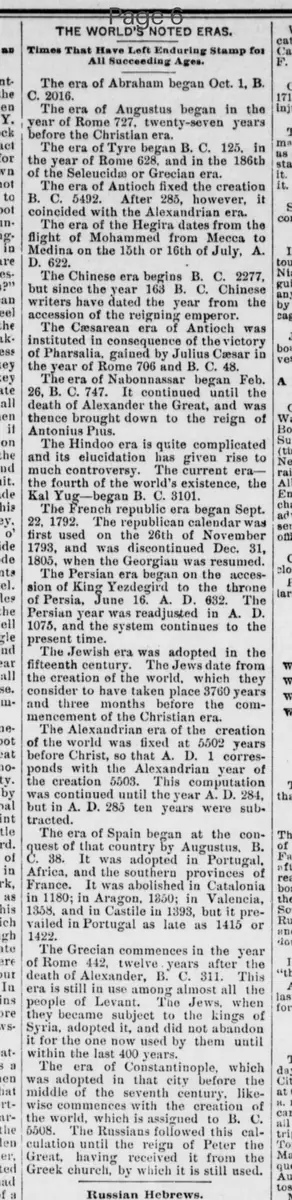
The World's Noted Eras.
Times That Have Left Enduring Stamp for All Succeeding Ages.
The era of Abraham began Oct. 1, B. C. 2016.
The era of Augustus began in the year of Rome 727, twenty-seven years before the Christian era.
The era of Tyre began B. C. 125, in the year of Rome 628, and in the 186th of the Seleucida or Grecian era.
The era of Antioch fixed the creation B. C. 5492. After 285, however, it coincided with the Alexandrian era.
The era of the Hegira dates from the flight of Mohammed from Mecca to Medina on the 15th or 16th of July, A. D. 622.
The Chinese era begins B. C. 2277, but since the year 163 B. C. Chinese writers have dated the year from the accession of the reigning emperor.
The Caesarean era of Antioch was instituted in consequence of the victory of Pharsalia, gained by Julius Caesar in the year of Rome 706 and B. C. 48.
The era of Nabonassar began Feb. 26, B. C. 747. It continued until the death of Alexander the Great, and was thence brought down to the reign of Antoninus Pius.
The Hindoo era is quite complicated and its elucidation has given rise to much controversy. The current era—the fourth of the world's existence, the Kal Yug—began B. C. 3101.
The French republic era began Sept. 22, 1792. The republican calendar was first used on the 26th of November 1793, and was discontinued Dec. 31, 1805, when the Gregorian was resumed.
The Persian era began on the accession of King Yezdegird to the throne of Persia, June 16, A. D. 632. The Persian year was readjusted in A. D. 1075, and the system continues to the present time.
The Jewish era was adopted in the fifteenth century. The Jews date from the creation of the world, which they consider to have taken place 3760 years and three months before the commencement of the Christian era.
The Alexandrian era of the creation of the world was fixed at 5502 years before Christ, so that A. D. 1 corresponds with the Alexandrian year of the creation 5503. This computation was continued until the year A. D. 284, but in A. D. 285 ten years were subtracted.
The era of Spain began at the conquest of that country by Augustus, B. C. 38. It was adopted in Portugal, Africa, and the southern provinces of France. It was abolished in Catalonia in 1180; in Aragon, 1350; in Valencia, 1358, and in Castile in 1393, but it prevailed in Portugal as late as 1415 or 1422.
The Grecian commences in the year of Rome 442, twelve years after the death of Alexander, B. C. 311. This era is still in use among almost all the people of Levant. The Jews, when they became subject to the kings of Syria, adopted it, and did not abandon it for the one now used by them until within the last 400 years.
The era of Constantinople, which was adopted in that city before the middle of the seventh century, likewise commences with the creation of the world, which is assigned to B. C. 5508. The Russians followed this calculation until the reign of Peter the Great, having received it from the Greek church, by which it is still used.
Times That Have Left Enduring Stamp for All Succeeding Ages.
The era of Abraham began Oct. 1, B. C. 2016.
The era of Augustus began in the year of Rome 727, twenty-seven years before the Christian era.
The era of Tyre began B. C. 125, in the year of Rome 628, and in the 186th of the Seleucida or Grecian era.
The era of Antioch fixed the creation B. C. 5492. After 285, however, it coincided with the Alexandrian era.
The era of the Hegira dates from the flight of Mohammed from Mecca to Medina on the 15th or 16th of July, A. D. 622.
The Chinese era begins B. C. 2277, but since the year 163 B. C. Chinese writers have dated the year from the accession of the reigning emperor.
The Caesarean era of Antioch was instituted in consequence of the victory of Pharsalia, gained by Julius Caesar in the year of Rome 706 and B. C. 48.
The era of Nabonassar began Feb. 26, B. C. 747. It continued until the death of Alexander the Great, and was thence brought down to the reign of Antoninus Pius.
The Hindoo era is quite complicated and its elucidation has given rise to much controversy. The current era—the fourth of the world's existence, the Kal Yug—began B. C. 3101.
The French republic era began Sept. 22, 1792. The republican calendar was first used on the 26th of November 1793, and was discontinued Dec. 31, 1805, when the Gregorian was resumed.
The Persian era began on the accession of King Yezdegird to the throne of Persia, June 16, A. D. 632. The Persian year was readjusted in A. D. 1075, and the system continues to the present time.
The Jewish era was adopted in the fifteenth century. The Jews date from the creation of the world, which they consider to have taken place 3760 years and three months before the commencement of the Christian era.
The Alexandrian era of the creation of the world was fixed at 5502 years before Christ, so that A. D. 1 corresponds with the Alexandrian year of the creation 5503. This computation was continued until the year A. D. 284, but in A. D. 285 ten years were subtracted.
The era of Spain began at the conquest of that country by Augustus, B. C. 38. It was adopted in Portugal, Africa, and the southern provinces of France. It was abolished in Catalonia in 1180; in Aragon, 1350; in Valencia, 1358, and in Castile in 1393, but it prevailed in Portugal as late as 1415 or 1422.
The Grecian commences in the year of Rome 442, twelve years after the death of Alexander, B. C. 311. This era is still in use among almost all the people of Levant. The Jews, when they became subject to the kings of Syria, adopted it, and did not abandon it for the one now used by them until within the last 400 years.
The era of Constantinople, which was adopted in that city before the middle of the seventh century, likewise commences with the creation of the world, which is assigned to B. C. 5508. The Russians followed this calculation until the reign of Peter the Great, having received it from the Greek church, by which it is still used.
What sub-type of article is it?
Essay
What themes does it cover?
Political
What keywords are associated?
Historical Eras
Calendars
Ancient Chronology
World History
Dating Systems
Literary Details
Title
The World's Noted Eras.
Subject
Times That Have Left Enduring Stamp For All Succeeding Ages.
Form / Style
Prose Enumeration Of Historical Eras